
What is the Ovulation Date Calculator?
This calculator estimates the day you are most likely to ovulate based on the first day of your last menstrual period and the length of your average cycle. Ovulation is when an ovary releases an egg, and it marks the most fertile point of your cycle. Knowing this date helps with family planning, whether you are trying to conceive or simply tracking your cycle.
How to use it
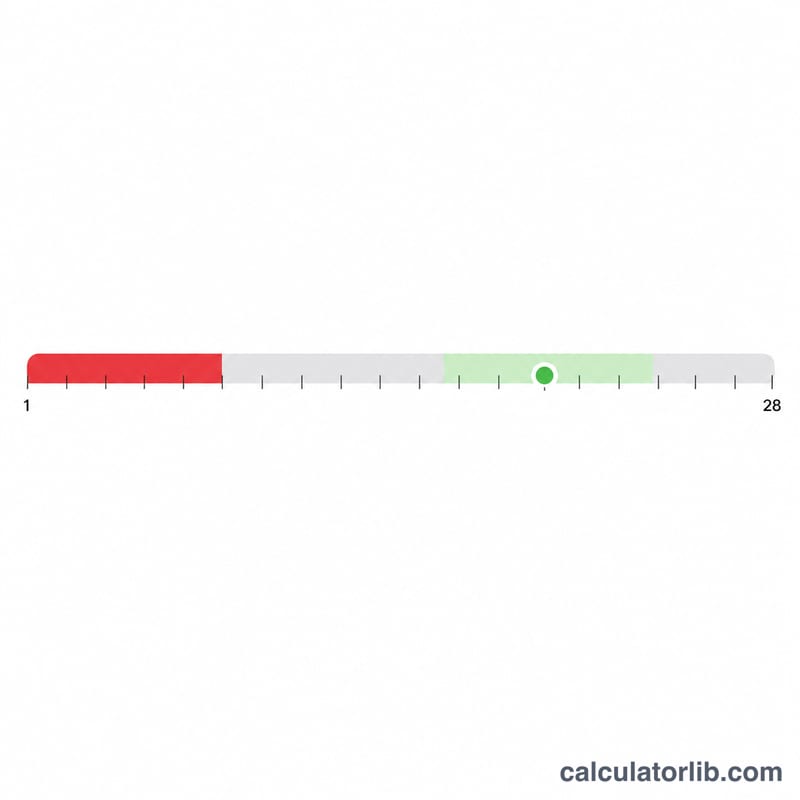
Enter the first day of your most recent period and your typical cycle length in days (counted from the first day of one period to the first day of the next). Most cycles run between 21 and 35 days, with 28 being a common average. The tool returns your estimated ovulation date, the fertile window, and when your next period is expected.
The formula explained
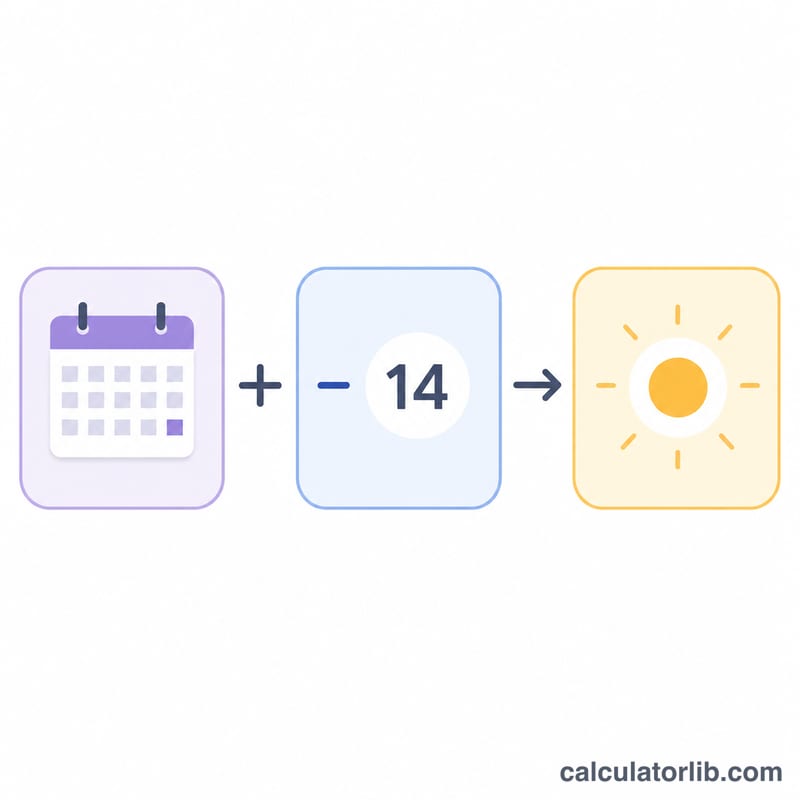
The calculation relies on the fact that the luteal phase — the time between ovulation and the start of the next period — is fairly constant at about 14 days. So ovulation is estimated as:
$$\text{Ovulation} = \text{Last Period Date} + \left( \text{Cycle Length} - 14 \right)\ \text{days}$$
The fertile window is the five days leading up to ovulation plus the ovulation day, because sperm can survive in the body for several days.
Worked example
Suppose your last period began on 2024-01-01 and your average cycle is 28 days. Then \(28 - 14 = 14\) days. Adding 14 days to January 1 gives an ovulation date of 2024-01-15. The fertile window runs from 2024-01-10 to 2024-01-15, and your next period would be expected around 2024-01-29.
FAQ
Is this 100% accurate? No. It is an estimate based on a regular cycle. Actual ovulation can vary, especially with irregular cycles, stress, or illness.
What if my cycle length changes month to month? Use an average over several months. The more consistent your cycles, the more reliable the estimate.
Should I rely on this for birth control? No. Cycle-based estimates are not a reliable contraceptive method on their own. Consult a healthcare provider for medical decisions.