
What is the Conception Date Calculator?
This tool estimates the day a pregnancy likely began (conception) based on either the first day of your last menstrual period (LMP) or a known due date. It uses the same clinical conventions that doctors apply: conception is assumed to occur roughly 14 days after the start of the last period in a typical 28-day cycle, and a full-term pregnancy lasts about 280 days (40 weeks) from the LMP.
How to use it
Choose whether you want to calculate from your last menstrual period or from a known due date, enter your average cycle length, then provide the reference date (year, month and day). The calculator returns the estimated conception date, the LMP, the estimated due date, and the ovulation offset it used. Dates are shown in YYYYMMDD format (for example, 20240115 means 15 January 2024) so the result is unambiguous worldwide.
The formula explained
The model follows Naegele's rule. Ovulation — and therefore conception — happens about a luteal-phase length before the next expected period, normally 14 days after the LMP. If your cycle differs from 28 days, the offset is adjusted by the difference: a 30-day cycle shifts conception two days later. The due date is simply the LMP plus 280 days. When you start from a due date, the calculator first subtracts 280 days to recover the LMP, then adds the ovulation offset.
$$\text{Conception} = \text{LMP} + 14\,\text{days},\quad \text{Due Date} = \text{LMP} + 280\,\text{days}$$For a non-standard cycle:
$$\text{Conception} = \text{LMP} + (14 + (\text{cycle} - 28))\,\text{days} ; \quad \text{Due Date} = \text{LMP} + 280\,\text{days}$$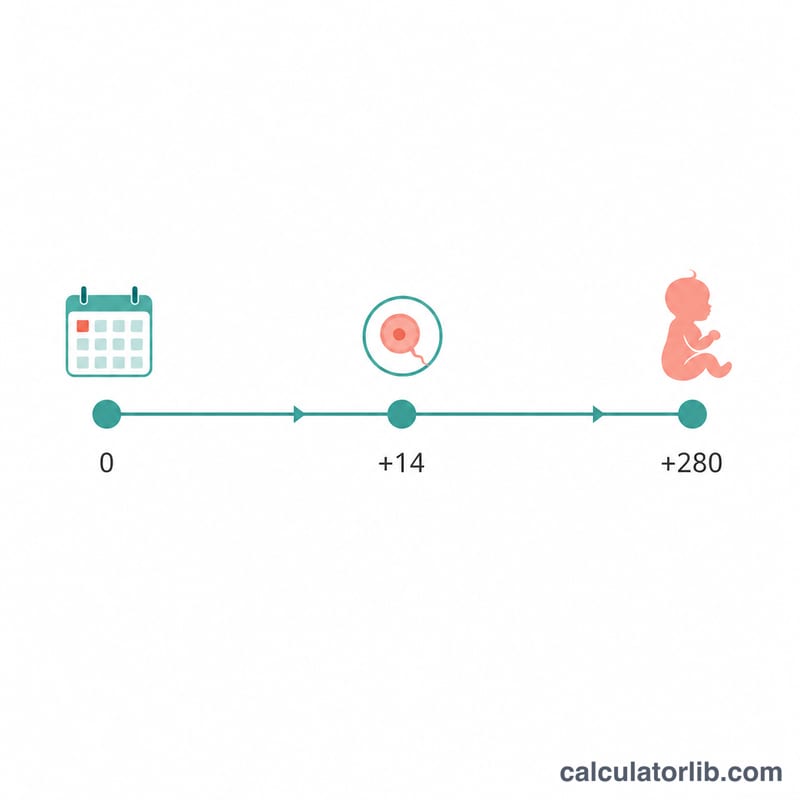
Worked example
Suppose your LMP was 1 January 2024 with a 28-day cycle. Conception = 1 Jan + 14 days = 15 January 2024 (20240115). Due date = 1 Jan + 280 days = 7 October 2024 (20241007).
$$\text{Conception} = \text{1 Jan} + 14\,\text{days} = \text{15 January 2024 (20240115)}$$$$\text{Due Date} = \text{1 Jan} + 280\,\text{days} = \text{7 October 2024 (20241007)}$$FAQ
Is the conception date exact? No. It is an estimate; actual conception can vary by several days depending on ovulation timing and sperm survival.
Why use 280 days? It is the standard medical average for human gestation measured from the LMP, equal to 40 weeks.
What if my cycle isn't 28 days? Enter your true average length; the tool shifts the assumed ovulation day accordingly.