
What Is a Z Score?
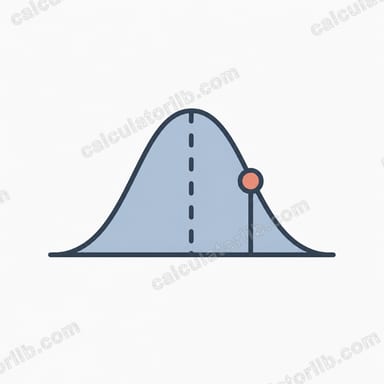
A z score (also called a standard score) measures how many standard deviations a data point lies above or below the mean of its distribution. A positive z score means the value is above the mean; a negative one means it is below. A z score of 0 means the value equals the mean exactly. Z scores are universal in statistics because they let you compare values from completely different scales on a common footing.
How to Use This Calculator
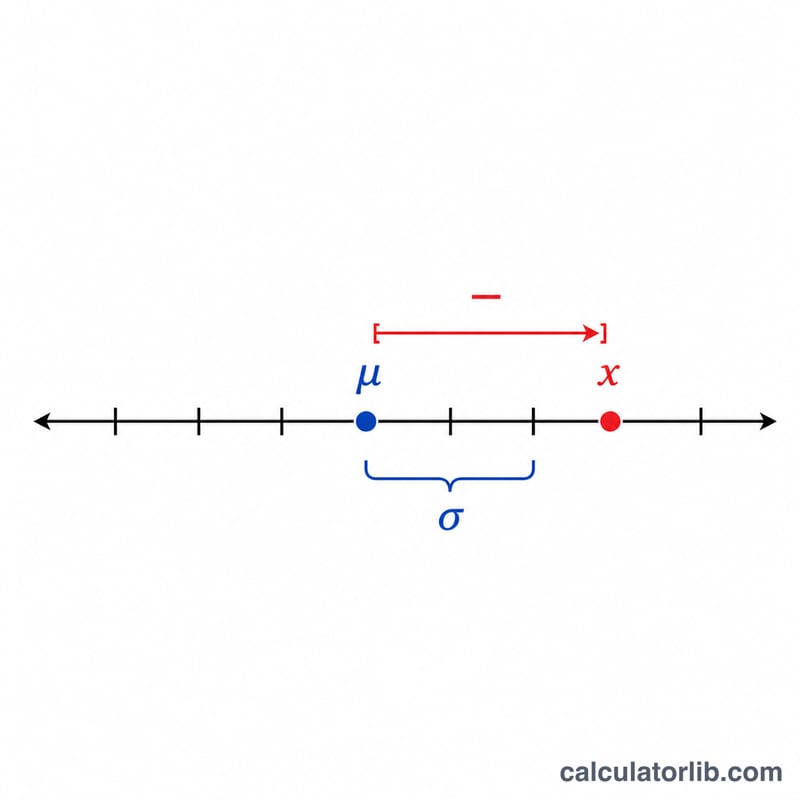
Enter three numbers: the raw score (\(x\)) you want to evaluate, the population mean (\(\mu\)), and the population standard deviation (\(\sigma\)). The calculator instantly returns the z score and the raw deviation \((x - \mu)\). Standard deviation must not be zero, since dividing by zero is undefined.
The Formula Explained
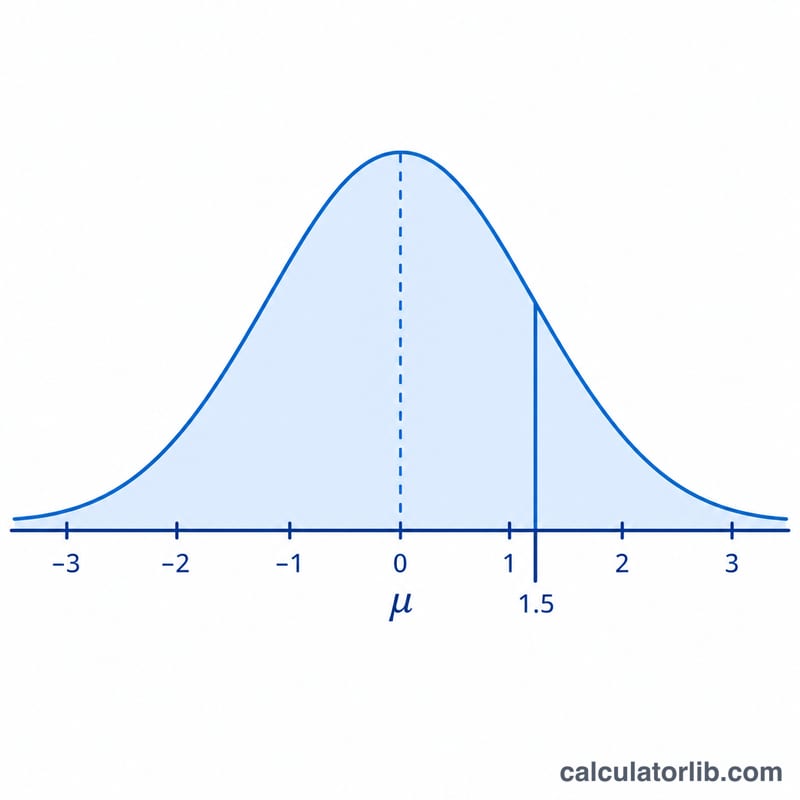
The standard score is defined as $$z = \frac{x - \mu}{\sigma}$$ First subtract the mean from your value to get the deviation, then divide by the standard deviation to express that deviation in standard-deviation units. This rescaling produces a distribution with a mean of 0 and a standard deviation of 1, known as the standard normal distribution when the data are normally distributed.
Worked Example
Suppose a student scores 85 on a test where the class mean is 70 and the standard deviation is 10. Then $$z = \frac{85 - 70}{10} = \frac{15}{10} = 1.5$$ The student scored 1.5 standard deviations above the average — better than roughly 93% of test takers if scores are normally distributed.
FAQ
What does a negative z score mean? It means the value is below the mean. A z score of \(-2\) sits two standard deviations below average.
What is a "good" z score? It depends on context, but values beyond \(\pm 2\) or \(\pm 3\) are considered unusual because they fall in the tails of the distribution.
Should I use the sample or population standard deviation? The classic z score uses the population standard deviation (\(\sigma\)). If you only have a sample, you may use the sample standard deviation as an estimate, but interpret results with care.