
What is a finite geometric series?
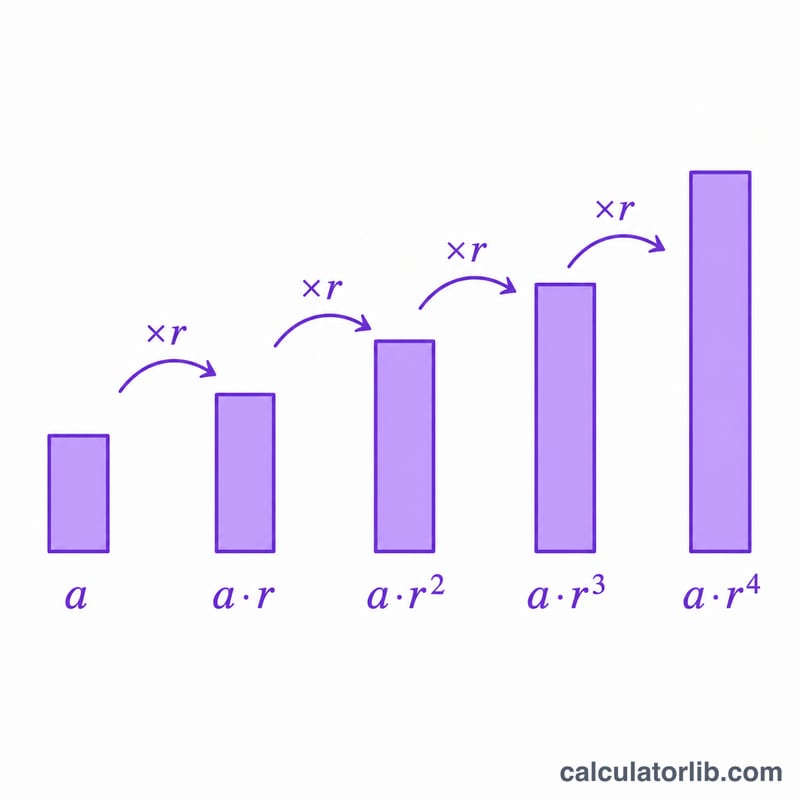
A geometric series is the sum of the terms of a geometric sequence, where each term is found by multiplying the previous one by a fixed number called the common ratio (\(r\)). A finite geometric series adds only a set number of terms, \(n\). This calculator returns the total sum \(S_n\) of the first \(n\) terms given the first term \(a_1\), the ratio \(r\), and the count \(n\).
How to use the calculator
Enter three values: the first term \(a_1\) (the starting value), the common ratio \(r\) (the factor between consecutive terms), and \(n\) (how many terms to add). Press calculate to get the sum, plus the value of the last term \(a_n\) and \(r^n\) for reference. Both whole numbers and decimals are supported, and \(r\) can be negative or a fraction.
The formula explained
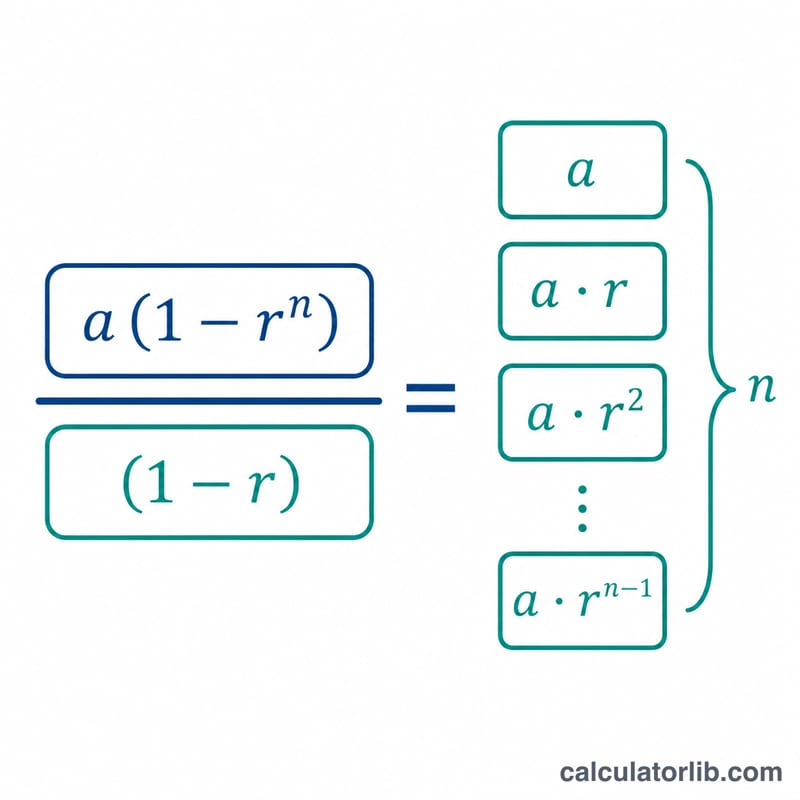
The closed-form sum is:
$$S_n = a_1 \cdot \frac{1 - r^n}{1 - r}$$valid whenever \(r \neq 1\).
This avoids adding terms one by one. If \(r = 1\), every term equals \(a_1\), so the sum is simply
$$S_n = a_1 \cdot n$$The calculator detects this special case automatically to avoid dividing by zero.
Worked example
Suppose \(a_1 = 2\), \(r = 3\), and \(n = 5\). The terms are 2, 6, 18, 54, 162. Using the formula: \(r^n = 3^5 = 243\), so
$$S_n = 2 \cdot \frac{1 - 243}{1 - 3} = 2 \cdot \frac{-242}{-2} = 2 \cdot 121 = 242$$Adding the five terms directly (\(2 + 6 + 18 + 54 + 162\)) also gives 242. ✓
FAQ
Can the ratio be negative? Yes. A negative \(r\) produces alternating signs (e.g. \(r = -2\) gives terms \(a_1, -2a_1, 4a_1, \ldots\)), and the formula handles it correctly.
What if r is between −1 and 1? The finite sum still works. As \(n\) grows, the sum approaches the infinite-series limit \(\frac{a_1}{1 - r}\), but this tool always sums exactly \(n\) terms.
What does rⁿ mean in the results? It is the common ratio raised to the power \(n\), an intermediate value in the formula shown for transparency.