
What is an infinite geometric series?
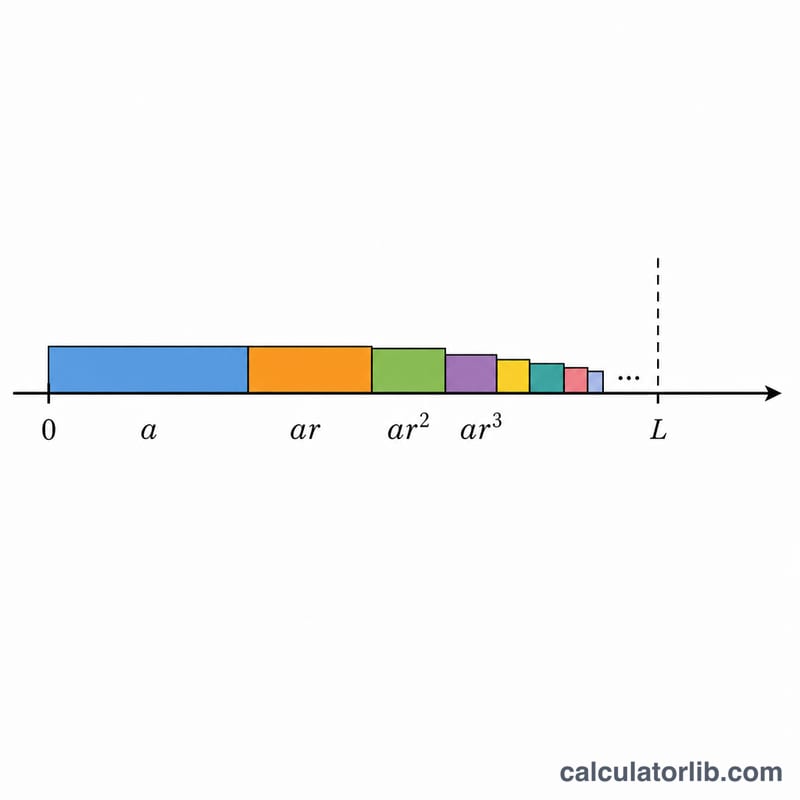
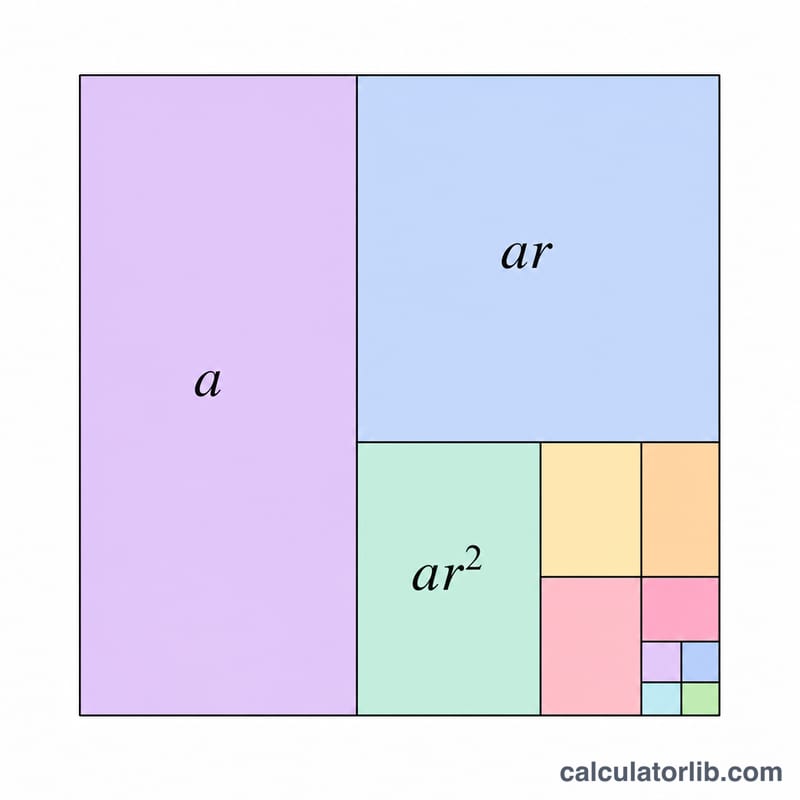
An infinite geometric series has the form \(a + ar + ar^{2} + ar^{3} + \ldots\), where each term is the previous one multiplied by a fixed number \(r\) called the common ratio, and \(a\) is the first term. When the ratio is small enough — specifically when it lies strictly between -1 and 1 — the running total settles toward a single finite value instead of growing forever. This calculator returns that limiting value, known as the sum to infinity. It is pure mathematics and applies identically everywhere.
How to use this calculator
Enter the first term a and the common ratio r. Both accept decimals or fraction-style input such as 1/3, which is evaluated to a decimal before the formula is applied. The ratio must satisfy \(-1 < r < 1\); if you enter a value of 1 or more (or -1 or less), the series diverges and the tool flags it instead of returning a number.
The formula explained
The closed form is $$S_{\infty} = \frac{a}{1 - r}$$ It comes from the finite partial sum \(S_{n} = \dfrac{a(1 - r^{n})}{1 - r}\). When \(|r| < 1\), the term \(r^{n}\) shrinks to 0 as \(n\) grows, so the expression collapses to \(\dfrac{a}{1 - r}\). The denominator \((1 - r)\) is never zero in the valid range because that would require \(r = 1\), which is excluded by the convergence condition.
Worked example
Suppose \(a = 1\) and \(r = 0.3\). Then $$S_{\infty} = \frac{1}{1 - 0.3} = \frac{1}{0.7} \approx 1.42857142857143.$$ For \(a = 2\) and \(r = -0.5\) (an alternating series), $$S_{\infty} = \frac{2}{1 - (-0.5)} = \frac{2}{1.5} \approx 1.33333333333333.$$
FAQ
Why must \(-1 < r < 1\)? Outside this range the terms do not shrink toward zero, so the partial sums grow without bound (\(r \ge 1\)) or oscillate (\(r = -1\)) and no finite sum exists.
Can the first term be negative or zero? Yes. A negative \(a\) simply flips the sign of the sum, and \(a = 0\) gives a sum of 0 for any valid ratio.
Can I enter a fraction? Yes — type values like 1/3 for either field and the calculator evaluates the division first.