
What is the Thermal Conductivity Calculator?
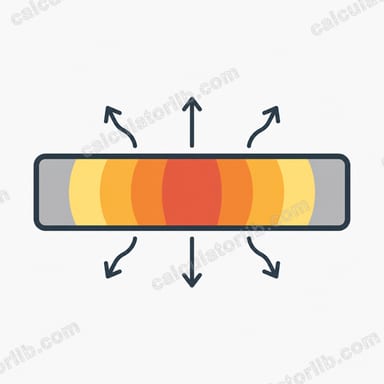
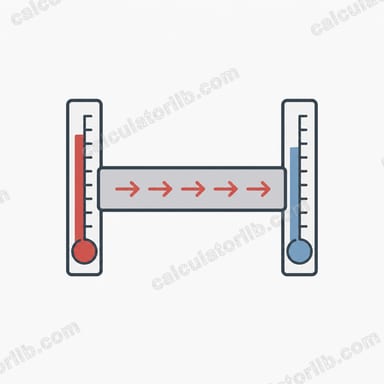
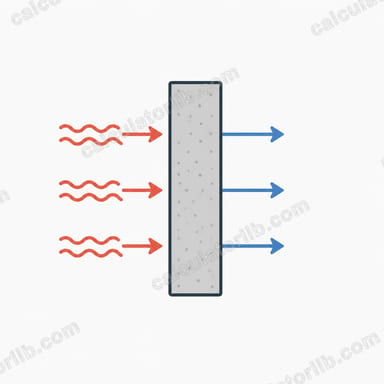
This calculator determines the thermal conductivity (k) of a material — a measure of how readily it conducts heat. It is based on Fourier's law of one-dimensional steady-state heat conduction. The result is expressed in watts per meter-kelvin, W/(m·K). Materials with high k (like copper) transfer heat quickly, while insulators (like foam or wood) have low k.
How to Use It
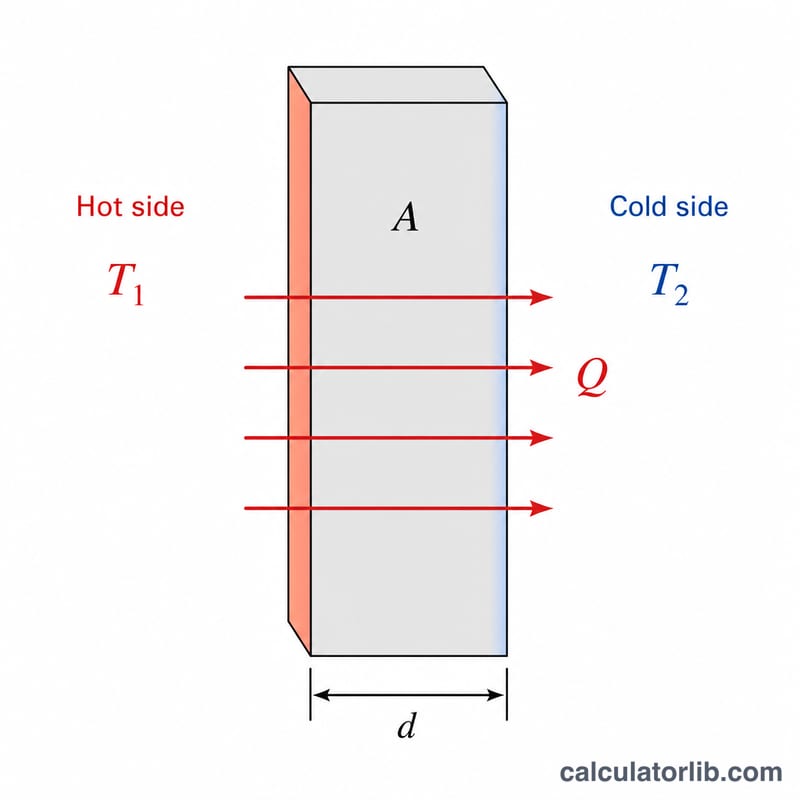
Enter the total heat energy transferred (Q in joules), the thickness of the material in the direction of heat flow (d in meters), the cross-sectional area perpendicular to heat flow (A in m²), the temperature difference across the material (ΔT in kelvin or °C — the size of a degree is the same), and the time over which the heat flows (t in seconds). The calculator returns k along with the heat transfer rate (power) and the thermal resistance \(R = d/k\).
The Formula Explained
The governing equation is:
$$k = \frac{\text{Heat } Q \cdot \text{Thickness } d}{\text{Area } A \cdot \Delta T \cdot \text{Time } t}$$
Here \(Q/t\) is the rate of heat flow (power in watts). Rearranging Fourier's law, \(Q/t = k \cdot A \cdot \Delta T / d\), so solving for k gives the formula above. Conductivity rises when more heat flows through a thick sample, and falls when a large area or a large temperature difference is needed to drive that heat.
Worked Example
Suppose Q = 30,000 J of heat passes through a slab d = 0.02 m thick, with area A = 1 m², temperature difference ΔT = 30 K, over t = 10 s. Then $$k = \frac{30000 \times 0.02}{1 \times 30 \times 10} = \frac{600}{300} = 2.0 \ \text{W/(m}\cdot\text{K)}$$ The heat transfer rate is \(Q/t = 3{,}000 \ \text{W}\) and the thermal resistance is \(R = d/k = 0.02 / 2 = 0.01 \ \text{m}^2\cdot\text{K/W}\).
FAQ
Does ΔT need to be in kelvin? A temperature difference of 30 °C equals 30 K, so either unit works as long as it's a difference, not an absolute temperature.
What if I get a very high or low k? Double-check units — thickness in meters and area in square meters are essential. Metals are typically 50–400 W/(m·K); insulators are below 0.1 W/(m·K).
Can I solve for heat instead? Yes — rearrange to \(Q = k \cdot A \cdot \Delta T \cdot t / d\) once you know the material's conductivity.