
What is a wavenumber?
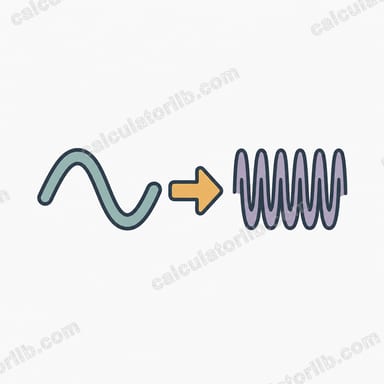
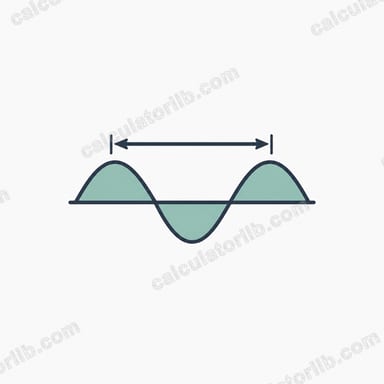
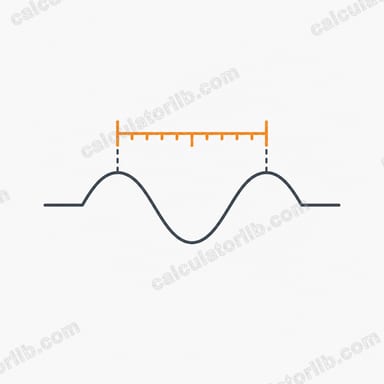
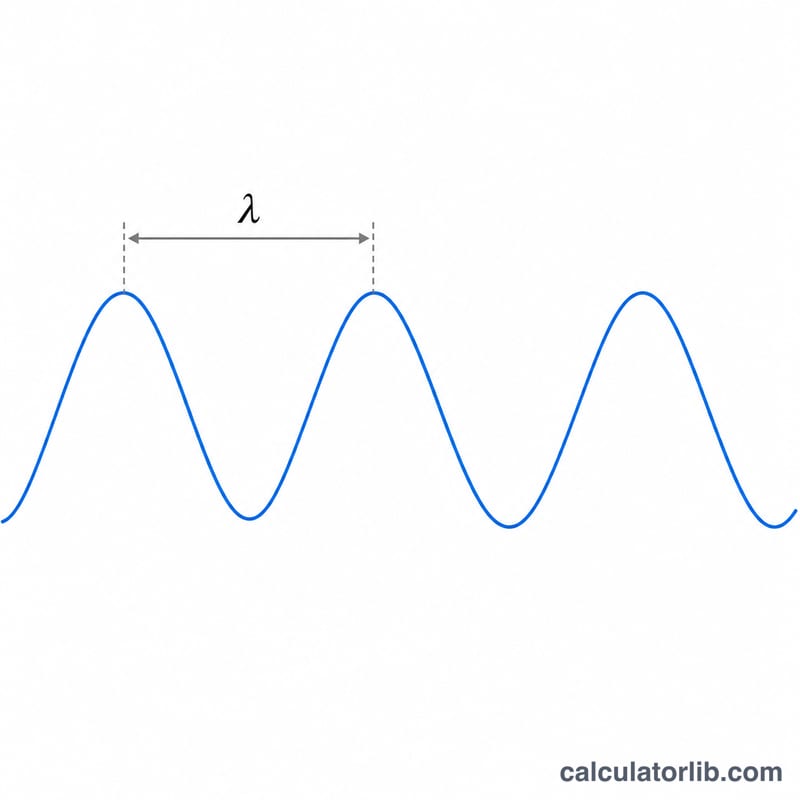
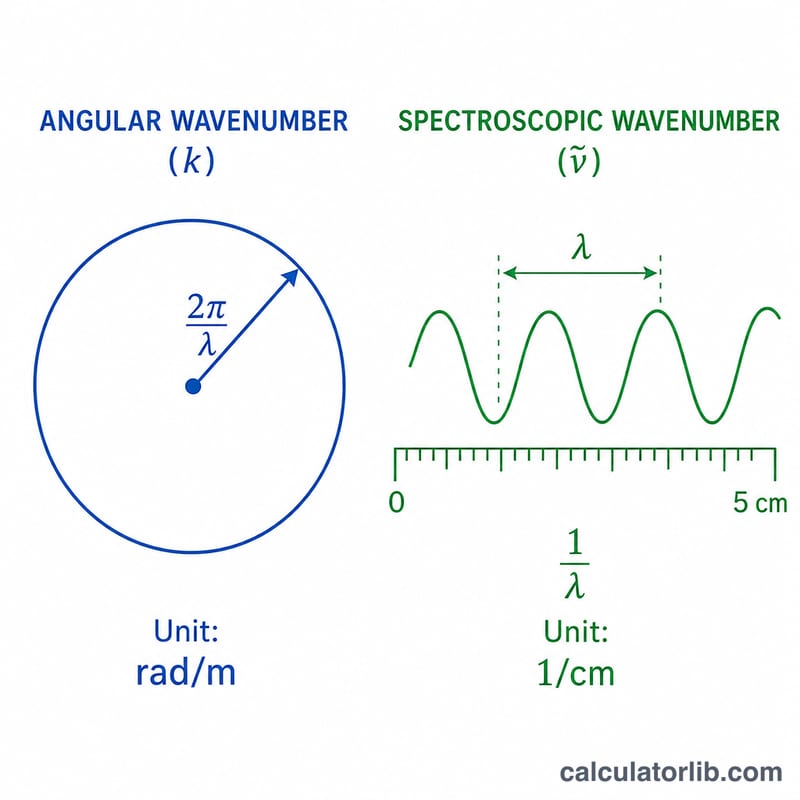
A wavenumber describes how many wave cycles occur per unit of distance. It is the spatial analogue of frequency: where frequency counts cycles per second, a wavenumber counts cycles (or radians) per meter. Two conventions are common. Physicists usually use the angular wavenumber \(k = 2\pi/\lambda\), measured in radians per meter, which appears directly in wave equations such as ei(kx − ωt). Spectroscopists prefer the spectroscopic wavenumber \(\tilde{\nu} = 1/\lambda\), the plain number of waves per unit length, almost always quoted in reciprocal centimeters (cm⁻¹).
How to use this calculator
Pick the convention you need — angular or spectroscopic — then enter the wavelength and choose its unit (nm, µm, mm, cm, or m). The tool converts the wavelength to meters, applies the chosen formula, and reports the wavenumber in both per-meter and per-centimeter units so the result is ready for either physics or spectroscopy work.
The formula explained
For the angular form, $$k = \frac{2\pi}{\lambda}$$ The 2π factor converts a full cycle into radians, so one wavelength corresponds to 2π radians of phase. For the spectroscopic form, $$\tilde{\nu} = \frac{1}{\lambda}$$ simply inverts the wavelength. To express in cm⁻¹, divide the per-meter value by 100 (since 1 m = 100 cm).
Worked example
Green light has a wavelength of 500 nm = \(5\times10^{-7}\) m. The angular wavenumber is $$k = \frac{2\pi}{5\times10^{-7}} \approx 1.2566\times10^{7}\ \text{rad/m}$$ The spectroscopic wavenumber is $$\tilde{\nu} = \frac{1}{5\times10^{-7}} = 2{,}000{,}000\ \text{m}^{-1} = 20{,}000\ \text{cm}^{-1}$$
FAQ
Which convention should I use? Use angular (\(2\pi/\lambda\)) for wave physics and dispersion relations; use spectroscopic (\(1/\lambda\)) for IR/Raman/optical spectra reported in cm⁻¹.
Why is cm⁻¹ so common? Infrared spectroscopy bands typically fall in the convenient 400–4000 cm⁻¹ range, making reciprocal centimeters the natural unit.
How does wavenumber relate to energy? Photon energy is proportional to wavenumber: \(E = h\cdot c\cdot\tilde{\nu}\), so a larger wavenumber means a higher-energy photon.