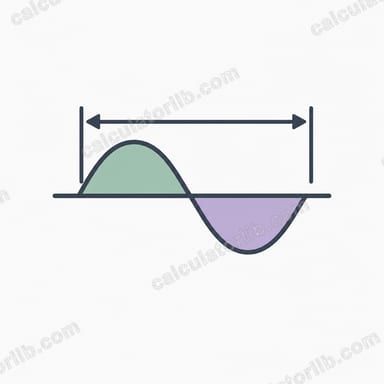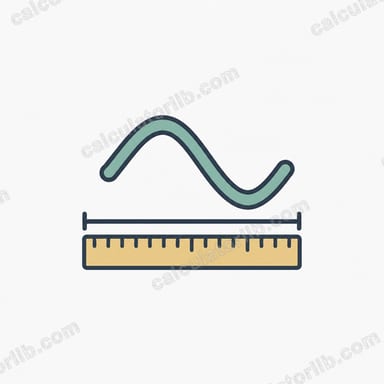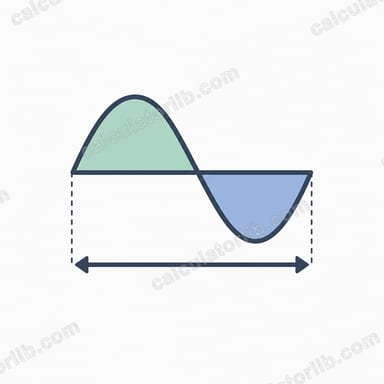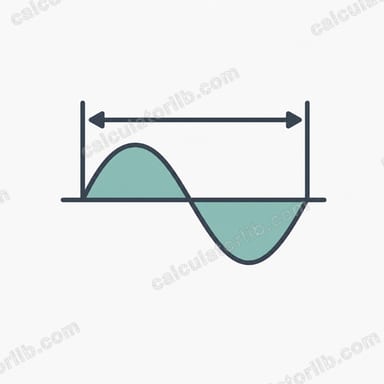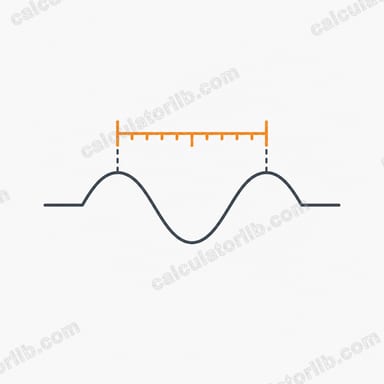

What Is the Wavelength to Frequency Calculator?
This tool converts the wavelength of any electromagnetic wave (light, radio, microwave, etc.) into its corresponding frequency. It relies on the fundamental relationship between a wave's speed, wavelength, and frequency. Because the calculator uses the speed of light in a vacuum, it applies universally to all electromagnetic radiation and requires no country-specific assumptions.
How to Use It
Enter the wavelength value, then select the unit it is expressed in — nanometers (nm), micrometers (µm), millimeters (mm), centimeters (cm), or meters (m). The calculator converts your wavelength to meters, then divides the speed of light by it to give frequency in hertz (Hz), gigahertz (GHz), and terahertz (THz).
The Formula Explained
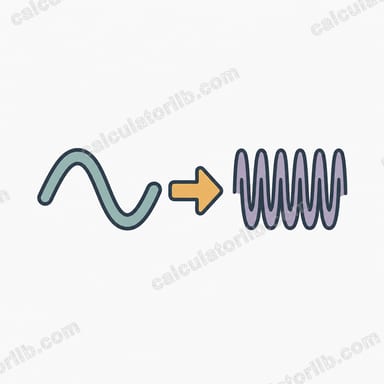
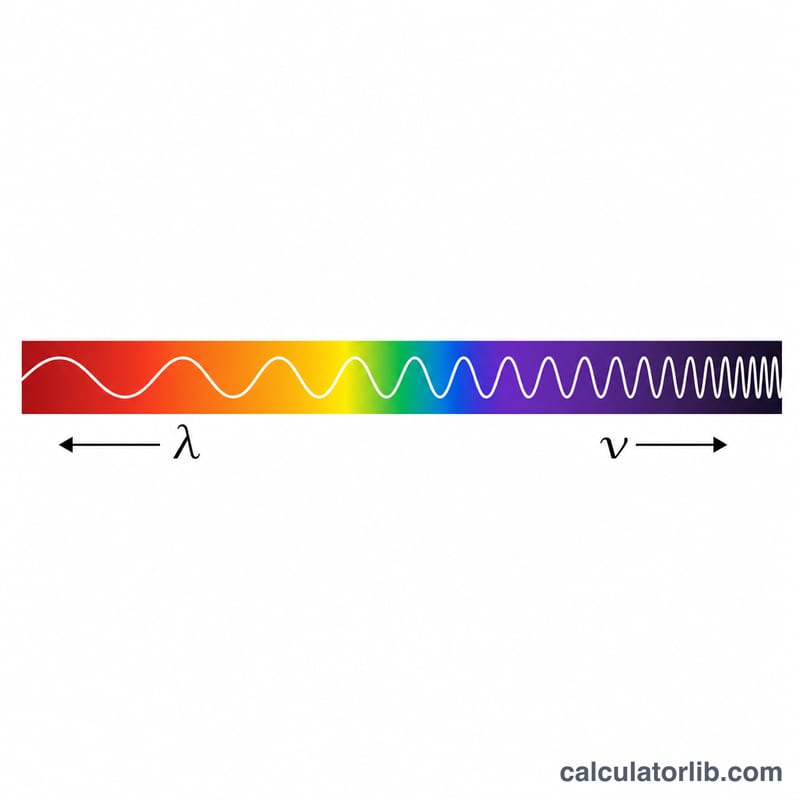
The governing equation is \(f = c / \lambda\), where \(f\) is frequency in hertz, \(c\) is the speed of light (\(2.998 \times 10^{8}\) m/s), and \(\lambda\) is wavelength in meters. Frequency and wavelength are inversely proportional: shorter wavelengths produce higher frequencies. Before dividing, the wavelength must always be converted to meters, since the speed of light is defined in meters per second.
$$f = \frac{c}{\lambda} = \frac{2.998 \times 10^{8}}{\text{Wavelength} \times 10^{-9}}$$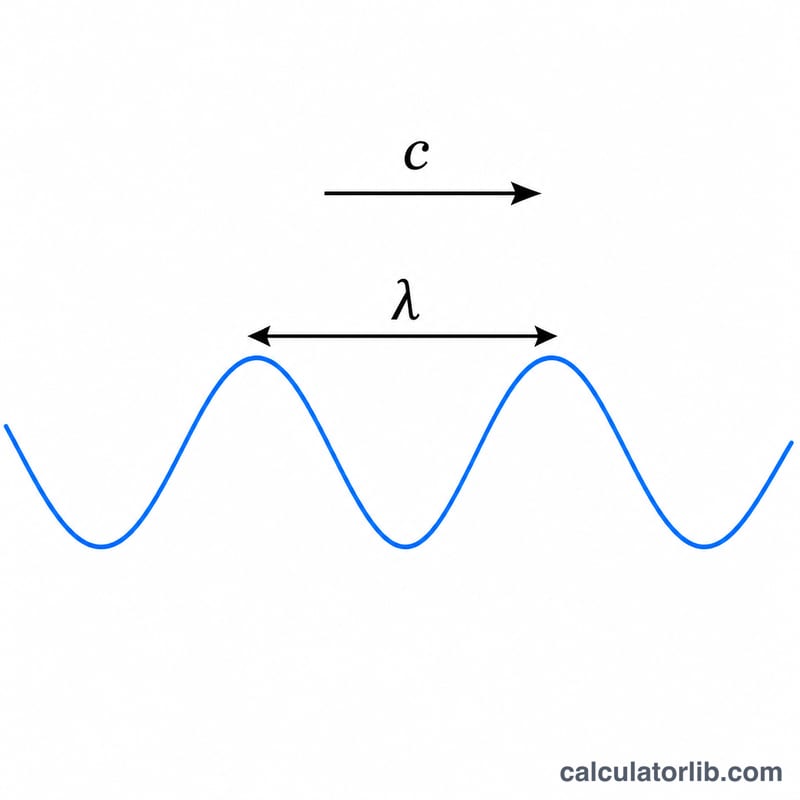
Worked Example
Consider green light with a wavelength of 500 nm. First convert: \(500 \text{ nm} = 500 \times 10^{-9} \text{ m} = 5 \times 10^{-7} \text{ m}\). Then apply the formula:
$$f = \frac{2.998 \times 10^{8}}{5 \times 10^{-7}} = 5.996 \times 10^{14} \text{ Hz}$$or about 599.6 THz. This falls squarely in the visible spectrum.
FAQ
Does this work for radio waves? Yes. Enter a long wavelength such as 3 m and you'll get roughly 99.9 MHz (0.0999 GHz), a typical FM radio frequency.
Why is the speed \(2.998 \times 10^{8}\) and not exactly \(3 \times 10^{8}\)? The exact speed of light is 299,792,458 m/s; \(2.998 \times 10^{8}\) is a precise common approximation used here.
Does the medium matter? This calculator assumes a vacuum. In glass or water, light travels slower, so the actual frequency would differ slightly for a given wavelength.