
What Is the Frequency to Wavelength Calculator?
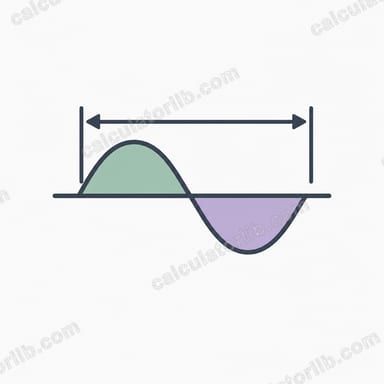
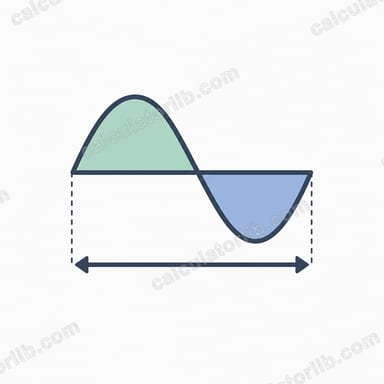
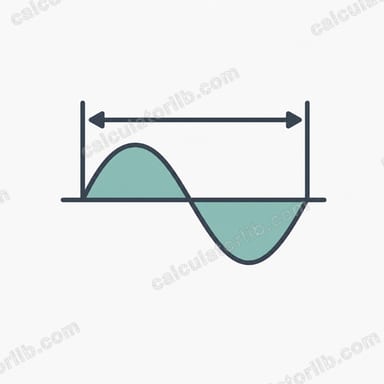
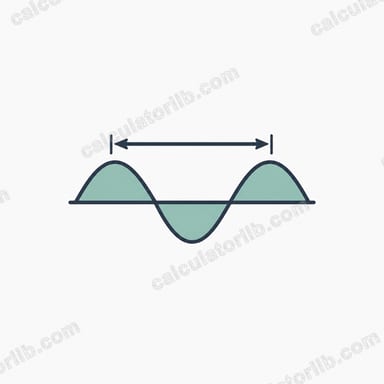
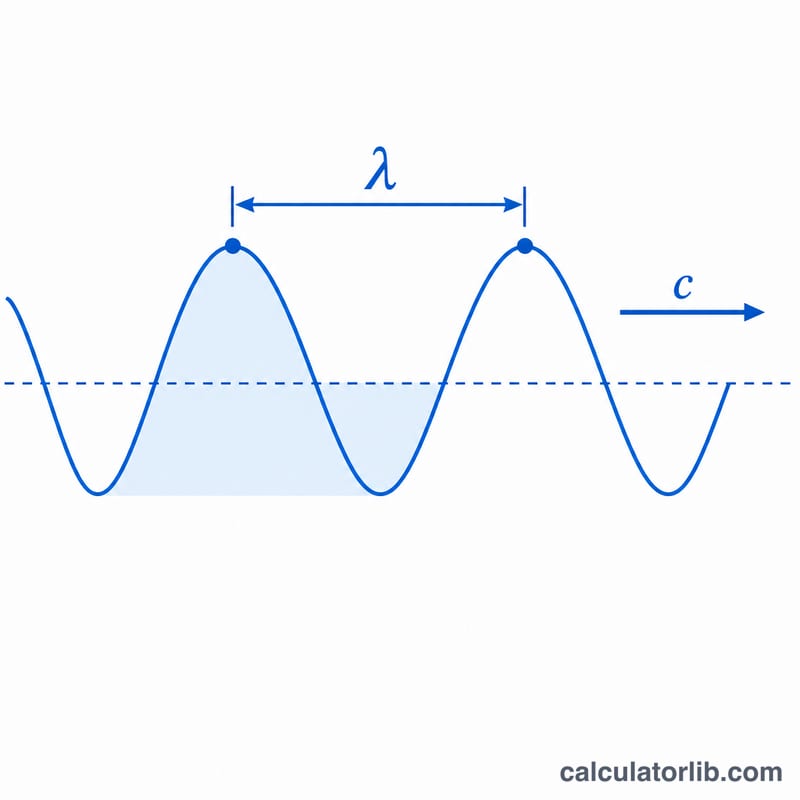
This tool converts the frequency of a wave into its wavelength using the fundamental relationship \(\lambda = c / f\), where \(\lambda\) is the wavelength, \(c\) is the speed of the wave, and \(f\) is the frequency. It works for electromagnetic waves traveling at the speed of light as well as sound waves moving through air or water.
How to Use It
Enter the frequency value, choose its unit (Hz, kHz, MHz, GHz, or THz), and select the wave speed for your medium. The calculator converts the frequency to hertz, divides the wave speed by it, and reports the wavelength in meters, centimeters, and millimeters.
The Formula Explained
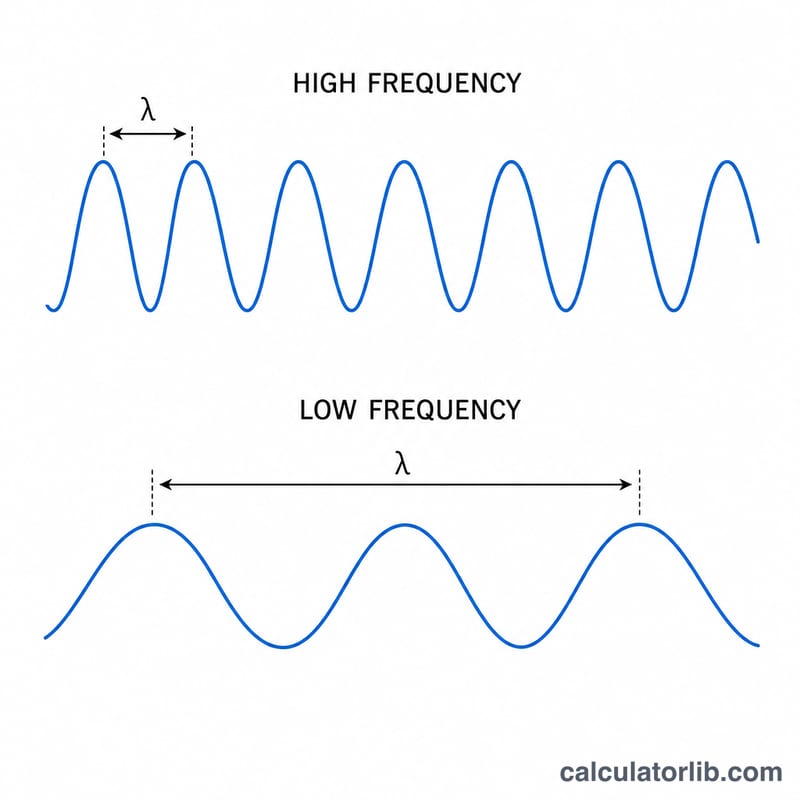
The wave equation states that speed equals frequency times wavelength (\(c = f \times \lambda\)). Rearranging for wavelength gives $$\lambda = \frac{c}{f}$$ For light in a vacuum, \(c = 299{,}792{,}458 \text{ m/s}\). For sound in dry air at about 20 °C, the speed is roughly 343 m/s, and in water it is around 1480 m/s. Higher frequencies always produce shorter wavelengths.
Worked Example
Suppose an FM radio station broadcasts at 100 MHz. First convert to hertz: \(100 \times 1{,}000{,}000 = 100{,}000{,}000 \text{ Hz}\). Then divide: $$\lambda = \frac{299{,}792{,}458}{100{,}000{,}000} \approx 2.998 \text{ meters}$$ That is the wavelength of the broadcast signal.
FAQ
Does this work for sound as well as light? Yes. Select the appropriate wave speed: light in vacuum, sound in air, or sound in water.
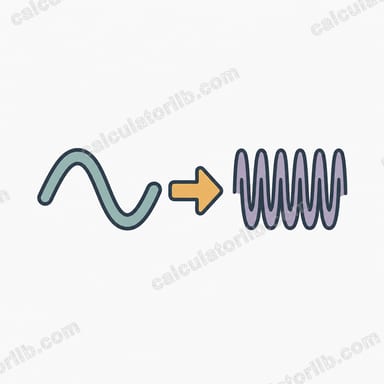
Why is the wavelength so small for high frequencies? Because wavelength is inversely proportional to frequency — doubling the frequency halves the wavelength.
What if I enter zero frequency? Wavelength is undefined for zero frequency, so the calculator returns 0 to avoid dividing by zero.