
What this calculator does
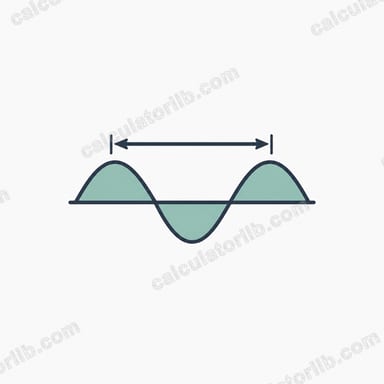
This tool converts between the wavelength and frequency of a wave. For electromagnetic waves traveling in a vacuum, it uses the speed of light, \(c = 299{,}792{,}458\) m/s. You can also enter a different wave speed (for example the speed of sound, ~343 m/s in air, or the speed of light in a medium) to model other waves. This is a universal physics tool and applies anywhere.
How to use it
Choose a direction. To find frequency, select "Wavelength → Frequency" and enter the wavelength in meters. To find wavelength, select "Frequency → Wavelength" and enter the frequency in hertz. Adjust the wave speed if your wave is not light in a vacuum, then read the result.
The formula explained
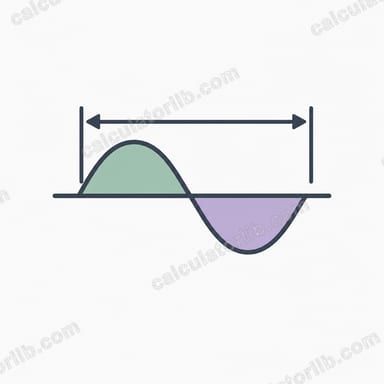
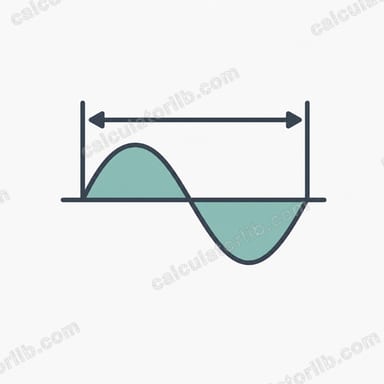
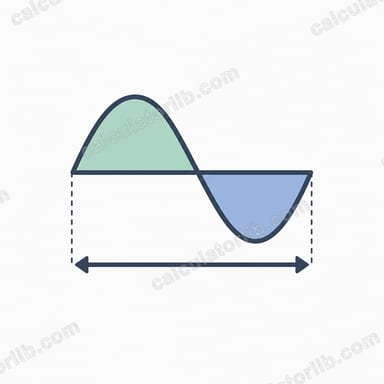
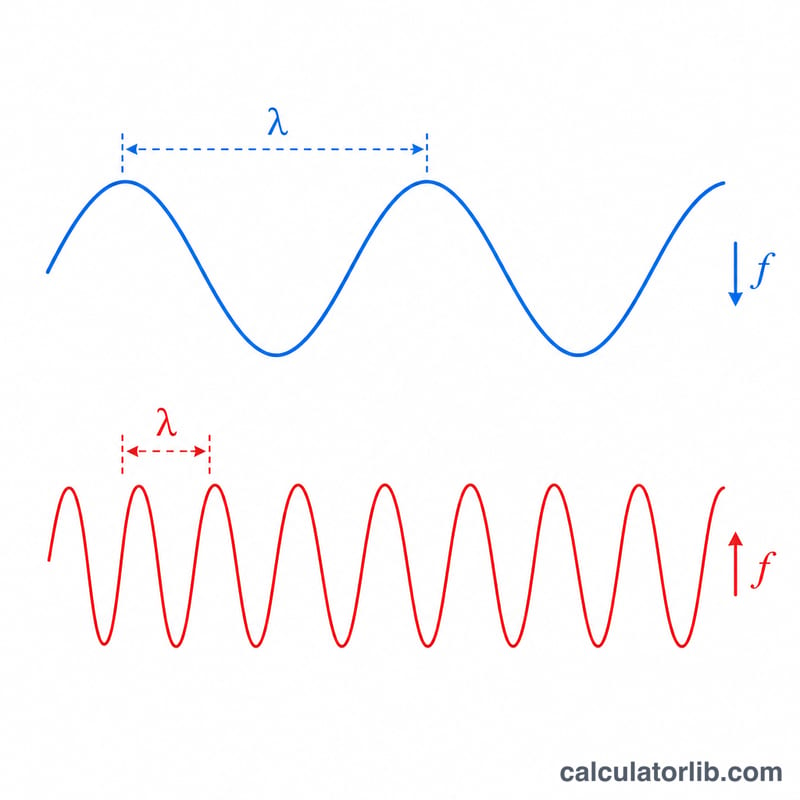
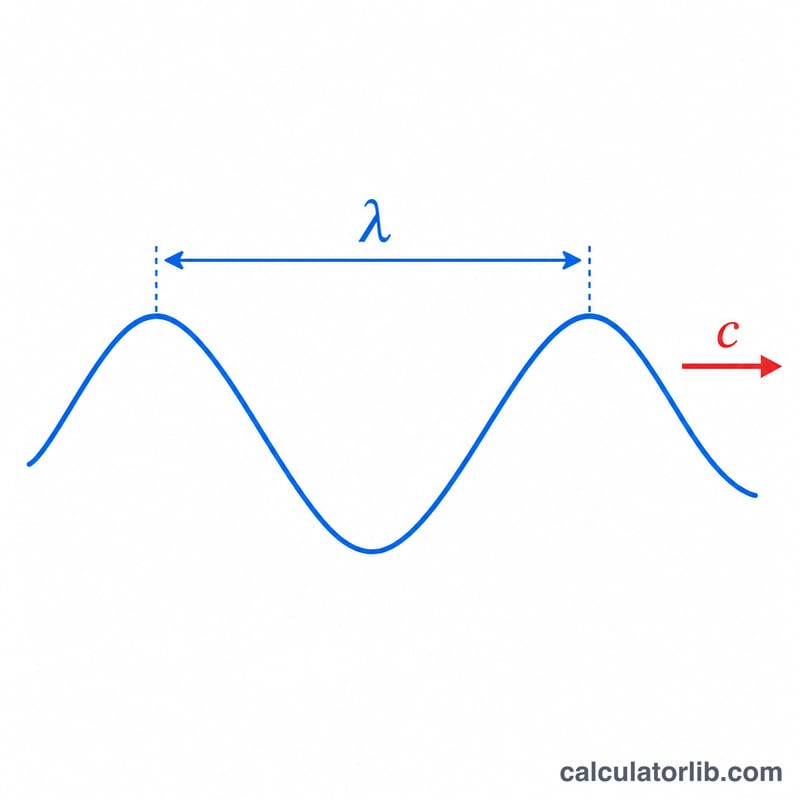
Every traveling wave obeys $$c = \lambda \times f,$$ where \(c\) is the wave speed, \(\lambda\) (lambda) is the wavelength, and \(f\) is the frequency. Rearranging gives the two forms used here: $$f = \dfrac{c}{\lambda} \qquad \lambda = \dfrac{c}{f}.$$ Frequency and wavelength are inversely proportional — double the wavelength and the frequency halves.
Worked example
Green light has a wavelength of about 550 nanometers, or \(550 \times 10^{-9} = 5.5 \times 10^{-7}\) m. Its frequency is $$f = \frac{c}{\lambda} = \frac{299{,}792{,}458}{0.00000055} \approx 5.451 \times 10^{14} \text{ Hz},$$ or about 545 terahertz — right in the visible band.
FAQ
What units should I use? Wavelength in meters and frequency in hertz keeps everything consistent with the m/s wave speed. Convert nm to m by multiplying by \(10^{-9}\).
Can I use this for sound? Yes. Set the wave speed to the speed of sound (about 343 m/s in air at 20 °C) instead of the speed of light.
Why is frequency so large for light? Because the speed of light is enormous and visible wavelengths are tiny, dividing yields hundreds of terahertz.