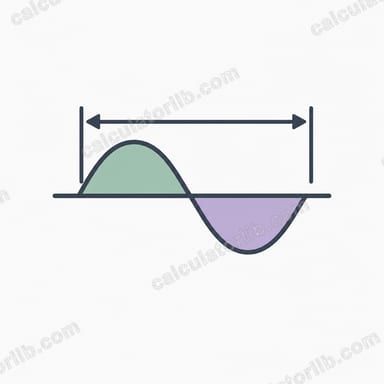

What this converter does
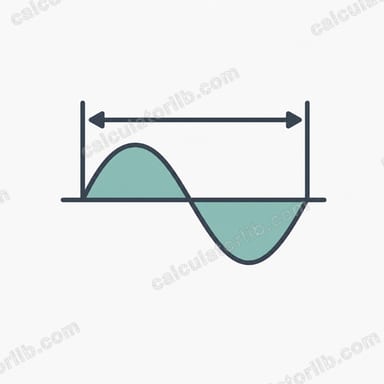
This tool converts between the frequency and the wavelength of a traveling wave. It works for any wave because it relies on one universal relationship between propagation speed, frequency and wavelength. The physics is identical everywhere, so no country or regional rules apply.
The formula
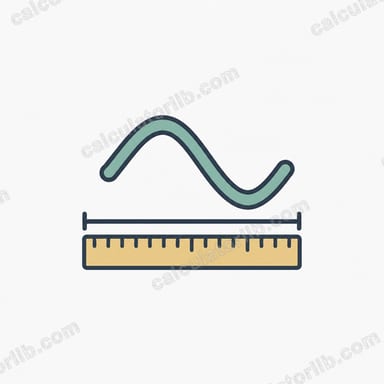
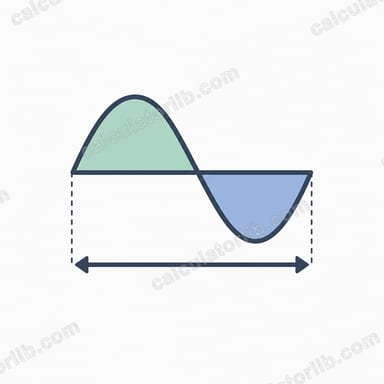
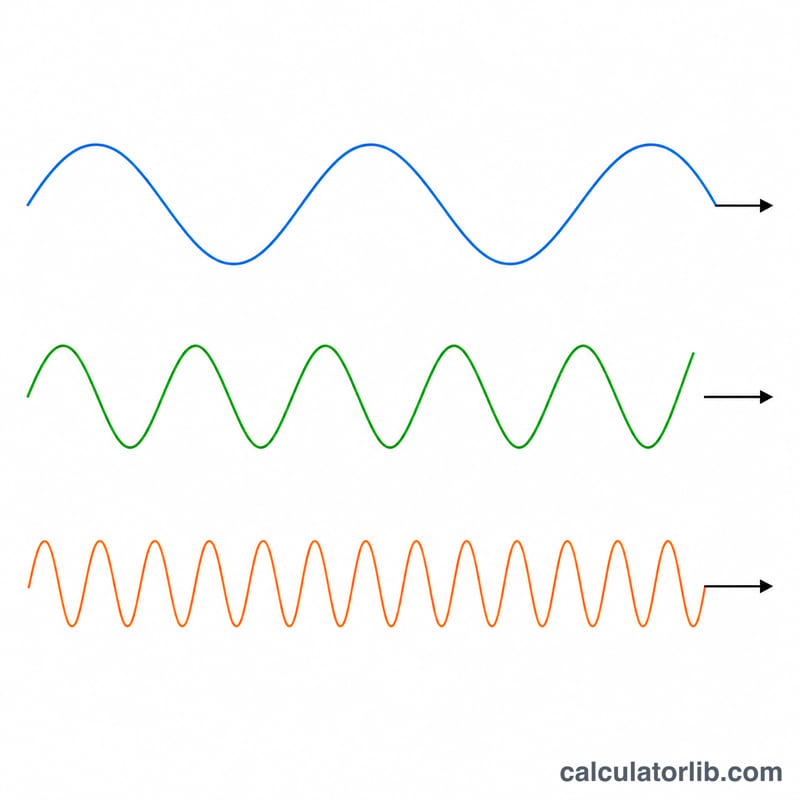
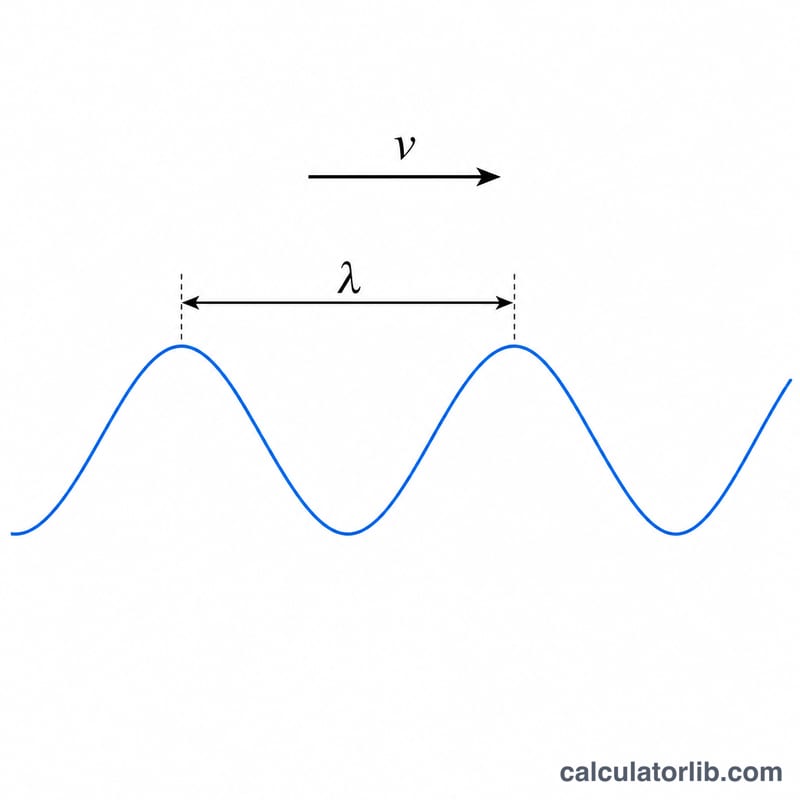
For any wave moving at speed v, the speed, frequency f and wavelength \(\lambda\) obey $$v = f \times \lambda$$ Rearranging gives the two conversions: $$f = \frac{v}{\lambda}$$ (frequency from wavelength) and $$\lambda = \frac{v}{f}$$ (wavelength from frequency). The speed depends on the medium: light in vacuum travels at exactly 299,792,458 m/s, sound in air is about 343 m/s near 20°C, and sound in seawater is roughly 1500 m/s.
How to use it
Pick a wave type to load its standard speed, or choose "Other" and type any speed in m/s. Enter a single value and choose its unit: if you pick a length unit (nm, µm, mm, m, km) the tool treats your number as a wavelength; if you pick a frequency unit (Hz, kHz, MHz, GHz, THz) it treats your number as a frequency. The calculator then returns both the wavelength in metres and the frequency in hertz.
Worked example
Choose Electromagnetic wave (\(v = 299{,}792{,}458\) m/s), enter 100 and select MHz. The frequency in SI units is $$100 \times 10^{6} = 1.0 \times 10^{8}\ \text{Hz}$$ The wavelength is $$\lambda = \frac{299{,}792{,}458}{10^{8}} \approx 2.998\ \text{m}$$ which matches the roughly 3 m wavelength of a 100 MHz FM radio signal.
FAQ
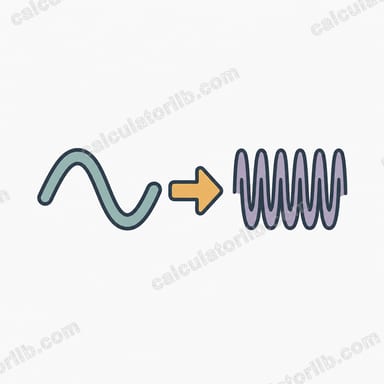
Why does the answer change with wave type? Because frequency and wavelength are linked through the wave's speed; the same frequency gives a much shorter wavelength for slow sound waves than for fast light waves.
Can I enter my own speed? Yes. Select "Other (manual entry)" and type any propagation speed greater than zero in m/s.
Are the preset speeds exact? The speed of light is exact by definition. Sound speeds are standard approximations that vary with temperature, pressure and salinity.