
What Is the Quilt Calculator?
The Quilt Calculator helps quilters plan a project before cutting any fabric. Enter your finished quilt's width and height plus the size of each square block, and it instantly tells you how many blocks you need to cover the top, the number of columns and rows in the layout, and how much backing fabric to buy. It works with any units, but inches are most common in quilting.
How to Use It
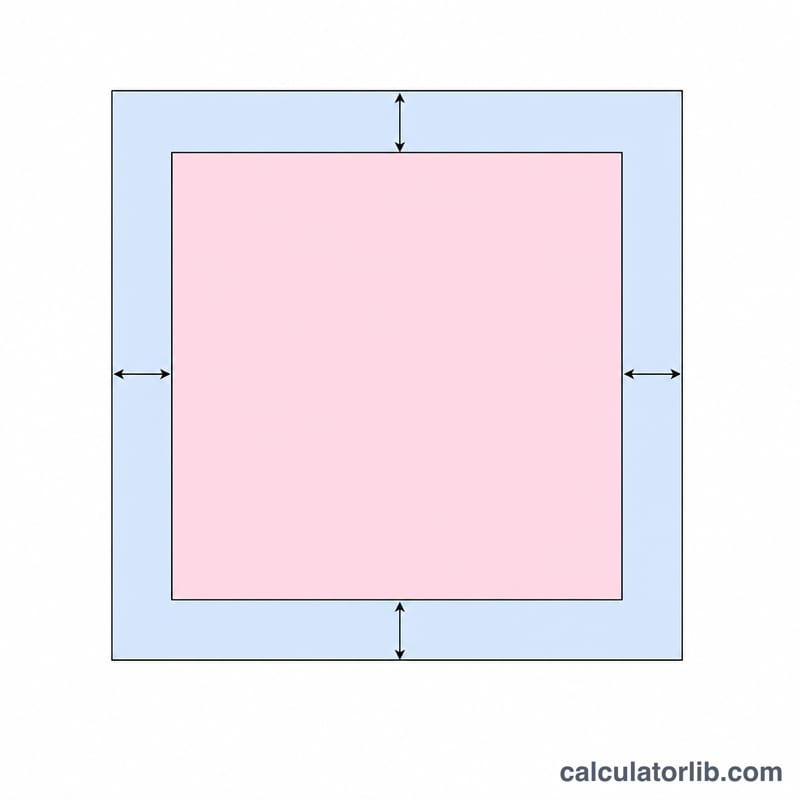
Type the finished quilt width and height in inches, then enter the size of a single finished block (for example 12 inches). The calculator divides each quilt dimension by the block size and rounds up, because a partial block still requires a full piece of fabric. It then multiplies columns by rows to get the total block count and computes a backing area with a generous 4-inch overhang on each edge.
The Formula Explained
Blocks needed = ceil(W ÷ b) × ceil(H ÷ b). Rounding up (the ceiling function) ensures the layout covers the entire top even when the quilt size is not an exact multiple of the block size.
$$\text{Blocks} = \left\lceil \frac{W}{b} \right\rceil \times \left\lceil \frac{H}{b} \right\rceil$$Backing area = (W + 8) × (H + 8), adding 8 inches total per side so the backing extends 4 inches beyond the quilt top all around — the standard allowance for long-arm or hand quilting. Backing yardage is the area divided by 1296 (36 × 36 square inches per square yard).
$$\text{Backing (yd)} = \frac{\left(W + 8\right)\left(H + 8\right)}{1296}$$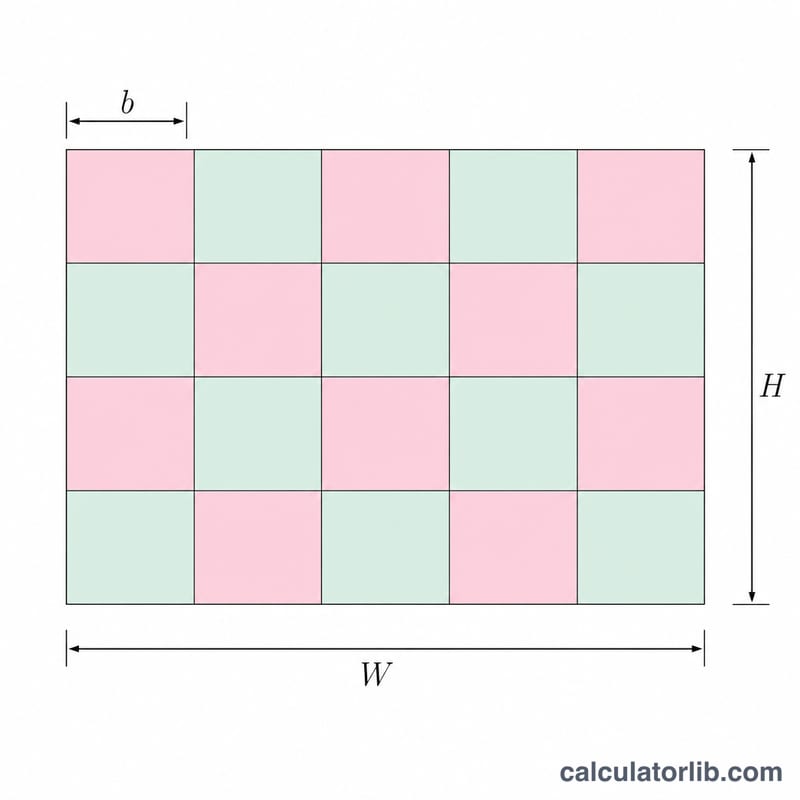
Worked Example
A 60 × 80 inch quilt with 12-inch blocks needs \(\lceil 60/12 \rceil = 5\) columns and \(\lceil 80/12 \rceil = 7\) rows, so \(5 \times 7 = 35\) blocks. The backing area is
$$(60 + 8) \times (80 + 8) = 68 \times 88 = 5{,}984 \text{ square inches},$$about 4.62 square yards.
FAQ
Why round each dimension up? Quilt blocks are whole squares; you cannot use a fraction of a block, so any leftover space requires another full block (trimmed during assembly).
Does this include seam allowance? Enter the finished block size. Cut your fabric pieces 0.5 inch larger (¼-inch seam on each side) than the finished size.
How much extra backing is included? The calculation adds a 4-inch overhang on every side, the typical amount required for quilting and squaring up.