
What Is the Hexagon Quilt Calculator?
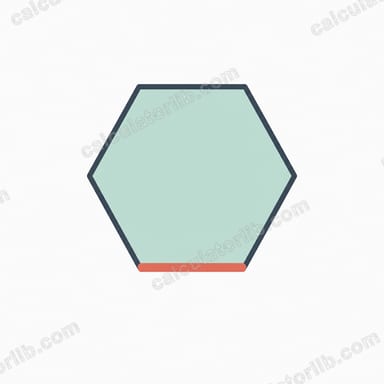
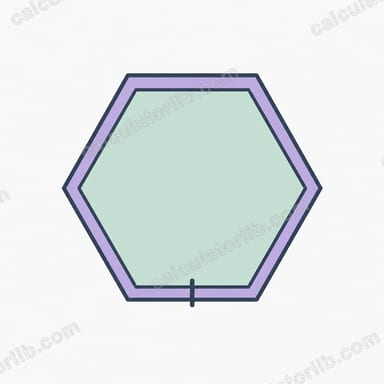
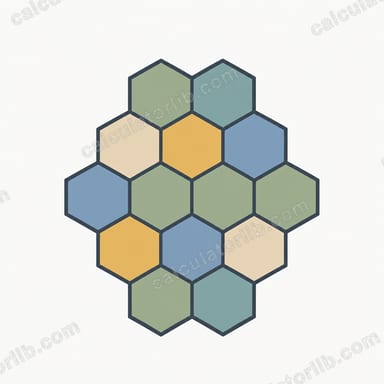
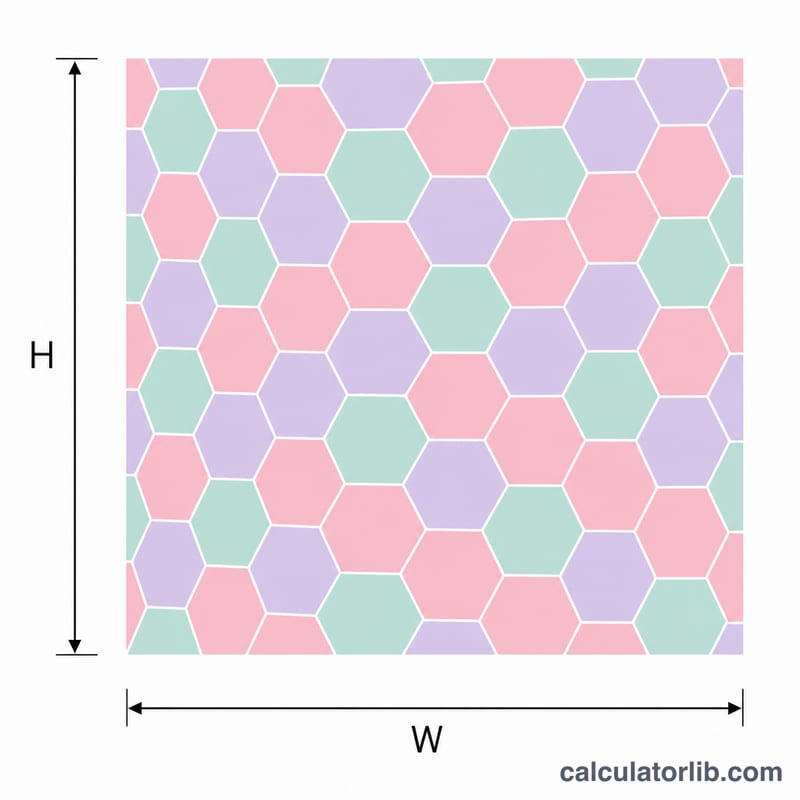
Hexagon (or "hexie") quilts are a classic patchwork design built from many small regular hexagons sewn edge to edge. This calculator estimates how many hexagons you need to cover a quilt of a given width and height, based on the side length of each hexagon. It also reports the area of a single hexagon and the total quilt area so you can plan fabric purchases with confidence.
How to Use It
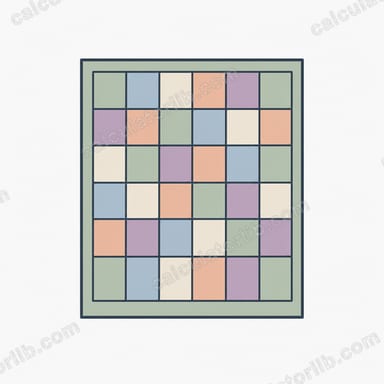
Enter the finished quilt width and height in inches, then enter the side length of one hexagon (the length of a single straight edge). The calculator divides the total quilt area by the area of one hexagon and rounds up, since you can't buy a fraction of a piece. Because hexagons tessellate perfectly, this area-based estimate is accurate; add a small extra margin for seam allowances and trimming at the edges.
The Formula Explained
A regular hexagon with side length s has area \(A = \frac{3\sqrt{3}}{2} \times s^{2} \approx 2.598 \times s^{2}\). The quilt area is simply width \(\times\) height. Dividing quilt area by hexagon area gives the number of hexagons:
$$n = \frac{W \times H}{A}$$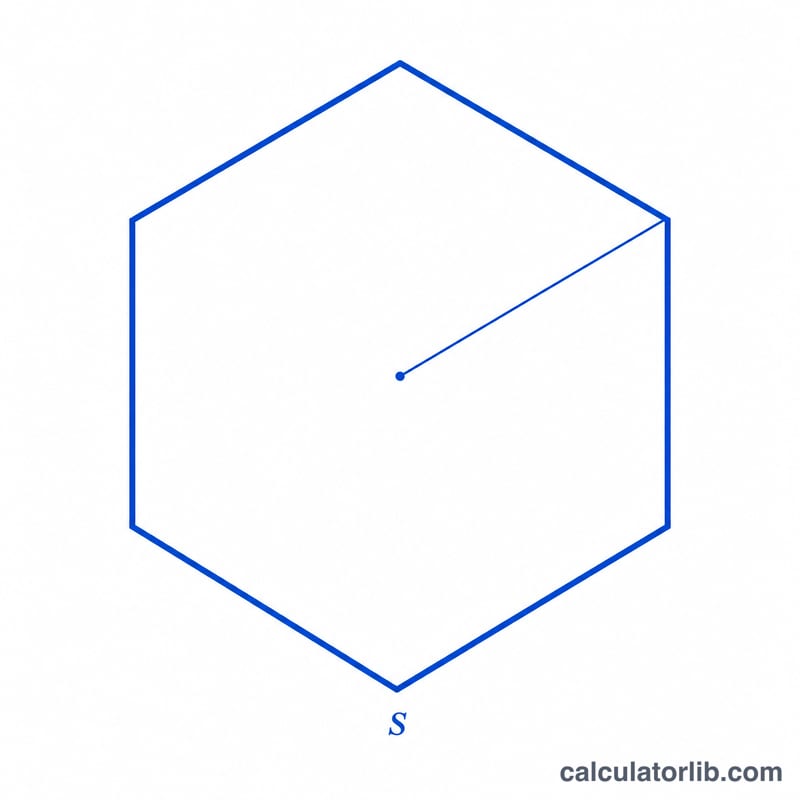
Worked Example
For a 60 in \(\times\) 80 in quilt using hexagons with a 2.5 in side: hexagon area = $$2.598 \times 2.5^{2} \approx 16.238 \text{ in}^{2}.$$ Quilt area = $$60 \times 80 = 4{,}800 \text{ in}^{2}.$$ Hexagons = $$\frac{4{,}800}{16.238} \approx 295.6,$$ so you'd need about 296 hexagons.
FAQ
Is the "side length" the same as the hexagon width? No. The side is one edge. The flat-to-flat width of a regular hexagon is \(s \times \sqrt{3}\), and the point-to-point width is \(2 \times s\).
Should I buy extra? Yes — add roughly 5–10% for seam allowances, edge trimming and mistakes.
Does this account for seam allowance? No, it uses finished sizes. Cut each fabric hexagon larger to include your seam allowance.