
What is the Permutations nPr Table Calculator?
This tool takes a single number of distinct objects, \(n\), and produces a complete table of permutations \({}_{n}P_{r}\) for every value of \(r\) from 0 up to \(n\). A permutation counts the number of ways to arrange \(r\) objects chosen from \(n\) when order matters. Because the results grow factorially, the calculator uses exact big-integer arithmetic so even very large values such as \(30!\) are shown precisely. This is pure combinatorics and applies identically everywhere; it is not region-specific.
How to use it
Enter the number of objects \(n\) (a non-negative whole number, default 30) and submit. The calculator returns the total number of arrangements of all objects (\({}_{n}P_{n} = n!\)) as the headline figure, plus a row-by-row table listing \({}_{n}P_{r}\) for \(r = 0, 1, 2, ..., n\). Read each row as "the number of ordered arrangements when choosing \(r\) of the \(n\) objects."
The formula explained
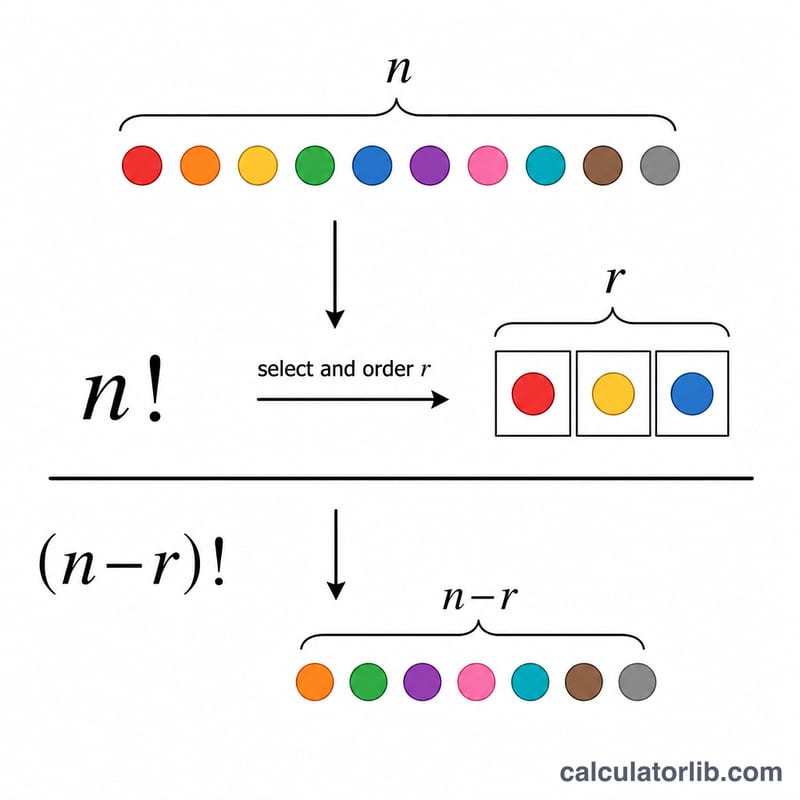
The defining formula is $$ {}_{n}P_{r} = \frac{n!}{(n - r)!} $$ Equivalently, \({}_{n}P_{r}\) is the falling factorial \(n \times (n-1) \times ... \times (n - r + 1)\), a product of exactly \(r\) descending terms. Special cases: \({}_{n}P_{0} = 1\) (the empty arrangement), \({}_{n}P_{1} = n\), and \({}_{n}P_{n} = n!\). The calculator builds the table efficiently by starting with \(P = 1\) and multiplying by \((n - r + 1)\) at each step, avoiding the need to compute huge factorials separately.
Worked example (n = 5)
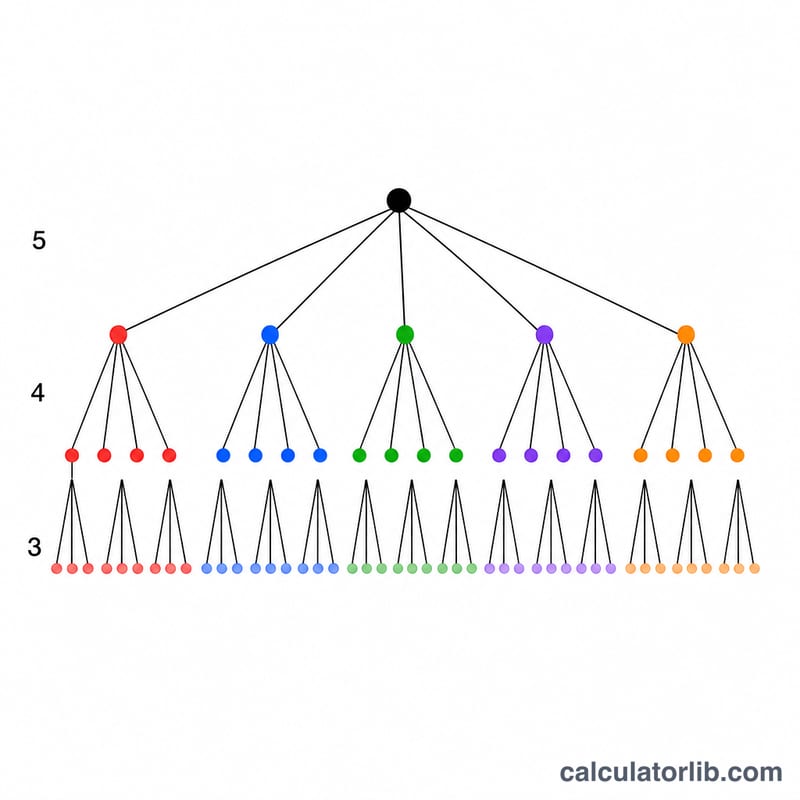
Starting from 1 and multiplying down: \({}_{5}P_{0} = 1\), \({}_{5}P_{1} = 5\), $$ {}_{5}P_{2} = 5 \times 4 = 20 $$ $$ {}_{5}P_{3} = 5 \times 4 \times 3 = 60 $$ \({}_{5}P_{4} = 120\), and \({}_{5}P_{5} = 120\). Note that \({}_{5}P_{4}\) and \({}_{5}P_{5}\) are equal because the final factor is 1.
FAQ
Why does nP0 equal 1? There is exactly one way to arrange zero objects: the empty arrangement.
What if r is larger than n? You cannot choose more objects than are available, so \({}_{n}P_{r} = 0\); the table therefore stops at \(r = n\).
How is nPr different from combinations nCr? Permutations count ordered arrangements, while combinations count unordered selections. They are related by $$ {}_{n}P_{r} = {}_{n}C_{r} \times r! $$