
What is the Combinations nCr Table Calculator?
This tool tabulates the binomial coefficient nCr - the number of ways to choose r distinct items from a set of n distinct items when order does not matter - for every value of \(r\) from 0 up to \(n\). Enter a single value of \(n\) and the calculator produces an \((n+1)\)-row table together with the row total, which is always 2 to the power \(n\). It supports \(n\) up to 300 using arbitrary-precision arithmetic, so even astronomically large coefficients such as \(\binom{300}{150}\) (about 89 digits) are computed exactly.
How to use it
Enter the number of items \(n\) (a non-negative integer, maximum 300). Choose a display precision in significant digits if you want to shorten very large numbers in the output; this only affects how the bigger values are shown and never changes the underlying math. Press calculate to see the full table of nCr values and the \(2^{n}\) total of all rows.
The formula explained
The combinations formula is $$\binom{n}{r} = \frac{n!}{r!\,(n-r)!}.$$ To avoid overflowing factorials, the calculator uses the multiplicative recurrence \(\binom{n}{0} = 1\) and \(\binom{n}{r} = \binom{n}{r-1} \cdot \frac{n - r + 1}{r}\). Each step stays exact with big-integer math. By symmetry \(\binom{n}{r}\) equals \(\binom{n}{n-r}\), and the total over all \(r\) equals the size of the power set, $$\sum_{r=0}^{n} \binom{n}{r} = 2^{n}.$$
Worked example (n = 5)
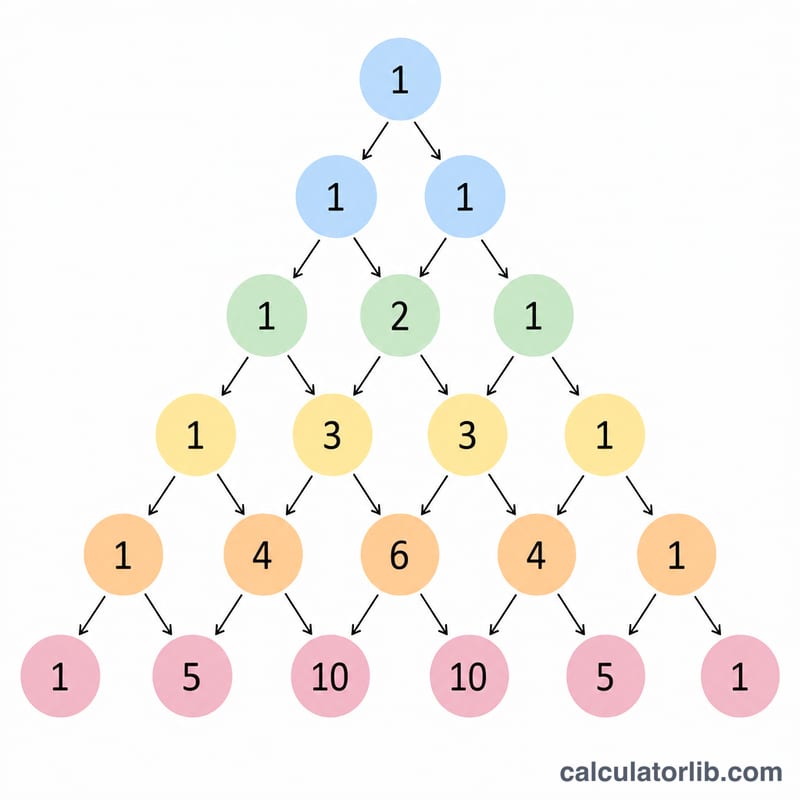
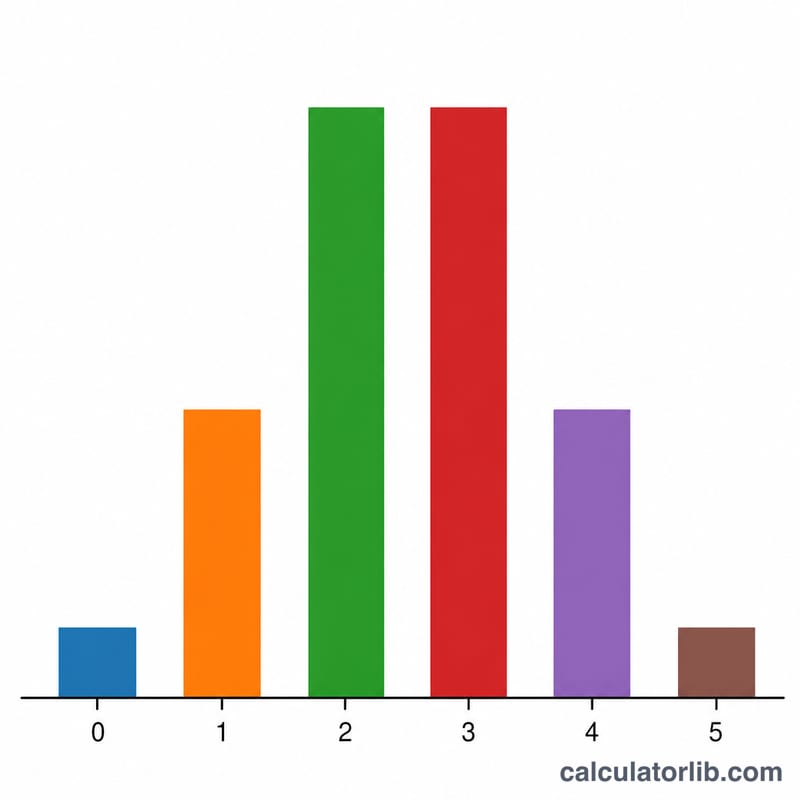
\(\binom{5}{0} = 1\), \(\binom{5}{1} = 5\), \(\binom{5}{2} = 10\), \(\binom{5}{3} = 10\), \(\binom{5}{4} = 5\), \(\binom{5}{5} = 1\). The row sum is $$1 + 5 + 10 + 10 + 5 + 1 = 32,$$ which equals \(2^{5}\). As a check, $$\binom{6}{2} = \frac{6!}{2!\,\cdot\,4!} = \frac{720}{2 \cdot 24} = 15.$$
FAQ
Why does the table have n+1 rows? Because \(r\) runs from 0 to \(n\) inclusive, giving \(n+1\) distinct choose counts.
What does nC0 mean? Choosing nothing - there is exactly one way to do that, so \(\binom{n}{0} = 1\), and likewise \(\binom{n}{n} = 1\).
Why allow up to 50 significant digits? Large coefficients have many digits; standard double precision loses accuracy past about 15-16 figures, so the display-precision selector lets you show exact-looking values without truncation.