
What this calculator does
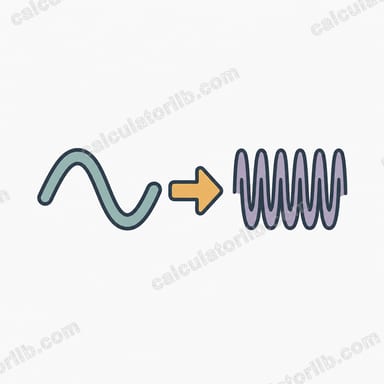
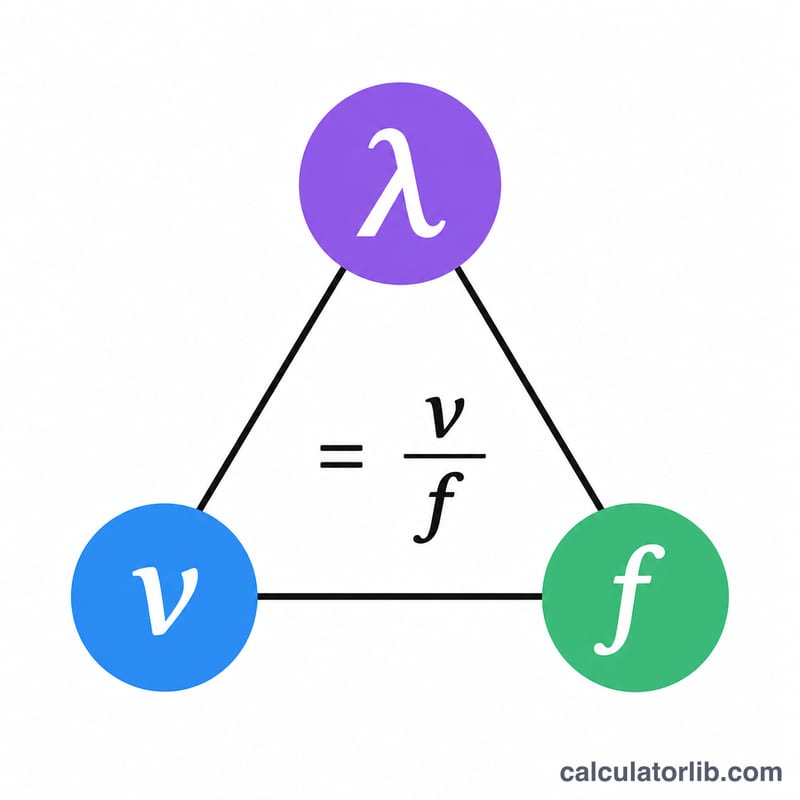
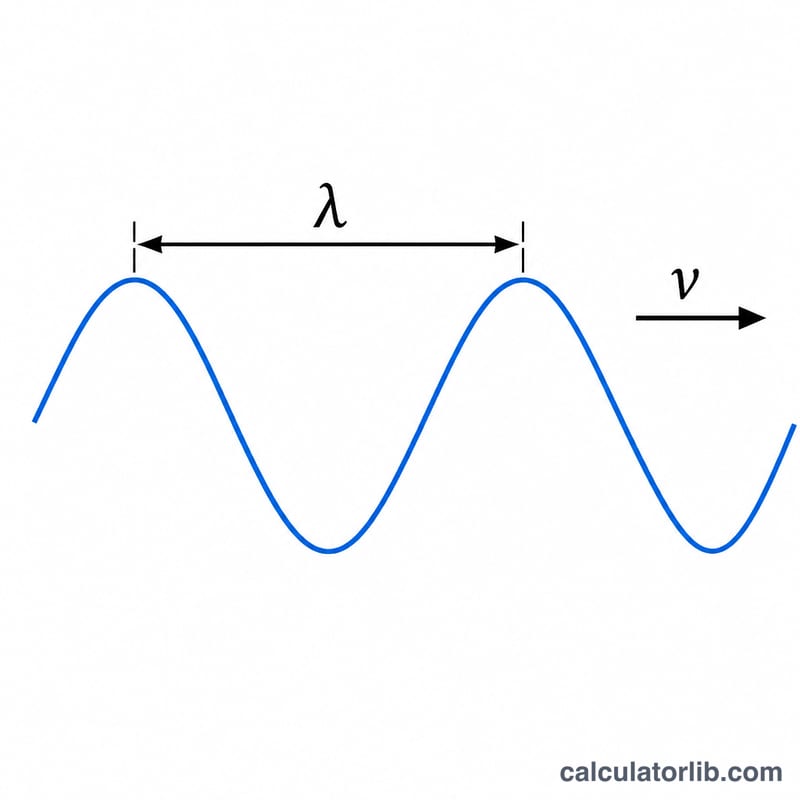
This tool solves the fundamental wave equation \(\lambda = v / f\), linking the wavelength (\(\lambda\)), the propagation velocity (\(v\)), and the frequency (\(f\)) of any periodic wave. Choose which quantity you want to find, enter the other two, and the calculator handles all unit conversions and significant-figure rounding for you. It works for sound waves, electromagnetic waves (light, radio), water waves, and any other wave where the relation holds.
How to use it
Pick a quantity to "Solve for" in the dropdown. Enter the two known values and select their units. For example, to find a wavelength, leave the mode on Wavelength, then type a velocity and a frequency. Internally every input is converted to SI units (meters, meters per second, hertz), the equation is evaluated, and the answer is converted back into your chosen output unit. Use the Significant Figures menu to round the display, or leave it on "auto" for full precision.
The formula explained
A wave travels a distance of one wavelength in one period of oscillation. Since frequency is the number of periods per second, multiplying wavelength by frequency gives the speed: $$v = \lambda \times f.$$ Dividing both sides yields $$\lambda = \frac{v}{f},$$ and solving for frequency gives $$f = \frac{v}{\lambda}.$$ All three forms describe the same physical relationship.
Worked example
A radio station broadcasts at 100 MHz. Radio waves travel at the speed of light, \(v = 299{,}792{,}458 \text{ m/s}\). The wavelength is $$\lambda = \frac{299{,}792{,}458}{100{,}000{,}000} = 2.998 \text{ m}$$ (3 significant figures). Switch the output unit to centimeters and the same answer reads 299.79 cm.
FAQ
Why do I get a "frequency cannot be zero" error? Solving for wavelength divides by frequency, and solving for frequency divides by wavelength. Division by zero is undefined, so the calculator blocks it.
What velocity should I use for light? In a vacuum, light travels at 299,792,458 m/s. In a medium it is slower by the refractive index, so adjust accordingly.
Does it work for sound? Yes. Sound in dry air at 20 C is about 343 m/s; enter that velocity with your frequency or wavelength to get the third value.