
What Is the Solar Payback & ROI Calculator?
This calculator tells you how long it takes for the money you save on electricity to cover the cost of installing a solar panel system — the "payback period" — and the total return on investment (ROI) over the system's life. It is a universal financial tool: enter values in any currency, as long as you are consistent.
How to Use It
Enter three numbers: the system cost (ideally after any rebates, tax credits, or incentives you receive), your annual electricity savings (how much your power bill drops each year), and the expected system lifespan in years (25 years is a common warranty figure). The calculator returns your break-even point, total lifetime savings, net lifetime profit, and ROI percentage.
The Formula Explained
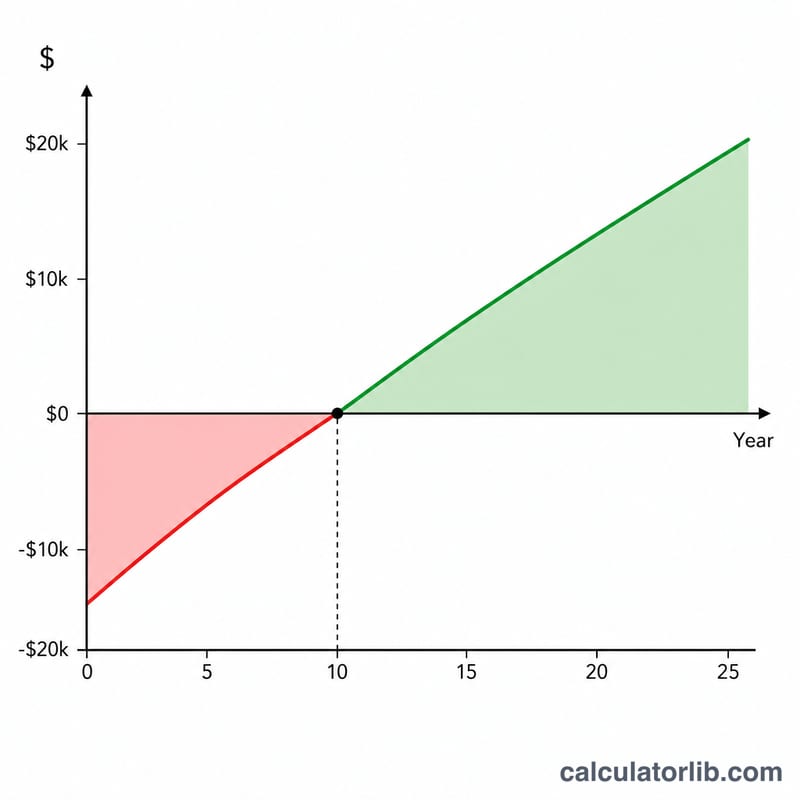
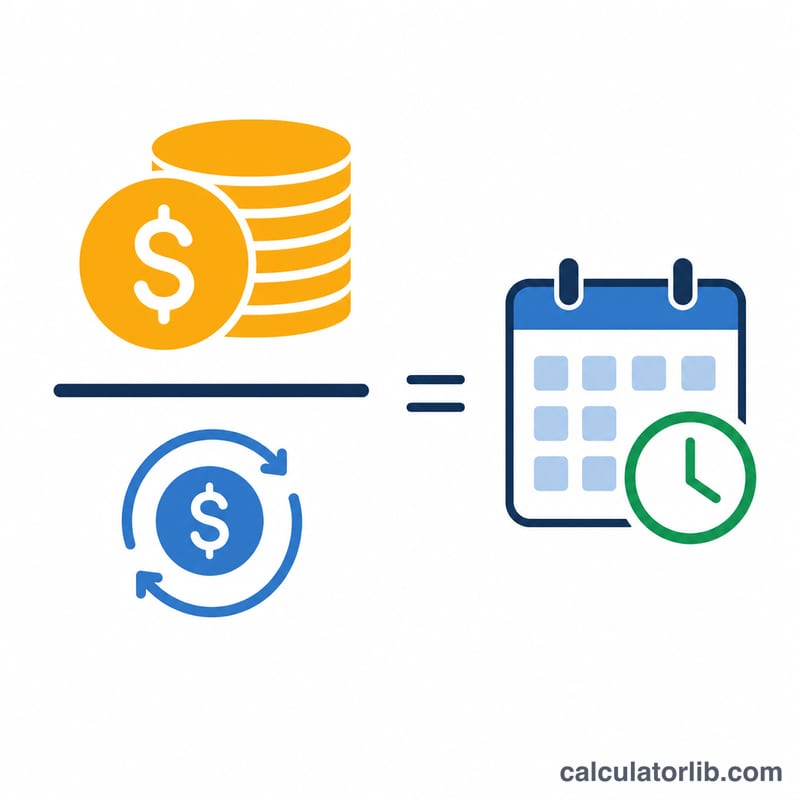
The core equation is simple: $$\text{Payback Years} = \dfrac{\text{System Cost}}{\text{Annual Savings}}$$ If a system costs 20,000 and saves 1,800 per year, it pays for itself in about 11.1 years. Lifetime savings is annual savings multiplied by lifespan; net profit subtracts the original cost; and ROI expresses that profit as a percentage of the investment.
Worked Example
Suppose your system costs 20,000 after incentives, saves 1,800 per year, and lasts 25 years. Payback $$= \frac{20{,}000}{1{,}800} = \textbf{11.11 years}$$ Lifetime savings $$= 1{,}800 \times 25 = \textbf{45,000}$$ Net profit $$= 45{,}000 - 20{,}000 = \textbf{25,000}$$ ROI $$= \frac{25{,}000}{20{,}000} \times 100 = \textbf{125\%}$$
FAQ
Should I include incentives in system cost? Yes — use your net out-of-pocket cost after rebates and tax credits for the most realistic payback.
Does this account for rising electricity prices? No. It assumes flat annual savings. Real payback is often faster because electricity prices tend to rise over time.
What is a good payback period? Many homeowners aim for 6–12 years; anything shorter than the system lifespan means a net financial gain.