
What Is a Wavenumber?
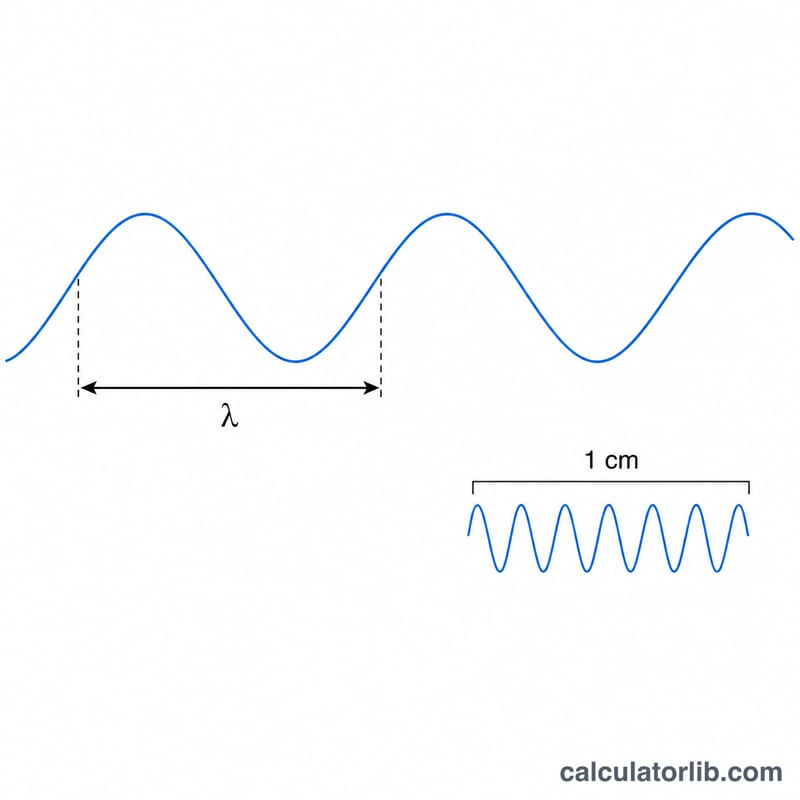
The wavenumber is the number of wave cycles per unit length, most commonly expressed in reciprocal centimeters (cm⁻¹) in spectroscopy. It is simply the inverse of the wavelength measured in centimeters. Wavenumbers are popular in infrared (IR) and Raman spectroscopy because they are directly proportional to photon energy and frequency, making spectral features easy to compare.
How to Use This Calculator
Enter the wavelength of your light or radiation and choose its unit (nanometers, micrometers, millimeters, centimeters, or meters). The calculator first converts the wavelength to centimeters, then takes the reciprocal to give the wavenumber in cm⁻¹. It also reports the equivalent wavelength in centimeters and nanometers for reference.
The Formula Explained
The core relationship is \(\tilde{\nu} = 1 / \lambda(\text{cm})\). Because 1 cm = 10⁷ nm, the practical shortcut for visible/UV work is \(\tilde{\nu} = 10^7 / \lambda(\text{nm})\). To convert any input to centimeters: 1 nm = 10⁻⁷ cm, 1 µm = 10⁻⁴ cm, 1 mm = 0.1 cm, and 1 m = 100 cm.
$$\tilde{\nu}\ (\text{cm}^{-1}) = \frac{1}{\text{Wavelength} \times 10^{-7}}$$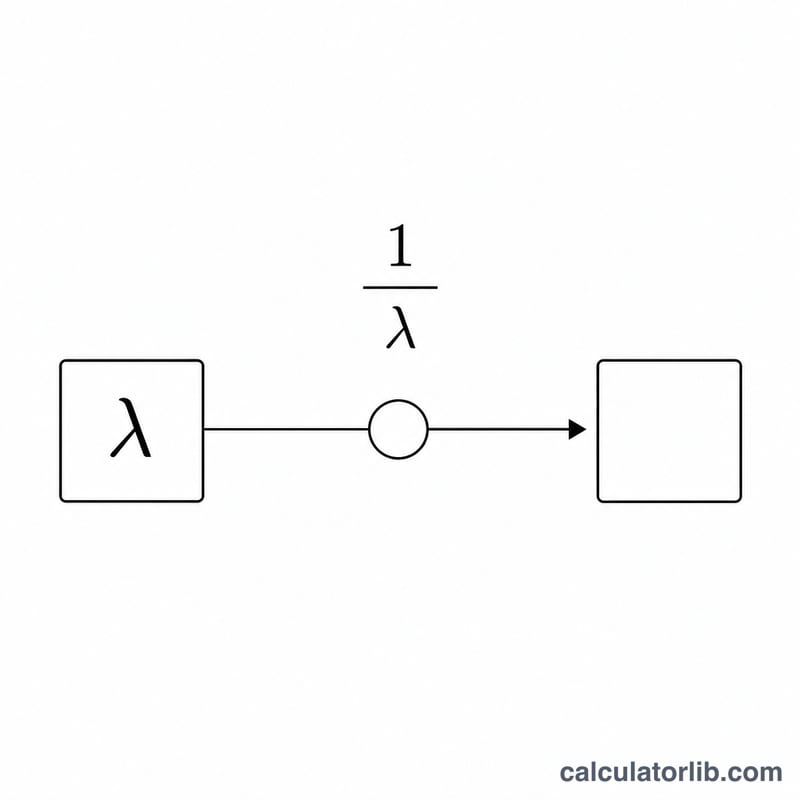
Worked Example
Consider green light with a wavelength of 500 nm. Convert to cm: \(500 \times 10^{-7} = 5 \times 10^{-5}\) cm. The wavenumber is
$$\frac{1}{5 \times 10^{-5}} = 20{,}000\ \text{cm}^{-1}$$Using the shortcut: \(10^7 / 500 = 20{,}000\ \text{cm}^{-1}\) — the same answer.
FAQ
Why use cm⁻¹ instead of frequency? Wavenumbers avoid huge frequency values (hundreds of terahertz) and scale linearly with energy, which is convenient for plotting and tabulating IR spectra.
Is wavenumber the same as the angular wavenumber k? No. The spectroscopic wavenumber \(\tilde{\nu} = 1/\lambda\) omits the 2π factor present in the physics angular wavenumber \(k = 2\pi/\lambda\).
What range is typical for IR spectroscopy? Mid-infrared spectra usually span roughly 400 to 4000 cm⁻¹, corresponding to wavelengths of about 2.5 µm to 25 µm.