
What Is Saturation Vapor Pressure?
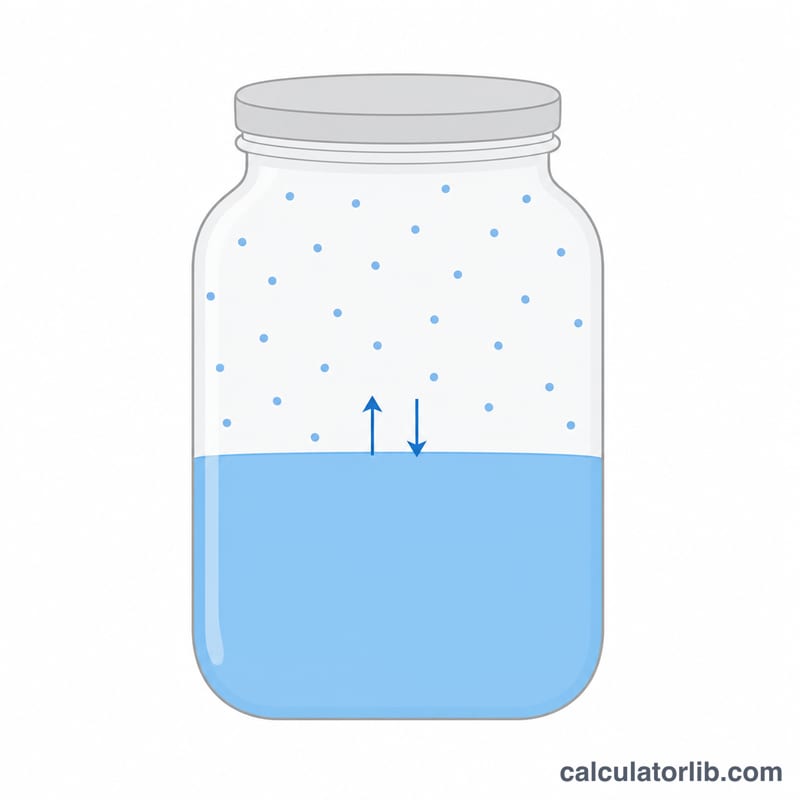
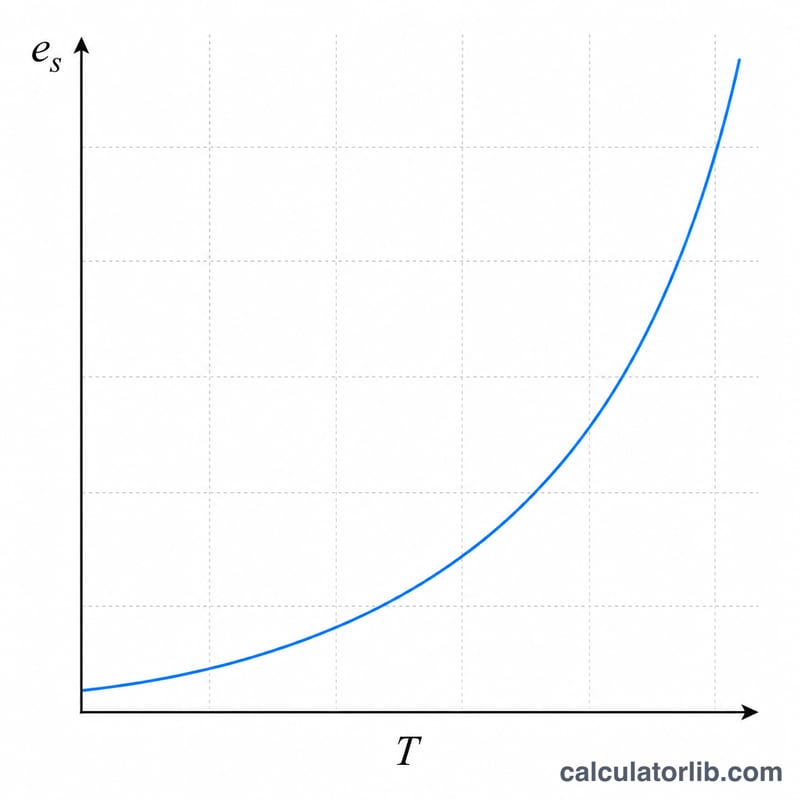
Saturation vapor pressure (\(e_s\)) is the partial pressure exerted by water vapor when the air is fully saturated at a given temperature — the maximum amount of moisture the air can hold before condensation begins. It rises sharply with temperature, which is why warm air can carry far more water than cold air. This value is fundamental in meteorology, HVAC design, agronomy (evapotranspiration), and building physics.
How to Use This Calculator
Enter the air (dry-bulb) temperature in degrees Celsius and the calculator returns the saturation vapor pressure in kilopascals (kPa), with conversions to hectopascals (hPa, equivalent to millibars) and pascals (Pa). The result is universal and applies to any location.
The Formula Explained
This tool uses the Tetens equation (also used by the FAO Penman–Monteith method):
$$e_s = 0.6108 \cdot \exp\!\left(\frac{17.27 \cdot \text{Temp (°C)}}{\text{Temp (°C)} + 237.3}\right)$$with \(e_s\) in kPa and \(T\) in °C.
The exponential term captures the steep, nonlinear growth of water-holding capacity with temperature. Multiply by 10 to get hPa, or by 1000 to get Pa.
Worked Example
At \(T = 30\) °C: exponent \(= 17.27 \times 30 / (30 + 237.3) = 518.1 / 267.3 = 1.93827\).
$$\exp(1.93827) = 6.94673$$$$e_s = 0.6108 \times 6.94673 = 4.24307 \text{ kPa} = 42.4307 \text{ hPa} = 4243.07 \text{ Pa}$$FAQ
Does this work below freezing? The Tetens coefficients here are tuned for liquid water (above 0 °C). Below freezing, a separate ice formulation (e.g. coefficients 21.875 and 265.5) gives more accurate values.
How does this relate to relative humidity? Relative humidity = actual vapor pressure ÷ saturation vapor pressure × 100%. This calculator gives the denominator.
What is the difference between kPa, hPa, and Pa? They are the same quantity in different scales: \(1 \text{ kPa} = 10 \text{ hPa} = 1000 \text{ Pa}\). hPa equals the older millibar unit common in weather reports.