
What this calculator does
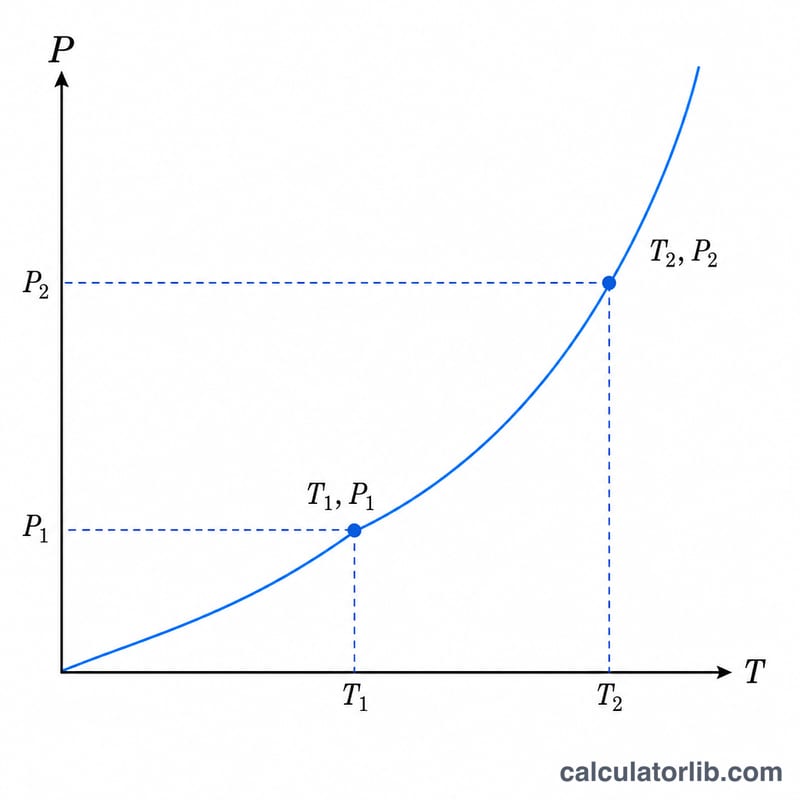
The Vapor Pressure Calculator uses the two-point Clausius-Clapeyron equation to estimate the vapor pressure of a liquid at a target temperature, given its vapor pressure at a known temperature and its molar enthalpy of vaporization. It is widely used in physical chemistry, chemical engineering, and thermodynamics coursework.
How to use it
Enter the known vapor pressure P1 (in any consistent pressure unit such as Pa, atm, or mmHg), the temperature T1 at which P1 is measured (in kelvin), the target temperature T2 (also in kelvin), and the enthalpy of vaporization ΔHvap in joules per mole. The result P2 is returned in the same pressure units you used for P1.
The formula explained
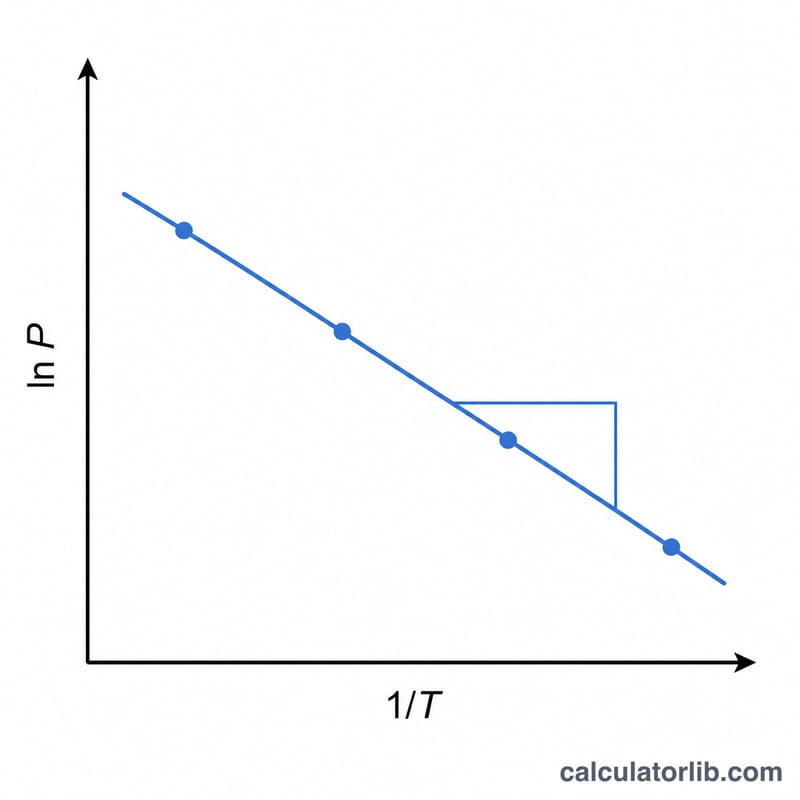
The equation is $$\ln\!\left(\frac{P_2}{P_1}\right) = -\frac{\Delta H_{vap}}{R}\left(\frac{1}{T_2} - \frac{1}{T_1}\right)$$ where \(R = 8.314\ \text{J/(mol}\cdot\text{K)}\). Solving for P2 gives $$P_2 = P_1 \cdot \exp\!\left[-\frac{\Delta H_{vap}}{R}\left(\frac{1}{T_2} - \frac{1}{T_1}\right)\right]$$ The model assumes ΔHvap is constant over the temperature range and that the vapor behaves ideally, which is a good approximation over modest temperature spans.
Worked example
Water has P1 = 101325 Pa at T1 = 373.15 K, with ΔHvap = 40700 J/mol. To find the vapor pressure at T2 = 350 K: $$\frac{1}{350} - \frac{1}{373.15} = 0.00285714 - 0.00267989 = 0.00017725$$ Multiply by \(-\frac{40700}{8.314} = -4894.8\): $$\ln\!\left(\frac{P_2}{P_1}\right) = -0.86756$$ Then \(P_2 = 101325 \cdot e^{-0.86756} \approx 42546\ \text{Pa}\).
FAQ
What units should temperature be in? Always kelvin — the equation requires absolute temperature.
Does P1 have to be in pascals? No. Any pressure unit works; P2 comes out in the same unit because the equation uses a ratio.
Why is the result approximate? ΔHvap actually varies slightly with temperature, so accuracy decreases over very large temperature ranges.