
What is the Resuspension Volume Calculator?
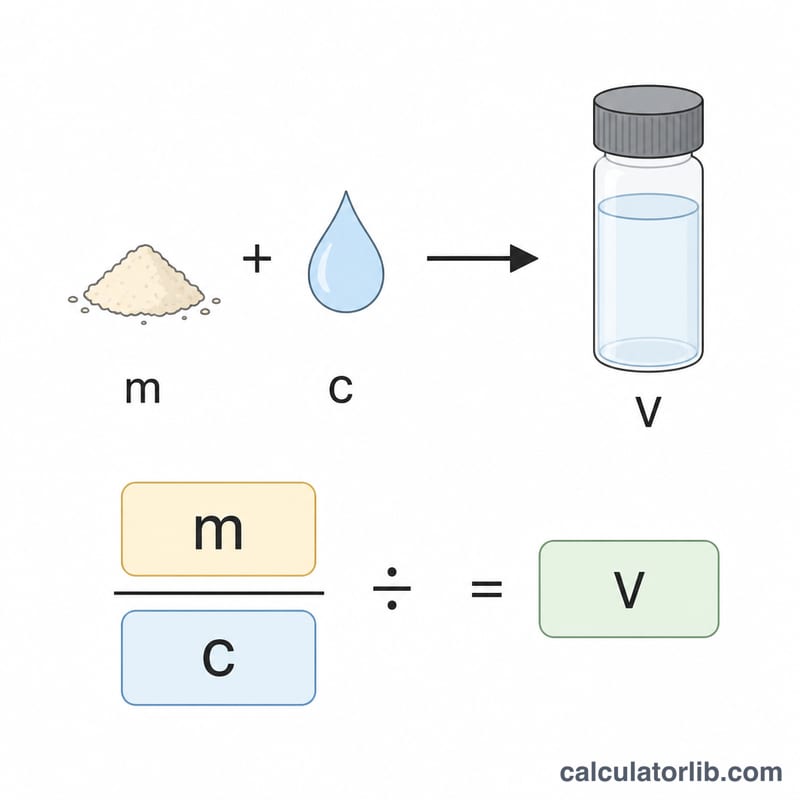
When you receive a lyophilized (freeze-dried) peptide, antibody, oligonucleotide, primer, or any dry reagent, you need to add the right amount of solvent to reach a usable stock concentration. This calculator tells you exactly how much liquid to add. It rearranges the simple concentration relationship so that volume = mass ÷ desired concentration, and handles unit conversions automatically.
How to use it
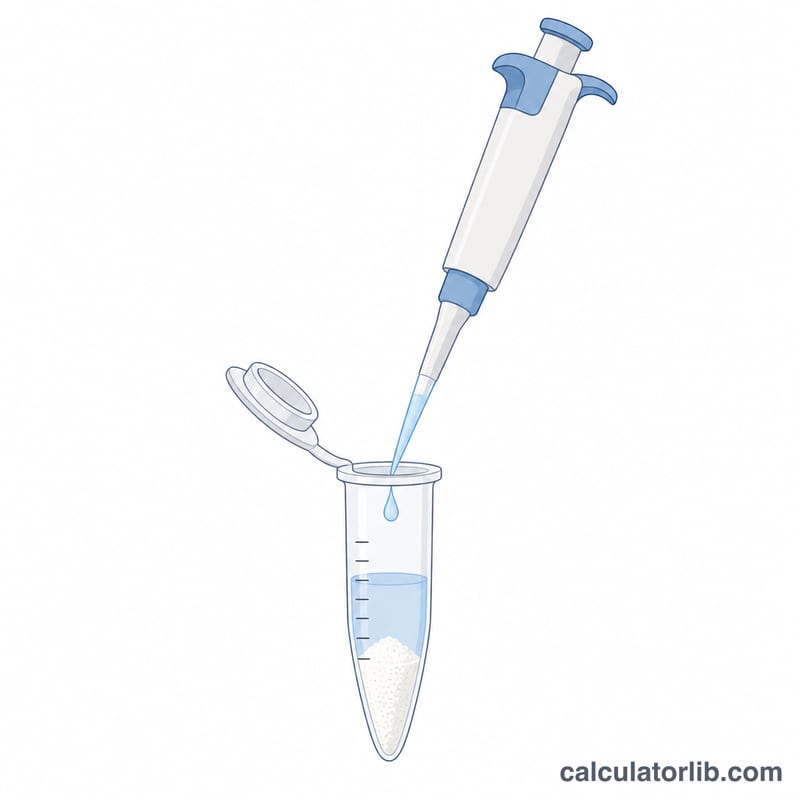
Enter the mass of dry substance you have (and pick its unit: ng, µg, mg, or g), then enter the concentration you want your final stock to be (and its unit). The calculator outputs the solvent volume in both milliliters and microliters. Add that volume of your chosen buffer or solvent to the vial, mix gently, and you'll have a stock at your target concentration.
The formula explained
Concentration is defined as mass per unit volume: \(C = m / V\). Solving for volume gives $$V = \dfrac{m}{C}$$ Internally the tool converts every mass to micrograms and every concentration to micrograms per milliliter before dividing, so any unit combination produces a correct result.
Worked example
You have 1 mg of peptide and want a 2 mg/mL stock. $$V = \frac{1\ \text{mg}}{2\ \text{mg/mL}} = 0.5\ \text{mL} = 500\ \mu\text{L}$$ Add 500 µL of solvent and you'll reach 2 mg/mL.
FAQ
What solvent should I use? Follow the manufacturer's datasheet — common choices include sterile water, PBS, DMSO, or TE buffer depending on the molecule.
Does it account for displacement by the solid? No. For typical milligram-scale reagents the solid volume is negligible, so the added solvent volume equals the final volume closely enough.
What are µg/mL and ng/mL good for? Dilute biological stocks (antibodies, standards) are often prepared at these lower concentrations; just pick the matching unit.