
What Is Atom Economy?
Atom economy is a green-chemistry metric that measures how efficiently the atoms of the reactants are incorporated into the desired product. Introduced by Barry Trost, it answers a simple question: of all the mass you put into a reaction, what fraction ends up as the product you actually want? A high atom economy means little waste, which lowers cost and environmental impact. Unlike percentage yield, atom economy is a theoretical efficiency derived purely from the balanced equation, independent of how well the reaction actually performs.
How to Use This Calculator
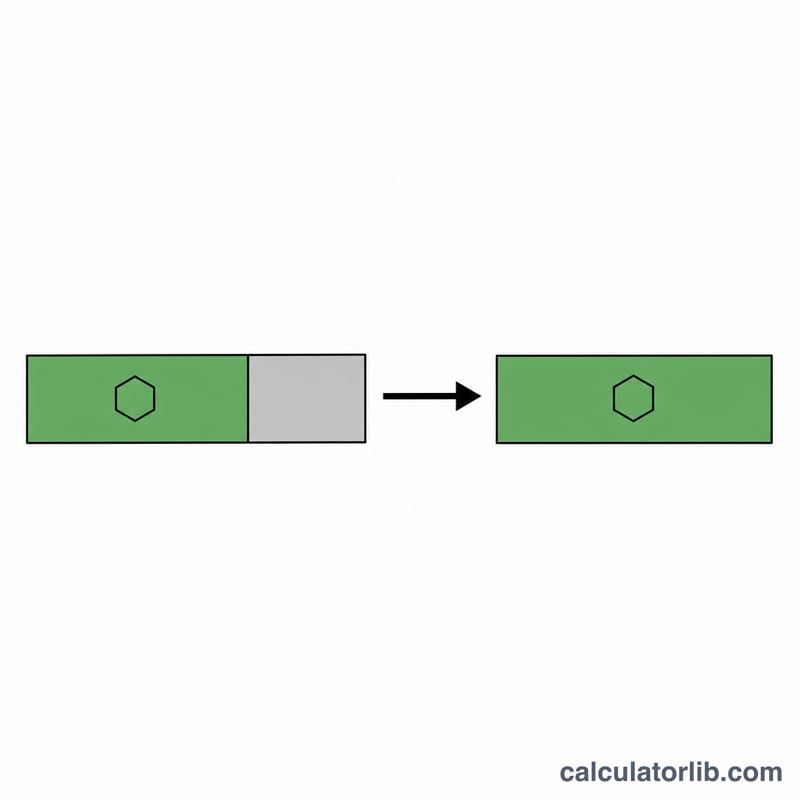
Enter the molar mass of your desired product (in g/mol) and the total molar mass of all reactants combined (in g/mol). The tool divides the product mass by the total reactant mass and multiplies by 100 to give the atom economy as a percentage. It also reports the wasted mass per mole and the waste percentage, so you can see exactly how much material becomes by-product.
The Formula Explained
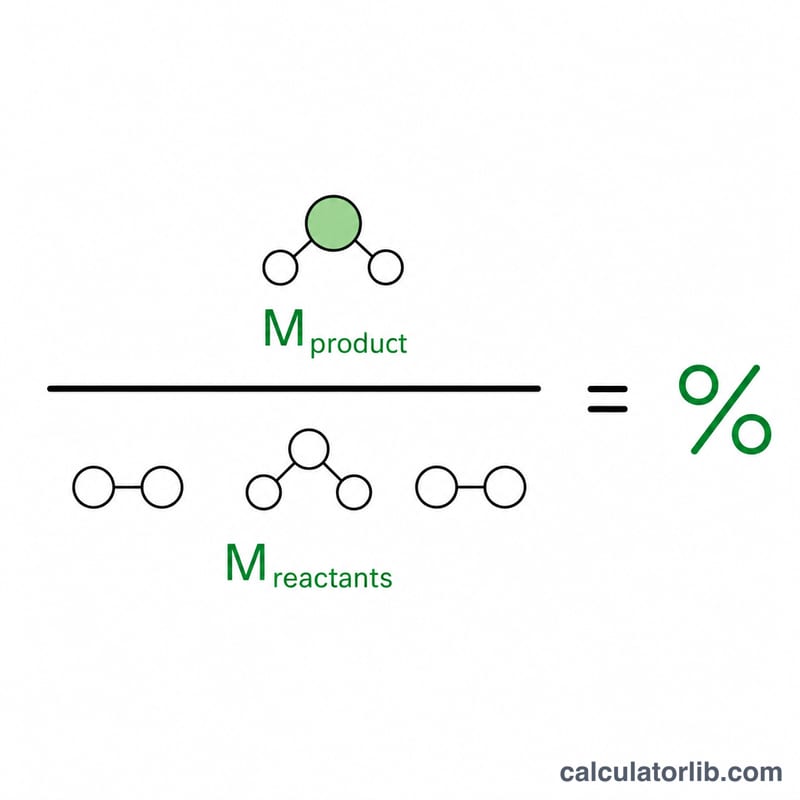
Atom economy (%) = (molar mass of desired product ÷ total molar mass of all reactants) × 100. Be sure to add up the molar masses of every reactant in the balanced equation, multiplying each by its stoichiometric coefficient. Only the single desired product appears in the numerator; everything else is treated as waste.
$$\text{Atom Economy} = \frac{M_{\text{product}}}{M_{\text{reactants}}} \times 100\%$$
$$\text{AE} = \frac{M_{\text{product}}}{\sum M_{\text{reactants}}} \times 100\%$$
$$\text{Waste} = \sum M_{\text{reactants}} - M_{\text{product}}$$
Worked Example
Consider the synthesis of glucose (C₆H₁₂O₆, M = 180.16 g/mol) where the reactants total 294.30 g/mol. Atom economy = $$\frac{180.16}{294.30} \times 100 = 61.2\%$$ This means about 61% of the input mass is retained in glucose, while roughly 39% (114.14 g/mol) becomes by-product.
Interpreting Your Atom Economy Result
Atom economy (AE) measures the proportion of reactant mass that ends up in the desired product, based purely on the balanced equation. It is calculated as:
$$\text{Atom Economy} = \frac{\text{molar mass of desired product}}{\text{total molar mass of all reactants}} \times 100\%$$The result tells you how efficiently atoms are incorporated into the target molecule, with the rest leaving as by-products or waste.
| Atom economy | Interpretation |
|---|---|
| 100% | Every reactant atom appears in the desired product; no by-products are formed (e.g. addition and rearrangement reactions). |
| 70–99% | High efficiency; only a small fraction of reactant mass becomes waste. |
| 40–69% | Moderate efficiency; a substantial portion of atoms ends up in by-products. |
| Below 40% | Low efficiency; the majority of reactant mass is lost as by-products (common in substitution and elimination reactions). |
As a worked illustration, in a reaction where the desired product has a molar mass of 56 g/mol and the combined reactants total 80 g/mol, the atom economy is 70%, meaning 30% of the reactant mass theoretically becomes by-product.
Why AE differs from percentage yield: Atom economy is a theoretical quantity derived only from the stoichiometry of the balanced equation — it does not depend on how much product is actually isolated. Percentage yield measures how much product was obtained relative to the theoretical maximum for a given amount of limiting reactant, and is affected by incomplete reactions, side reactions, and losses during work-up. A reaction can have 100% atom economy but a low yield, or 100% yield but poor atom economy. The two metrics describe different aspects of efficiency and are complementary.
Link to the E-factor and Trost's principles: Atom economy was introduced by Barry Trost as a foundational concept of green chemistry, encouraging chemists to design reactions in which most or all reactant atoms are incorporated into the product. It is closely related to the E-factor (the mass of waste produced per unit mass of product, popularized by Roger Sheldon): higher atom economy generally corresponds to a lower E-factor and less waste. However, the E-factor also accounts for solvents, reagents in excess, and isolated yield, so it gives a more complete picture of real process waste, whereas atom economy reflects only the idealized stoichiometry.
Key Terms & Definitions
- Atom economy
- A measure of the fraction of total reactant mass that is incorporated into the desired product, expressed as a percentage and calculated from the balanced chemical equation.
- Molar mass
- The mass of one mole of a substance, expressed in grams per mole (g/mol), obtained by summing the atomic masses of all atoms in its chemical formula.
- Stoichiometric coefficient
- The whole number placed in front of a chemical species in a balanced equation, indicating the relative number of moles of that species that take part in the reaction. Coefficients must be included when summing reactant molar masses.
- Desired product
- The target compound a reaction is intended to produce; its molar mass forms the numerator in the atom economy calculation.
- By-product / waste
- Any substance formed alongside the desired product that is not the intended target. By-products account for the difference between the atom economy and 100%.
- Percentage yield
- The actual quantity of product obtained divided by the theoretical maximum (based on the limiting reactant), expressed as a percentage. It reflects practical losses rather than reaction stoichiometry.
- E-factor
- The environmental factor, defined as the mass of waste generated per unit mass of desired product. A lower E-factor indicates a cleaner, more efficient process.
FAQ
Is atom economy the same as yield? No. Yield measures the actual amount of product obtained versus the theoretical maximum. Atom economy is a fixed property of the balanced equation that assumes 100% yield.
Can atom economy exceed 100%? No. Since the product mass cannot exceed the total reactant mass, the value is always between 0 and 100%.
What is a good atom economy? Higher is better. Addition reactions can reach 100% (no by-products), while substitution and elimination reactions are typically lower.