
What Is the Mole Calculator?
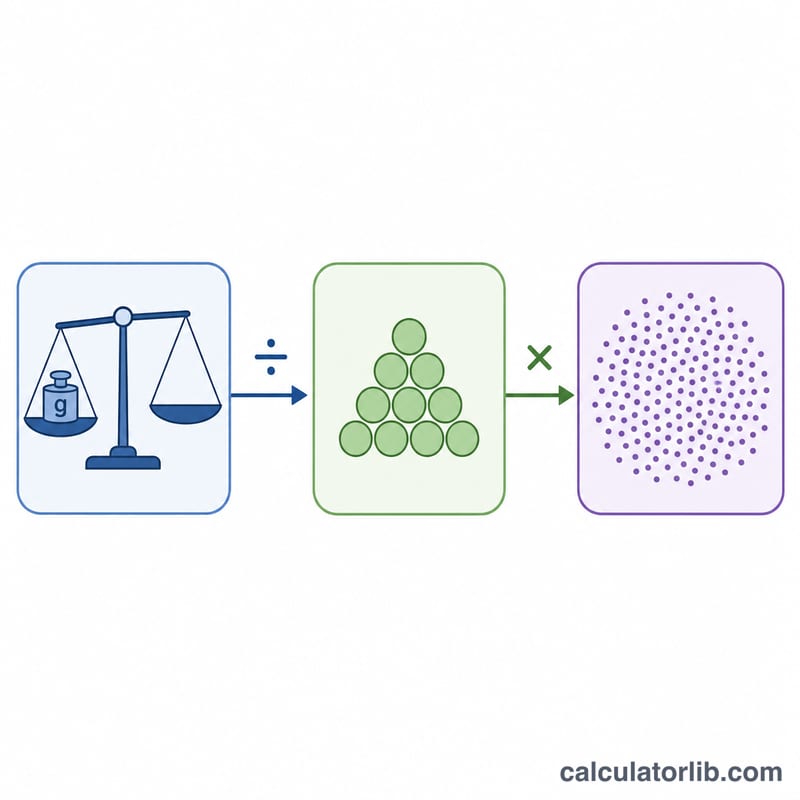
The mole is the SI unit for the amount of a substance. One mole contains exactly Avogadro's number (\(6.02214076 \times 10^{23}\)) of particles — atoms, molecules, ions or electrons. This calculator converts a measured mass into the number of moles using the substance's molar mass, and also reports how many particles that represents.
How to Use It
Enter the mass of your sample in grams and its molar mass in grams per mole. The molar mass is the sum of the atomic masses of every atom in the formula — for example, water (H₂O) is about 18.015 g/mol. The calculator instantly returns the number of moles and the corresponding particle count.
The Formula Explained
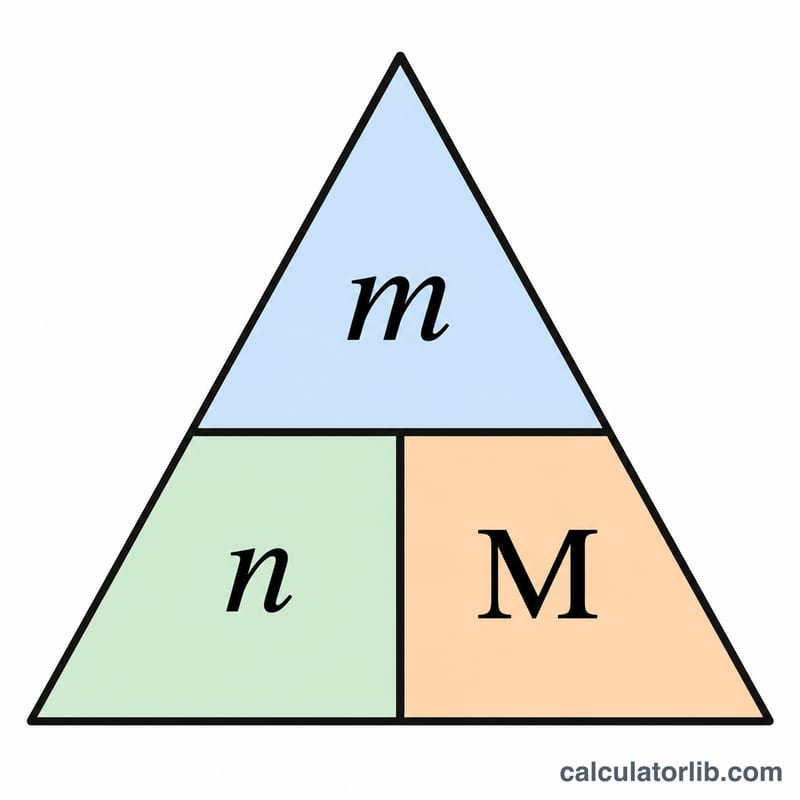
The relationship is $$n = \dfrac{m}{M}$$ where n is moles, m is mass in grams, and M is molar mass in g/mol. Multiplying the moles by Avogadro's number gives the total number of particles: $$N = n \times 6.022 \times 10^{23}$$
Worked Example
Suppose you have 36 g of water with a molar mass of 18.015 g/mol. Then $$n = \frac{36}{18.015} \approx 1.998 \text{ mol}$$ Multiplying by Avogadro's number gives about \(1.203 \times 10^{24}\) molecules of water.
FAQ
Where do I find the molar mass? Add up the atomic masses (from the periodic table) of each atom in the chemical formula.
Can I use it for elements? Yes — use the element's atomic mass as the molar mass (e.g. carbon is 12.011 g/mol).
What if molar mass is zero? Division by zero is undefined, so the calculator returns 0 — always enter a positive molar mass.