
What Is Normality?
Normality (symbol N) is a measure of concentration equal to the number of gram-equivalents of solute dissolved per litre of solution. Unlike molarity, which counts moles, normality counts reactive equivalents — making it especially useful in acid-base titrations, redox reactions, and precipitation chemistry where the reacting capacity of a substance matters more than its raw mole count.
How to Use This Calculator
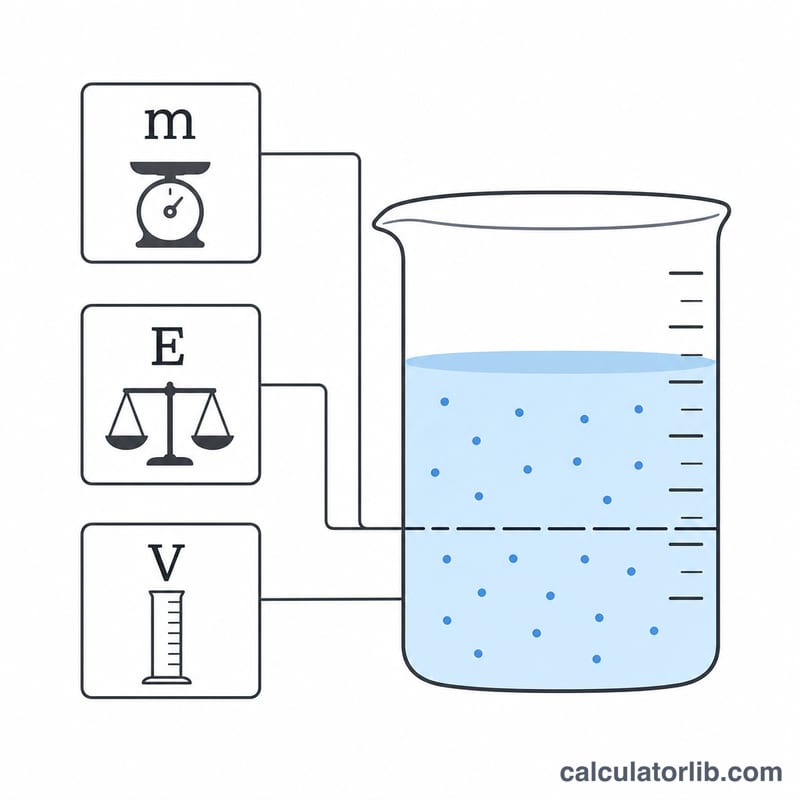
Enter three values: the mass of solute in grams, the equivalent weight of the solute in grams per equivalent, and the total volume of solution in litres. The calculator first finds the gram-equivalents (mass ÷ equivalent weight), then divides by the volume to give normality in N.
The Formula Explained
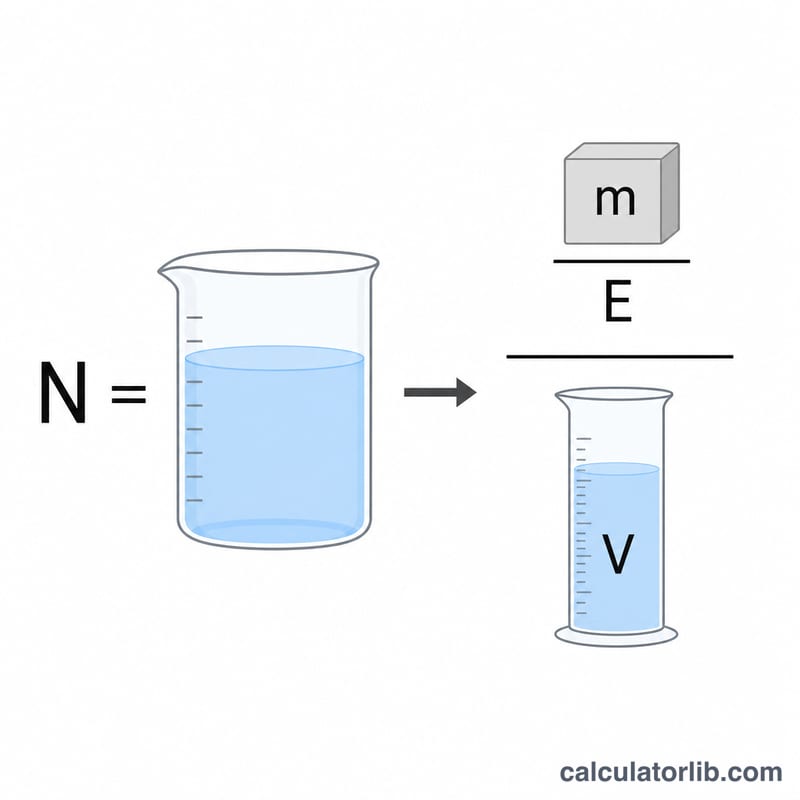
The core relationship is:
$$N = \dfrac{m / E}{V}$$
The equivalent weight is the molar mass divided by the substance's valence factor (number of H⁺ or OH⁻ ions exchanged, or electrons transferred). For example, sulfuric acid (H₂SO₄) has a molar mass of about 98 g/mol and provides 2 hydrogen ions, so its equivalent weight is 49 g/eq.
Worked Example
Suppose you dissolve 40 g of sodium hydroxide (NaOH) in water to make 1 litre of solution. NaOH has an equivalent weight of 40 g/eq. Gram-equivalents = \(40 / 40 = 1\) eq. Normality = \(1 \text{ eq} / 1 \text{ L}\) = 1 N.
FAQ
How is normality different from molarity? Molarity counts moles per litre; normality counts equivalents per litre. They are related by \(N = M \times \text{valence factor}\). For substances with valence factor 1 (like NaOH or HCl), N equals M.
What is equivalent weight? It is the molar mass divided by the number of reactive units (H⁺, OH⁻, or electrons). For Ca(OH)₂ (molar mass ≈ 74 g/mol, 2 OH⁻), the equivalent weight is 37 g/eq.
Can normality change with the reaction? Yes. Because it depends on the valence factor, the same solution can have different normalities for different reactions, especially in redox chemistry.