
What Is the Molarity to Normality Calculator?
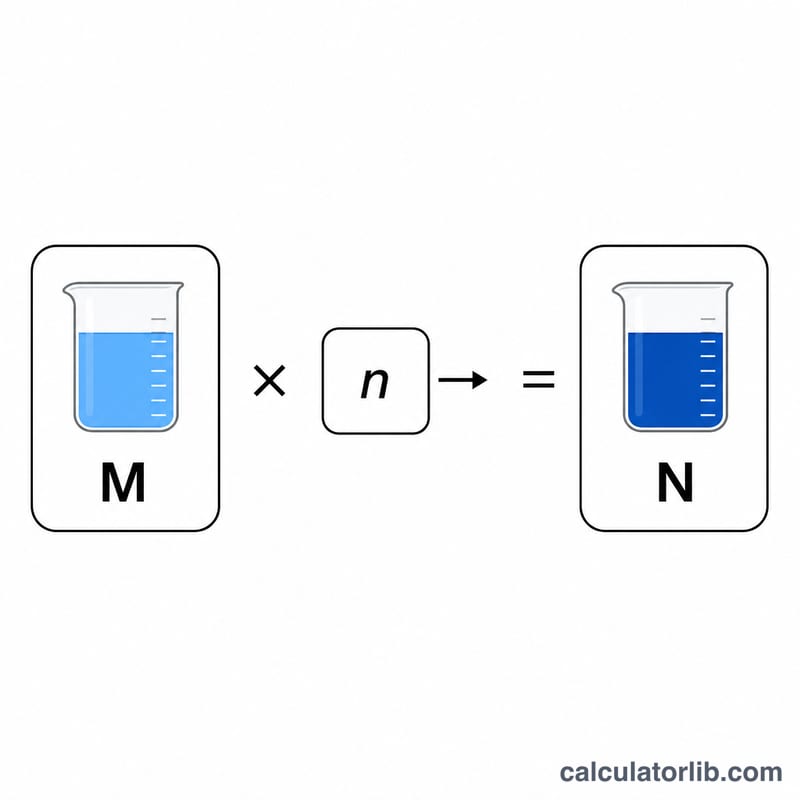
This calculator converts the molarity (M) of a solution into its normality (N). Molarity measures moles of solute per liter, while normality measures the number of reactive equivalents per liter. Because one mole of a substance can supply more than one equivalent (for example, H₂SO₄ provides two H⁺ ions), the two values are related by the equivalence factor n.
How to Use It
Enter the molarity of your solution and the number of equivalents per mole (n) of the solute. The number of equivalents depends on the reaction: for acids it is the number of replaceable H⁺ ions, for bases the number of OH⁻ ions, and for redox or salt reactions the number of electrons or charge transferred per formula unit. The calculator multiplies the two values to return normality.
The Formula Explained
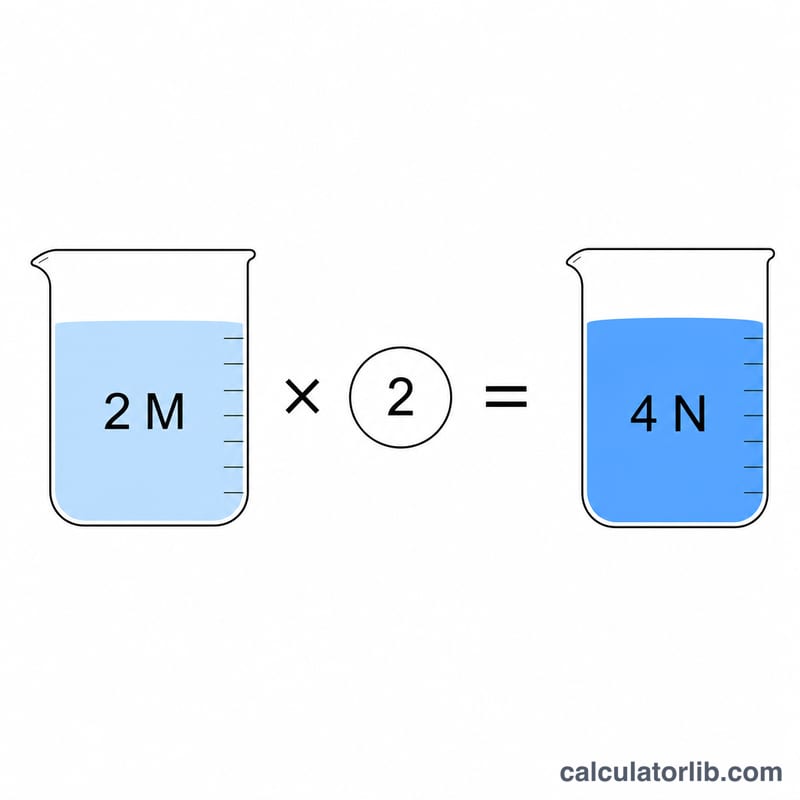
The relationship is simply $$\text{N} = \text{M} \times \text{n}$$ where N is normality (eq/L), M is molarity (mol/L), and n is the number of equivalents per mole. When \(n = 1\) (e.g., HCl, NaOH), molarity and normality are equal. When \(n > 1\) the normality exceeds the molarity.
Worked Example
Suppose you have a 1.5 M solution of sulfuric acid (H₂SO₄), which provides 2 equivalents (2 H⁺) per mole. Then $$\text{N} = 1.5 \times 2 = 3.0 \ \text{N}$$ A 0.25 M phosphoric acid (H₃PO₄, n = 3) solution has a normality of $$0.25 \times 3 = 0.75 \ \text{N}$$
FAQ
Are molarity and normality ever the same? Yes — whenever \(n = 1\), such as HCl, HNO₃, NaOH, or KOH.
How do I find n? It is the number of reactive units (H⁺, OH⁻, or electrons/charge) per formula unit in the specific reaction. The same compound can have different n in different reactions.
Why is normality used? Normality simplifies stoichiometry in titrations because equal volumes of solutions with equal normality react completely with each other.