
What Is the Heat Transfer Rate Calculator?
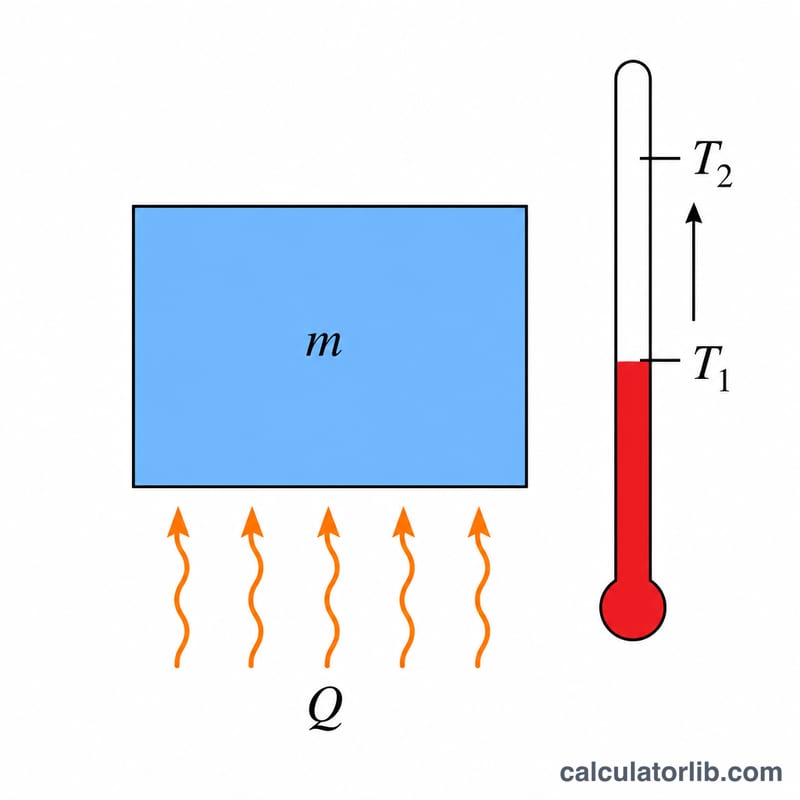
This calculator finds the amount of heat energy Q that must be added to or removed from a substance to change its temperature. It uses the classic sensible-heat equation \(Q = m \cdot c \cdot (T_2 - T_1)\), where the heat depends on how much material you have, what it is made of, and how big a temperature swing you want. The result is given in both joules (J) and kilojoules (kJ).
How to Use It
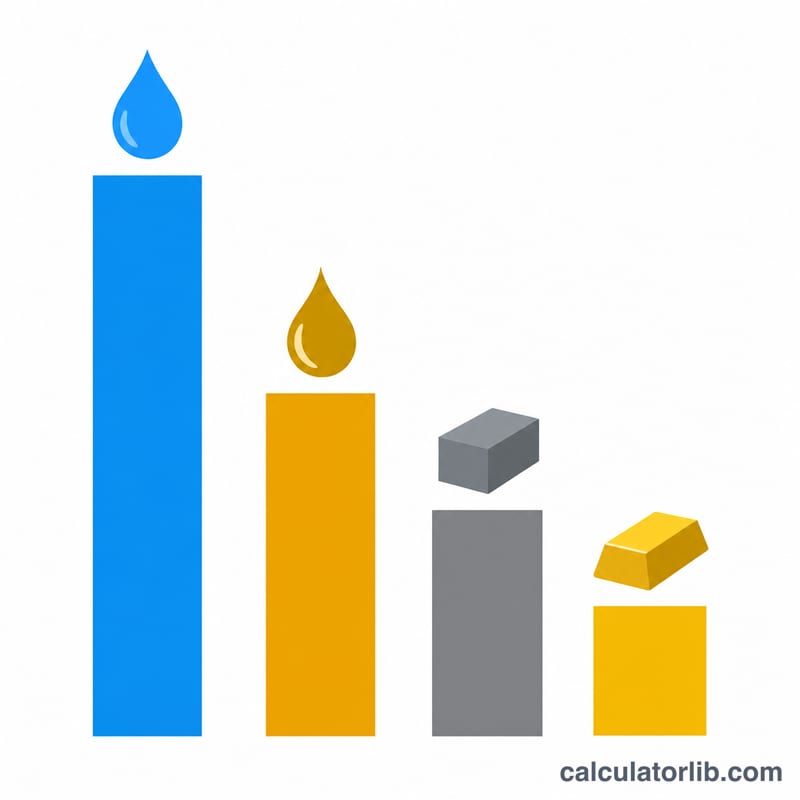
Enter the mass of the substance in kilograms, its specific heat capacity \(c\) in J/kg·°C (water is 4186, aluminium ≈ 900, copper ≈ 385), the initial temperature \(T_1\), and the final temperature \(T_2\). A positive \(Q\) means heat is absorbed (heating up); a negative \(Q\) means heat is released (cooling down).
The Formula Explained
$$Q = m \cdot c \cdot \Delta T$$ Mass scales the energy linearly, specific heat tells you how much energy each kilogram needs per degree, and \(\Delta T = T_2 - T_1\) is the temperature change. The equation applies only when no phase change (melting, boiling) occurs — those require latent heat instead.
Worked Example
Heat 2 kg of water (\(c = 4186\) J/kg·°C) from 20 °C to 80 °C. \(\Delta T = 60\) °C, so $$Q = 2 \times 4186 \times 60 = 502{,}320 \text{ J} \approx 502.32 \text{ kJ}$$
FAQ
What units should I use? Mass in kilograms and \(c\) in J/kg·°C give \(Q\) in joules. Keep units consistent.
Can ΔT be in Kelvin? Yes — a change of 1 °C equals a change of 1 K, so the numeric \(\Delta T\) is identical.
What if there is a phase change? This formula covers only sensible heat. Melting or boiling needs the latent heat formula \(Q = m \cdot L\).