What Is the Overdraft Fee Calculator?
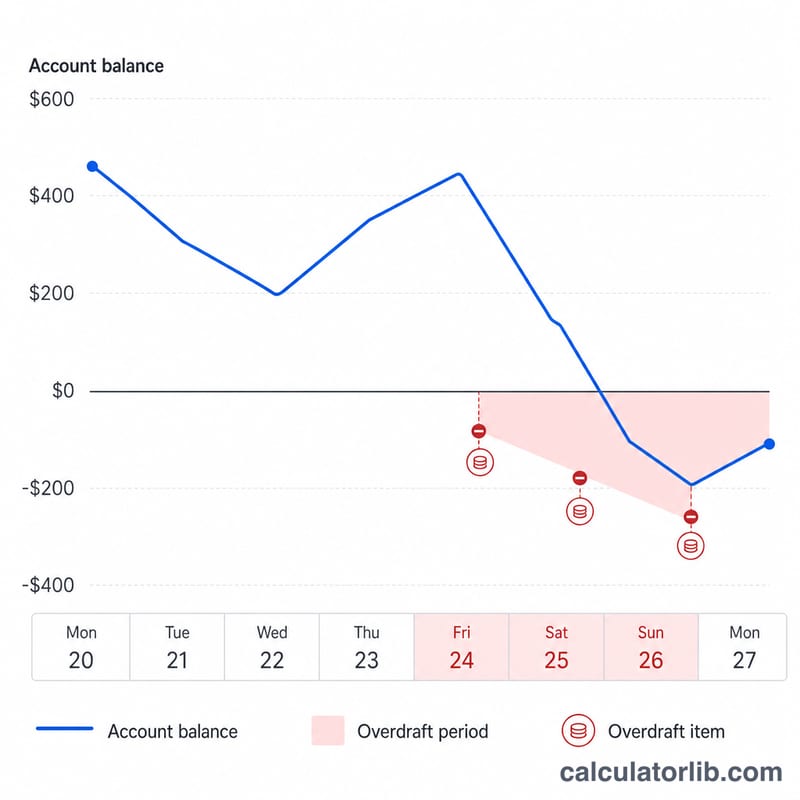
An overdraft occurs when a transaction is paid even though your account balance is too low to cover it. Banks typically charge a flat fee for each item they cover (the per-item or "non-sufficient funds" fee) and may add an extended or "sustained" overdraft fee for every day the account remains negative. This calculator adds both charge types together so you can see the true cost of an overdrawn account.
How to Use It
Enter the number of overdraft items the bank covered, the fee charged per item, the number of days your account stayed negative, and any daily extended overdraft fee. The tool multiplies and sums these to show your total estimated fees, broken down by per-item charges and daily charges.
The Formula Explained
The calculation is straightforward:
$$\text{Total Fees} = \left(\text{Items} \times \text{Fee/Item}\right) + \left(\text{Days Negative} \times \text{Daily Fee}\right)$$
The first term covers each individual transaction the bank honored while you were short. The second term reflects ongoing penalties some banks apply for each day you don't bring the balance positive.
Worked Example
Suppose your bank covered 3 overdraft items at $35 each, and your account stayed negative for 5 days with a $7 daily extended fee. Per-item fees = \(3 \times \$35 = \$105\). Extended fees = \(5 \times \$7 = \$35\). Total = \(\$105 + \$35 =\) $140.
Overdraft Terms Glossary
Overdraft rules and fee names vary by bank and by country. The terms below describe common practice, especially in the United States, but your own account agreement and published fee schedule always take precedence.
- Overdraft item
- A single transaction (a debit card purchase, check, ACH payment, or ATM withdrawal) that the bank pays even though your available balance is too low to cover it. In this calculator, each such transaction is one "item" (the num_overdrafts field).
- Per-item fee
- The flat charge a bank applies for each overdraft item it pays (the fee_per_item field). In the US, many large banks have charged around $30 to $35 per item, though some have lowered or eliminated this fee. Check your own schedule rather than assuming a typical figure.
- NSF fee (non-sufficient funds)
- A fee charged when the bank declines or returns a transaction because of insufficient funds, rather than paying it. An NSF fee is separate from an overdraft fee, and some banks charge it while others do not. If you want to include NSF charges, you can count them as items at their own fee amount, or run them separately.
- Extended (sustained) overdraft fee
- A recurring charge applied when an account stays negative for a set number of days. It is often charged per day (the daily_extended_fee field) after the account has been overdrawn for a stated period, such as several consecutive business days. Not every bank charges it.
- Negative balance days
- The number of days the account stays below zero and is subject to the extended fee (the days_negative field). Use only the days the fee actually applies, which may exclude an initial grace period, weekends, or holidays depending on the bank.
- Overdraft protection / linked-account transfer
- An arrangement where the bank covers a shortfall by automatically moving money from a linked savings account, another checking account, or a credit line. Transfer fees are usually lower than per-item overdraft fees, and some banks charge nothing, but terms differ. Any such fee should be entered based on your fee schedule.
- Grace period
- A window of time, or a small shortfall threshold, during which the bank does not charge a fee if you bring the balance back above zero. Examples include a cushion on the overdrawn amount or until the end of the next business day. Not all banks offer one.
Caps and limits: Many banks limit how many overdraft fees they charge per day (for example, a maximum number of fees per day), set a daily dollar cap, or waive fees on very small overdrafts. The calculator multiplies items by the fee and adds days times the daily fee, so it does not apply caps automatically. To get an accurate estimate, take your inputs from the bank's published fee schedule and adjust the item count to reflect any daily limit.
This is general information, not financial advice. Confirm the details with your bank.
FAQ
Can overdraft fees be reversed? Yes — many banks will waive a fee on request, especially for first-time or rare overdrafts. It is always worth calling customer service.
What is the difference between an overdraft fee and an NSF fee? An overdraft fee is charged when the bank pays a transaction despite low funds; an NSF (non-sufficient funds) fee is charged when the bank declines it. Either way you can plug the per-item charge into this calculator.
Does this apply to my country? The math is universal, but fee structures and consumer-protection rules vary by bank and country. Use your own bank's published fee schedule for the input values.