
What Are Degree Days?
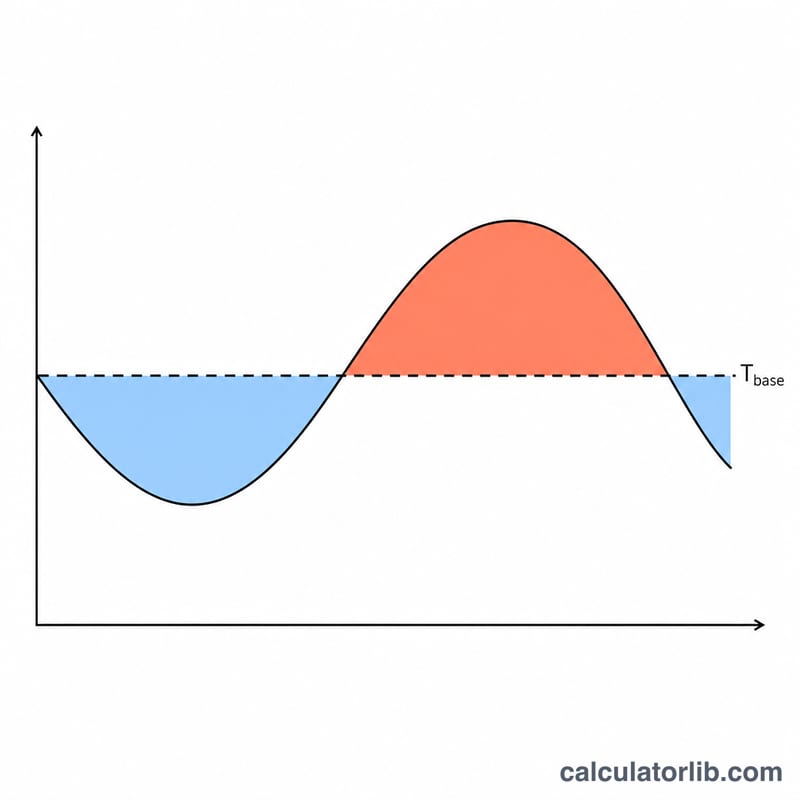
Degree days measure how much, and for how long, the outside air temperature differs from a chosen base temperature (often 65°F or 18°C). They are a simple, widely used proxy for building energy demand: Heating Degree Days (HDD) estimate the need for heating on cold days, while Cooling Degree Days (CDD) estimate the need for air conditioning on warm days. Utilities, engineers, and energy analysts use them to normalize energy bills against weather and to size HVAC systems.
How to Use This Calculator
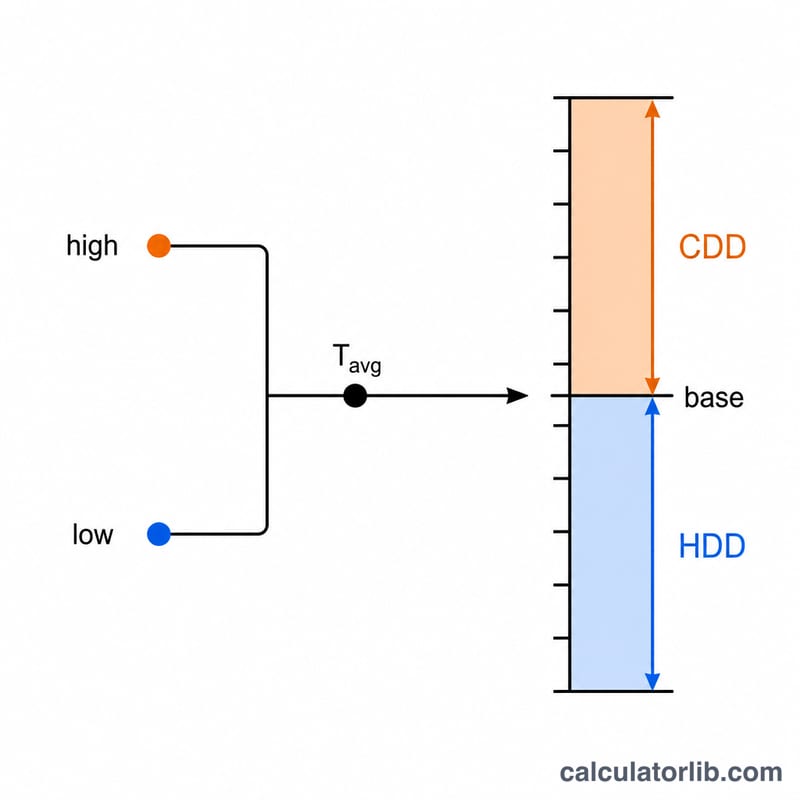
Enter the day's high and low temperature, choose a base temperature, and set the number of days you want to total over. The calculator finds the average temperature, computes HDD and CDD per day, then multiplies by the number of days. Use whatever temperature scale you prefer — just keep all inputs in the same unit (the common US base is 65°F; the common metric base is 18°C).
The Formula Explained
First the mean daily temperature is found:
$$T_{avg} = \frac{T_{high} + T_{low}}{2}$$Then \(\text{HDD} = \max(0,\; T_{base} - T_{avg})\) and \(\text{CDD} = \max(0,\; T_{avg} - T_{base})\). The \(\max(0, \dots)\) ensures a day never contributes negative degree days — a single day is either a heating day or a cooling day (or neither, when the average equals the base). Each per-day value is multiplied by the number of days for the period total.
Worked Example
Suppose a day has a high of 75° and a low of 55° with a base of 65°. The average is
$$\frac{75 + 55}{2} = 65°$$Since the average equals the base, both HDD and CDD are 0 for that day. Now take a colder day: high 50°, low 30°, base 65°. Average = 40°, so
$$\text{HDD} = 65 - 40 = 25 \quad\text{and}\quad \text{CDD} = 0$$Over 7 such days, HDD total = 175.
FAQ
What base temperature should I use? 65°F (18.3°C) is the traditional standard, based on the idea that buildings need no heating or cooling near this outdoor temperature. Some analyses use 60°F or 18°C.
Can a day count as both HDD and CDD? No. With a single daily average, a day contributes to one or the other (or neither), never both at once.
Why average the high and low? It's the simplest standard method. More precise methods integrate hourly temperatures, but the high/low average is the common practical approach.