
What Are Heating Degree Days?
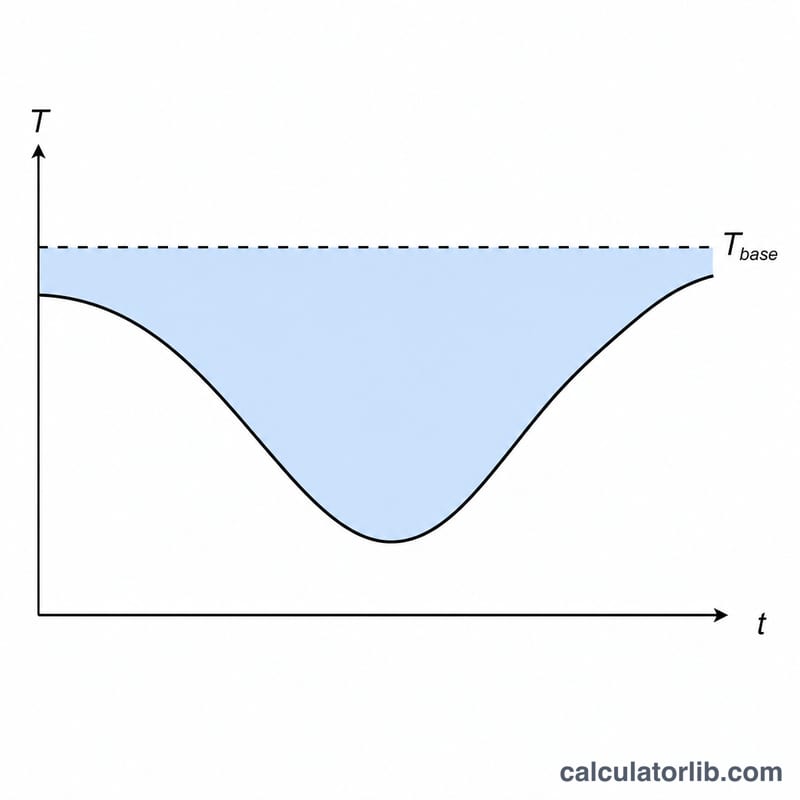
Heating Degree Days (HDD) measure how cold a day is relative to a chosen base (or balance-point) temperature — the outdoor temperature below which a building generally needs heating. The colder the day, the more degree-days accumulate, and the more energy is typically required to keep indoor spaces comfortable. HDD is widely used by utilities, energy analysts, facility managers and weather-normalisation models to compare fuel use across days, months and seasons.
How to Use This Calculator
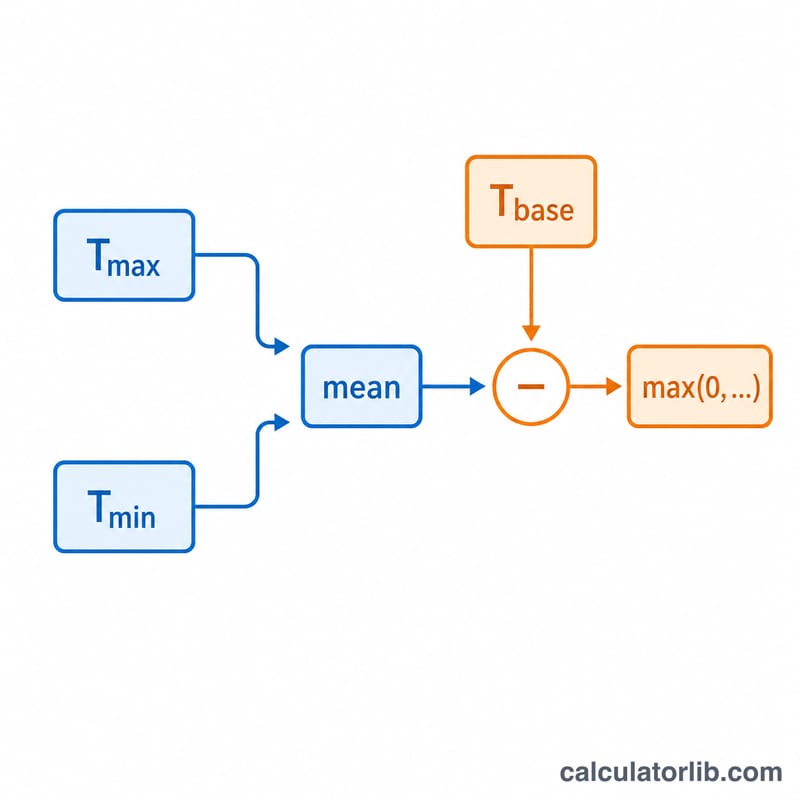
Enter the day's high temperature, low temperature and your base temperature, all in the same units (this tool uses °C, but the math is unit-agnostic — use °F values if you prefer °F degree-days). The calculator finds the mean daily temperature, subtracts it from the base, and clamps the result at zero so warm days never produce negative HDD.
The Formula Explained
The mean–temperature method estimates the daily average as \(\frac{T_{\max} + T_{\min}}{2}\). Heating Degree Days equal the base temperature minus that mean, but only when the mean is below the base:
$$\text{HDD} = \max\left(0,\ T_{\text{base}} - \frac{T_{\max} + T_{\min}}{2}\right)$$
If the average temperature is at or above the base, no heating is assumed and \(\text{HDD} = 0\).
Worked Example
Suppose the base temperature is 18 °C, the daily high is 10 °C and the daily low is 2 °C. The mean temperature is $$\frac{10 + 2}{2} = 6\ \text{°C}.$$ Then $$\text{HDD} = 18 - 6 = 12\ \text{degree-days}.$$ To estimate a month's total, simply add each day's HDD together.
FAQ
What base temperature should I use? A common default is 18 °C (about 65 °F), but the ideal base depends on a building's insulation, occupancy and internal heat gains. Utilities often publish the base they use.
Can HDD be negative? No. On days warmer than the base temperature, HDD is set to zero, since no heating is needed.
How do I get monthly or seasonal HDD? Compute HDD for each day and sum them. Higher seasonal totals indicate colder periods and generally higher heating energy use.