
What Is the Coriolis Force?
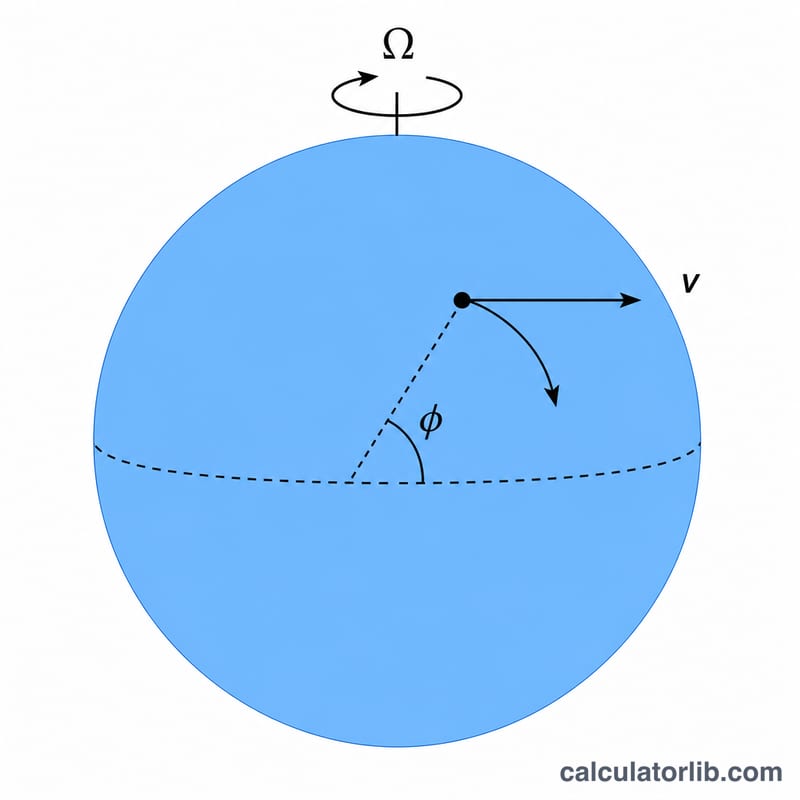
The Coriolis force is an apparent (inertial) force that acts on objects moving within a rotating reference frame — most familiarly the rotating Earth. It deflects moving air, water and projectiles to the right in the Northern Hemisphere and to the left in the Southern Hemisphere. While it is a fictitious force (it arises from the rotation of the frame rather than a physical push), its effects are very real: it shapes weather systems, ocean currents and long-range artillery trajectories.
The Formula
This calculator uses the horizontal Coriolis force magnitude:
$$F_c = 2 \cdot m \cdot v \cdot \Omega \cdot \sin(\varphi)$$
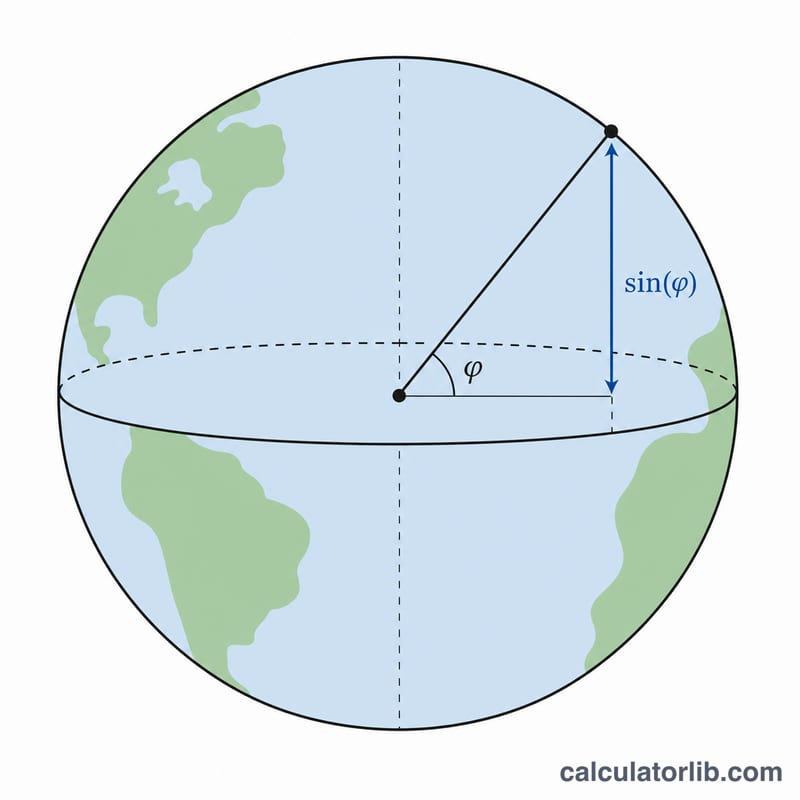
where m is the object's mass in kilograms, v is its speed in metres per second, Ω is Earth's angular velocity (\(7.292\times10^{-5}\) rad/s, one rotation per sidereal day), and φ is the latitude in degrees. The factor \(\sin(\varphi)\) means the effect vanishes at the equator (\(\varphi = 0\)) and is strongest at the poles (\(\varphi = \pm90°\)).
How to Use It
Enter the mass of the moving object, its velocity, and the latitude where it is moving. The calculator returns the Coriolis force in newtons, along with the mass-independent Coriolis acceleration (\(a_c = 2v\Omega\sin\varphi\)).
Worked Example
A 1000 kg object moving at 100 m/s at latitude 45°: \(\sin(45°) \approx 0.70711\), so $$F_c = 2 \times 1000 \times 100 \times 7.292\times10^{-5} \times 0.70711 \approx 10.31 \text{ N}.$$ The corresponding acceleration is about \(0.01031 \text{ m/s}^2\) — small per second, but it accumulates significantly over long distances and times.
FAQ
Why doesn't the Coriolis force affect my draining sink? At household scales the Coriolis acceleration is utterly tiny compared with other influences (basin shape, residual motion), so it does not determine drain direction.
Does it depend on direction of motion? This calculator gives the maximum horizontal magnitude. The actual deflection direction is always perpendicular to the velocity, and the precise component depends on heading; here we use the standard horizontal magnitude \(2mv\Omega\sin\varphi\).
What value of Ω is used? Earth's sidereal angular velocity, \(7.292\times10^{-5}\) rad/s.