
What is the Dry Adiabatic Lapse Rate?
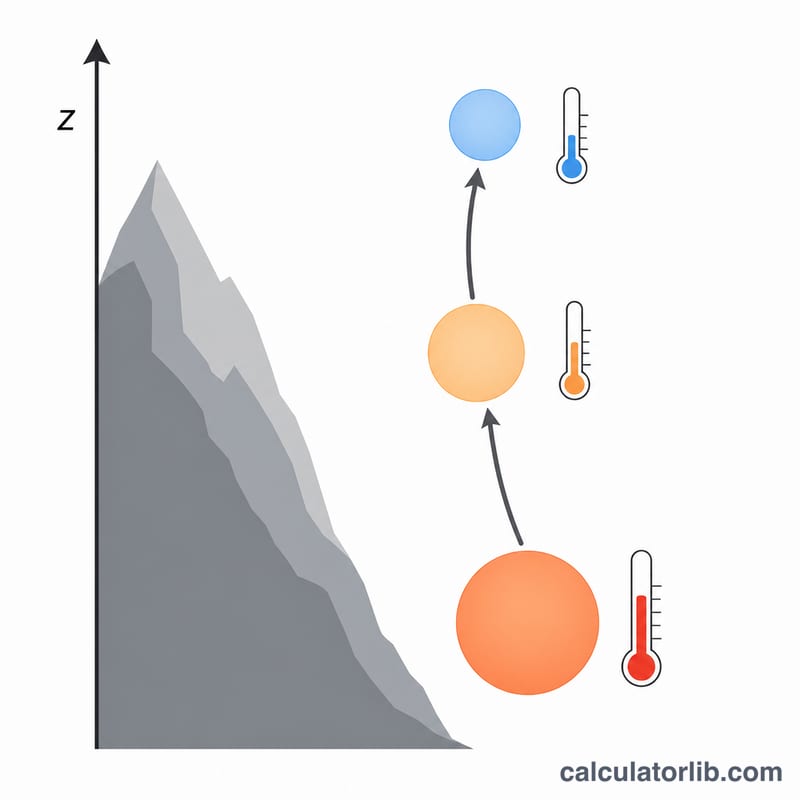
The dry adiabatic lapse rate (DALR) describes how the temperature of a parcel of unsaturated air changes as it rises or sinks in the atmosphere with no exchange of heat with its surroundings. Because rising air expands and cools, dry air loses about 9.8 °C for every 1000 metres it climbs — and gains the same amount when it descends. This value is a universal physical constant derived from gravity and the specific heat of air, so the calculator applies anywhere on Earth.
How to Use the Calculator
Enter the surface (or starting) temperature in °C, the starting altitude in metres, and the target altitude you want the temperature for. The calculator computes the altitude change, multiplies it by the lapse rate, and returns the temperature at the target height. Use a higher target altitude to model a rising parcel (cooling) or a lower one to model descent (warming, as in foehn or chinook winds).
The Formula Explained
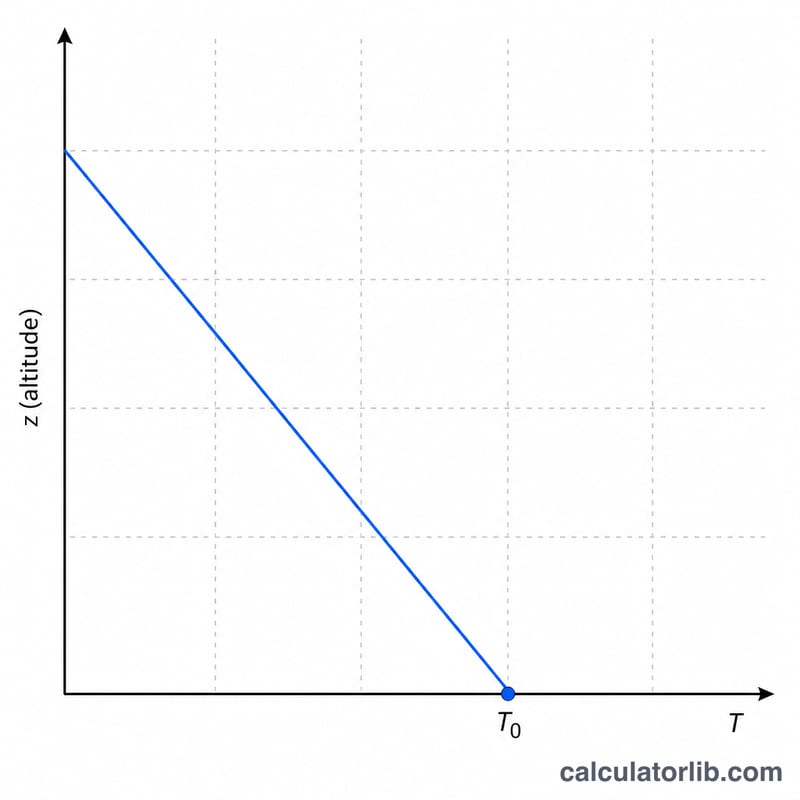
The governing equation is $$T = T_0 - 9.8 \times \frac{\Delta z}{1000}$$ where \(T_0\) is the starting temperature, \(\Delta z\) is the altitude difference in metres, and 9.8 is the dry lapse rate in °C per kilometre. The rate itself comes from \(\Gamma_d = \frac{g}{c_p}\), with \(g \approx 9.81\ \text{m/s}^2\) and \(c_p \approx 1005\ \text{J/(kg}\cdot\text{K)}\), giving roughly 9.8 °C per km.
Worked Example
Suppose the surface temperature is 20 °C at sea level (0 m) and we want the temperature of a dry parcel lifted to 1500 m. The altitude change is 1500 m, so $$\Delta T = -9.8 \times \frac{1500}{1000} = -14.7\ \text{°C}$$ The final temperature is \(20 - 14.7 = \mathbf{5.3\ \text{°C}}\).
Definitions & Glossary
- Adiabatic process
- A thermodynamic change in which no heat is exchanged with the surroundings. Temperature changes occur solely through expansion (cooling) or compression (warming) of the parcel.
- Air parcel
- An imaginary small volume of air treated as a discrete unit that retains its identity, used to track temperature, pressure and moisture as it moves vertically.
- Dry adiabatic lapse rate (\(\Gamma_d\))
- The rate at which an unsaturated (no condensation) air parcel cools as it rises, ≈ 9.8 °C per 1000 m. It applies equally to warming during descent.
- Saturated / moist adiabatic lapse rate (\(\Gamma_m\))
- The slower cooling rate of a rising parcel once it is saturated and water vapor is condensing, ≈ 5 °C/km on average, because latent heat release counteracts adiabatic cooling.
- Environmental lapse rate (\(\Gamma_e\))
- The actual measured change of temperature with height in the surrounding atmosphere at a given time and place, averaging ≈ 6.5 °C/km in the standard atmosphere. Comparing it to the adiabatic rates determines atmospheric stability.
- Foehn / chinook wind
- A warm, dry downslope wind. Air rises and cools (often losing moisture as precipitation), then descends the lee side, warming at the dry adiabatic rate, arriving warmer and drier than at the same altitude on the windward side.
- \(T_0\)
- The starting (surface or reference) air temperature, in °C, at the starting altitude.
- \(\Delta z\)
- The change in altitude, \(z_1 - z_0\), in meters. Positive for ascent (cooling), negative for descent (warming).
- \(\Gamma_d\)
- Symbol for the dry adiabatic lapse rate, 9.8 °C/km, used as the multiplier in the temperature formula.
FAQ
Why 9.8 and not the environmental 6.5 °C/km? The 9.8 °C/km figure is the dry adiabatic rate for a moving parcel. The average environmental lapse rate (~6.5 °C/km) describes the actual atmosphere and includes moisture and mixing effects.
What about saturated (cloudy) air? Once condensation occurs, latent heat slows the cooling to the moist adiabatic rate (~5 °C/km). This tool covers only the dry case.
Can I model descending air? Yes — set the target altitude lower than the starting altitude and the air will warm by 9.8 °C per 1000 m of descent.