
What this paint calculator does
This calculator estimates how many gallons of paint you need to cover the walls of a room. It works out the total wall surface from your room's length, width and ceiling height, subtracts the area taken up by doors and windows, multiplies by the number of coats you plan to apply, and then divides by how many square feet a single gallon covers. Coverage is assumed in square feet and dimensions in feet — any consistent units work the same way.
How to use it
Enter the room's length and width along the floor, plus the wall height. Add the number of doors and windows so their surface can be deducted (we assume a standard 21 sq ft per door and 15 sq ft per window). Choose how many coats you want — two is typical for good coverage and color depth. Finally enter the coverage rating from your paint can; most interior paints cover about 350 sq ft per gallon, though textured walls cover less.
The formula explained
The wall perimeter is \(2 \times (\text{length} + \text{width})\). Multiplying by height gives the gross wall area. We subtract door and window areas to get the net paintable area, then multiply by the number of coats. Dividing that by the per-gallon coverage gives the number of gallons. Because paint is sold in whole gallons (and quarts), always round up your purchase.
$$G = \frac{\left[\,2\,(L+W)\cdot H - D\,\right]\times \text{Coats}}{\text{Coverage (sq ft)}}$$ $$\text{where}\quad \left\{ \begin{aligned} L &= \text{Length (ft)} \\ W &= \text{Width (ft)} \\ H &= \text{Wall Height (ft)} \\ D &= 21\,\text{Doors} + 15\,\text{Windows} \end{aligned} \right.$$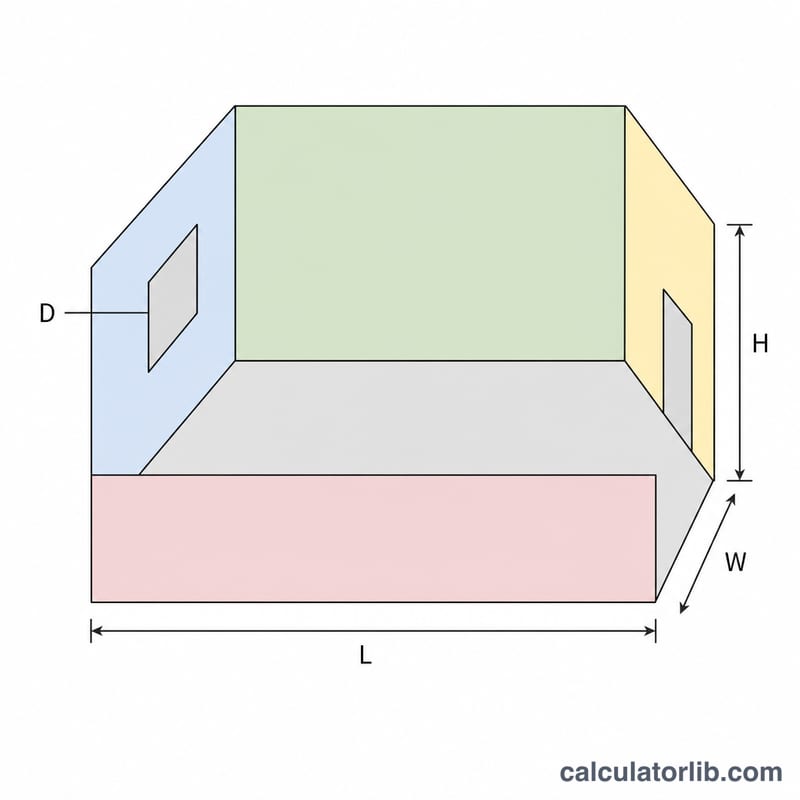
Worked example
A 12 ft × 10 ft room with 8 ft walls has a perimeter of \(2 \times (12 + 10) = 44\) ft, so the gross area is \(44 \times 8 = 352\) sq ft. With 1 door (21 sq ft) and 1 window (15 sq ft), deductions total 36 sq ft, leaving 316 sq ft. Two coats need \(316 \times 2 = 632\) sq ft of coverage. At 350 sq ft per gallon, that's \(632 \div 350 \approx 1.81\) gallons — so buy 2 gallons.
Paint Coverage by Surface and Paint Type
A gallon of paint covers a finite area, and how far it stretches depends mostly on the texture and porosity of the surface. Manufacturers usually quote around 350–400 sq ft per gallon, but rough or unsealed surfaces drink up far more paint. Use the value that best matches your walls in the coverage field of the calculator.
| Surface / Paint Type | Approx. coverage per gallon | Notes |
|---|---|---|
| Smooth, previously painted drywall | ~400 sq ft | Best case; one coat goes furthest on a sealed, smooth wall. |
| Primed walls (new primer coat) | ~350 sq ft | A safe default for most interior rooms. |
| Lightly textured walls | ~300 sq ft | Orange-peel or knockdown texture adds surface area. |
| Heavily textured walls | ~250 sq ft | Popcorn or stucco-style finishes; expect higher consumption. |
| Bare / porous surfaces (new drywall, raw wood, masonry) | ~200–250 sq ft | Prime first to seal, or the first coat will absorb unevenly. |
| Primer (interior) | ~200–300 sq ft | Often thinner coverage than topcoat; check the can label. |
Color changes matter: going from a dark wall to a light one (or covering a bold accent color) commonly needs an extra coat, or a tinted primer, to fully hide the old color. Set coats to 3 in those cases, or prime first.
Paint Needed for Common Room Sizes
The table below assumes 8 ft wall height, two coats, 350 sq ft per gallon coverage, and subtracts one door (21 sq ft) and two windows (30 sq ft) per room. Net wall area is the painted surface; gallons are rounded up to the nearest whole can. Formula: \(G = \dfrac{[\,2(L+W)\cdot H - D\,]\times \text{Coats}}{\text{Coverage}}\).
| Room size (ft) | Gross wall area (sq ft) | Openings deducted | Net wall area (sq ft) | Gallons (2 coats, rounded up) |
|---|---|---|---|---|
| 10 × 10 | 320 | 51 | 269 | 2 |
| 12 × 12 | 384 | 51 | 333 | 2 |
| 12 × 14 | 416 | 51 | 365 | 3 |
| 15 × 20 | 560 | 51 | 509 | 3 |
A typical bedroom needs 1–2 gallons for two coats, while a large living room can require 3 gallons. If your walls are textured or you are making a big color change, recalculate with a lower coverage value or an extra coat.
How Much Paint to Buy
- Round up to the next whole gallon. Paint is sold by the can, and running out mid-wall is far more costly (in time and color matching) than a little leftover.
- Add about 10% extra for touch-ups, spills, second-coat absorption, and corners or trim that consume more than the math suggests.
- "Box" your paint. If you buy more than one can of the same color, pour them all into one large bucket and stir before starting. Slight batch-to-batch tint differences disappear, so your walls stay a uniform color.
- Buy ceiling and trim paint separately. This calculator estimates wall paint only. Ceilings use a flat ceiling paint, and trim/doors use a more durable semi-gloss or satin — budget those as their own line items.
- Keep the leftovers. Seal the can tightly and label it with the room and color name. A small amount of the exact paint makes future repairs and scuff touch-ups invisible.
This is general guidance for estimating purposes. Always check the coverage and recoat times printed on your specific paint can, and test a small area first when matching or changing colors.
FAQ
Does this include the ceiling? No — it estimates wall paint only. Calculate the ceiling separately as length × width.
How much should I buy? Round the result up to the next whole gallon, and keep a little extra for touch-ups.
Why does coverage vary? Smooth, primed walls cover more area; porous, textured, or dark-to-light color changes cover less, so check your paint can's stated coverage.