
What this paint calculator does
This tool estimates how many gallons of paint you need to cover a room or surface. It takes the total wall area, subtracts the area of doors and windows you won't paint, multiplies by the number of coats, and divides by how much area one gallon covers. The result is shown both as the exact gallons required and rounded up to the nearest whole gallon — because you can only buy paint in whole cans.
How to use it
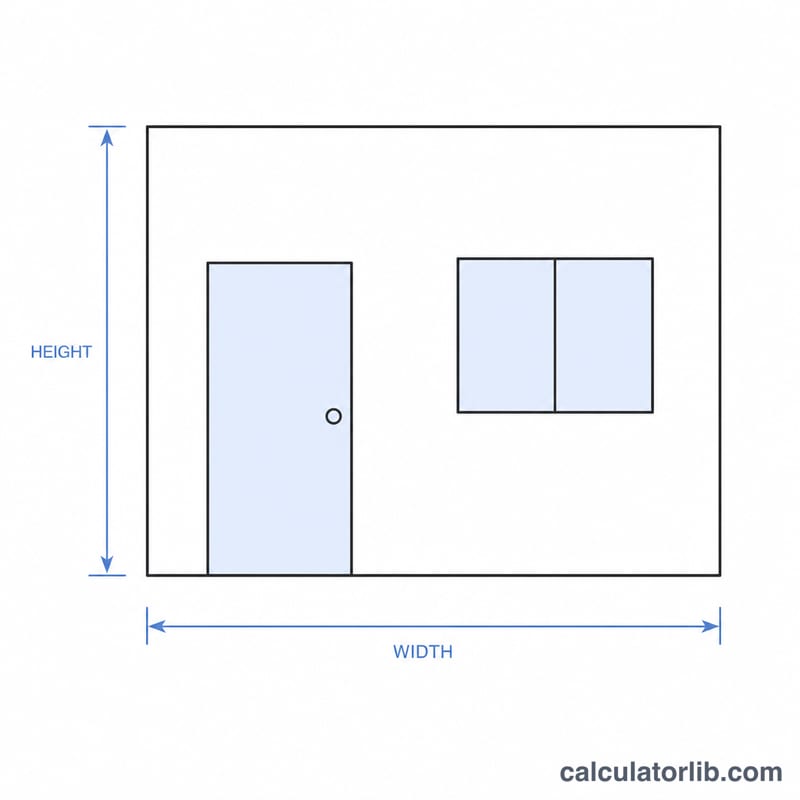
Measure each wall (height × width) and add them up for the total wall area. Estimate the combined area of doors and windows (a standard door is roughly 21 sq ft, a window about 15 sq ft) and enter that as openings. Choose how many coats you plan to apply — two is typical for good coverage or a color change. Coverage defaults to 350 sq ft per gallon, the industry average; check your paint can and adjust if needed (rough or porous surfaces cover less).
The formula explained
The calculation is gallons = (wall area − openings) × coats ÷ coverage. Subtracting openings avoids buying paint for surfaces you skip. Multiplying by coats accounts for each pass over the wall. Dividing by coverage converts square feet into cans.
Worked example
A room has 900 sq ft of wall, with 60 sq ft of doors and windows. You want 2 coats at 350 sq ft per gallon. Paintable area = 900 − 60 = 840 sq ft. Total area = 840 × 2 = 1,680 sq ft. Gallons = 1,680 ÷ 350 = 4.8 gallons, so you'd buy 5 gallons.
Paint Coverage by Type and Surface
Coverage tells you how many square feet a single gallon will cover in one coat. Manufacturers commonly quote 350–400 sq ft per gallon for interior wall paints, but the real figure depends heavily on the surface and how thickly the paint is applied.
| Product | Typical coverage (sq ft / gallon, 1 coat) | Notes |
|---|---|---|
| Flat / matte | 350–400 | Best hide; good on imperfect walls |
| Eggshell | 350–400 | Slight sheen, washable |
| Satin | 350–400 | Good for high-traffic rooms |
| Semi-gloss | 350–400 | Trim, kitchens, baths |
| Primer / sealer | 200–300 | Soaks into porous surfaces |
Surface adjustments
| Surface condition | Effective coverage adjustment |
|---|---|
| Smooth, previously painted | Full quoted coverage (≈400 sq ft) |
| New / unprimed drywall | Reduce ~10–20% (more porous) |
| Porous masonry, raw plaster | Reduce ~20–30%; prime first |
| Textured (knockdown, orange peel) | Reduce ~20–30% (more surface area) |
| Heavy texture / popcorn / stucco | Reduce 30–50% |
When unsure, use a conservative figure such as 350 sq ft per gallon so you do not run short mid-job.
Standard Door & Window Sizes to Subtract
Subtract the area of doors and windows from your gross wall area before calculating paint, since those openings are not painted. Standard sizes below give an approximate square-foot deduction for each.
| Opening | Typical size (W × H) | Area to deduct (sq ft) |
|---|---|---|
| Interior door | 2 ft 8 in × 6 ft 8 in | ≈ 18 |
| Interior door (wide) | 3 ft × 6 ft 8 in | ≈ 20 |
| Exterior / entry door | 3 ft × 6 ft 8 in | ≈ 20 |
| Double / French doors | 5–6 ft × 6 ft 8 in | ≈ 33–40 |
| Small window | 2 ft × 3 ft | ≈ 6 |
| Standard window | 3 ft × 4 ft | ≈ 12 |
| Large / picture window | 4 ft × 5 ft | ≈ 20 |
| Sliding patio door | 6 ft × 6 ft 8 in | ≈ 40 |
A common shortcut is to deduct about 20 sq ft per door and 15 sq ft per average window. For small jobs, many painters skip the deduction entirely as a built-in safety margin.
How Much Paint to Buy
- Round up to the next whole gallon. Paint is sold in whole containers, so if the math says 2.3 gallons, buy 3.
- Add about 10% extra for waste, spills, roller absorption, and future touch-ups. Keeping leftover paint from the same batch ensures a color match later.
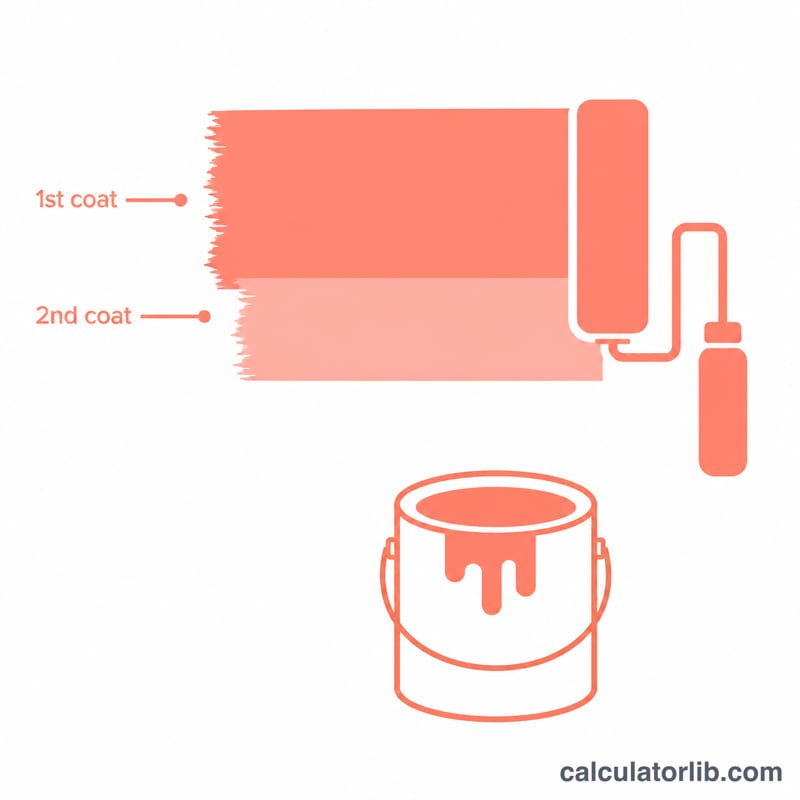
- Plan for two coats. Most projects need two coats for even color and full hide, especially over a different color or with deep/bright tints. Double your one-coat estimate unless repainting the same color on a clean wall.
- Don't forget primer. New drywall, patches, stains, or a drastic color change usually need a separate primer coat. Estimate primer at its own lower coverage (200–300 sq ft/gal).
- Gallons vs. a 5-gallon bucket. Buy individual gallons for small rooms or when you want batch flexibility. A 5-gallon bucket is usually cheaper per gallon and worth it once you need roughly 4 or more gallons of the same color, and it keeps large open areas color-consistent.
This is general guidance; always check the coverage and recoat instructions printed on your specific product's label.
Paint Needed for Common Room Sizes
The estimates below assume 8 ft ceilings, coverage of 350 sq ft per gallon, and a deduction for typical doors and windows. Gallons are rounded up to the next whole container.
| Room | Approx. dimensions | Net wall area (sq ft) | 1 coat | 2 coats |
|---|---|---|---|---|
| Small bedroom | 10 × 10 ft | ≈ 270 | 1 gal | 2 gal |
| Average living room | 14 × 16 ft | ≈ 440 | 2 gal | 3 gal |
| Large great room | 20 × 24 ft | ≈ 660 | 2 gal | 4 gal |
Example for the average living room at 2 coats: \( \lceil (440 \times 2) \div 350 \rceil = \lceil 880 \div 350 \rceil = \lceil 2.51 \rceil = 3 \) gallons. Add ceiling area separately if you plan to paint it, and round up after including your touch-up margin.
FAQ
How much does a gallon of paint cover? Most interior wall paints cover about 350–400 sq ft per gallon on a smooth, primed surface; textured or unprimed walls cover less.
Do I really need two coats? Two coats give the most even, durable finish and are recommended for color changes or fresh drywall. A single refresh of the same color may need only one.
Should I add extra for waste? Rounding up to whole gallons usually provides a buffer, but for large jobs consider keeping a little extra for touch-ups.