What This Calculator Does
The Square Feet per Gallon Paint Calculator estimates how many gallons of paint you should buy for a project. It takes the surface area you want to paint, the coverage rating printed on the paint can, and the number of coats you plan to apply, then returns the number of gallons rounded up to the next whole can.
How to Use It
Enter the total wall or surface area in square feet. Add the coverage per gallon — most interior paints cover 300–400 sq ft per gallon (350 is a common average). Choose how many coats you want, usually two for good color depth and durability. The result tells you how many gallons to purchase.
The Formula Explained
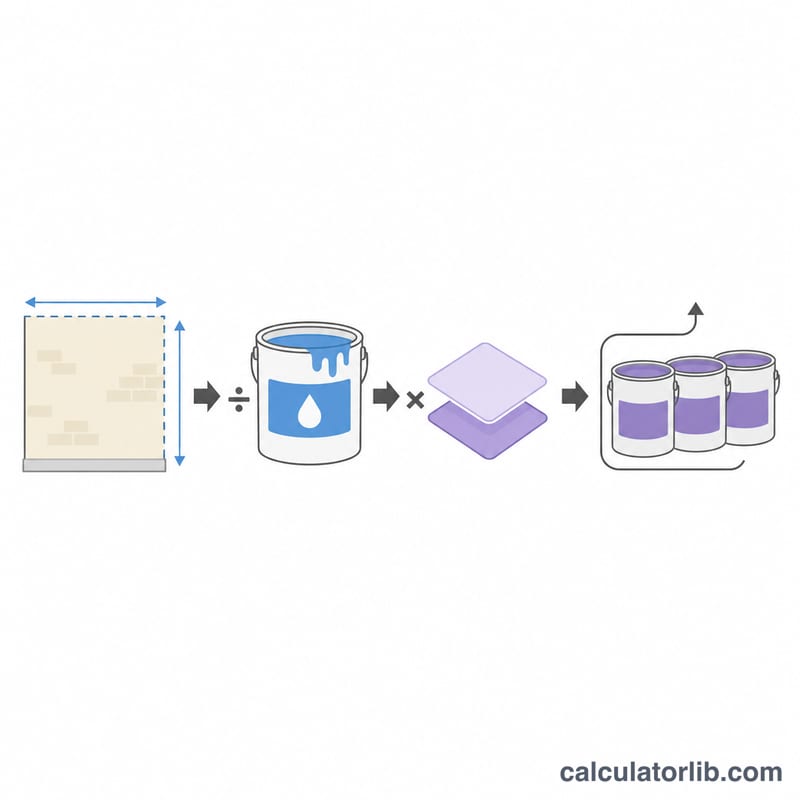
The math is straightforward: divide the area by the coverage per gallon to find gallons for a single coat, multiply by the number of coats, then round up because you cannot buy a fraction of a can.
$$\text{gallons} = \left\lceil \frac{\text{area}}{\text{coverage}} \times \text{coats} \right\rceil$$
Worked Example
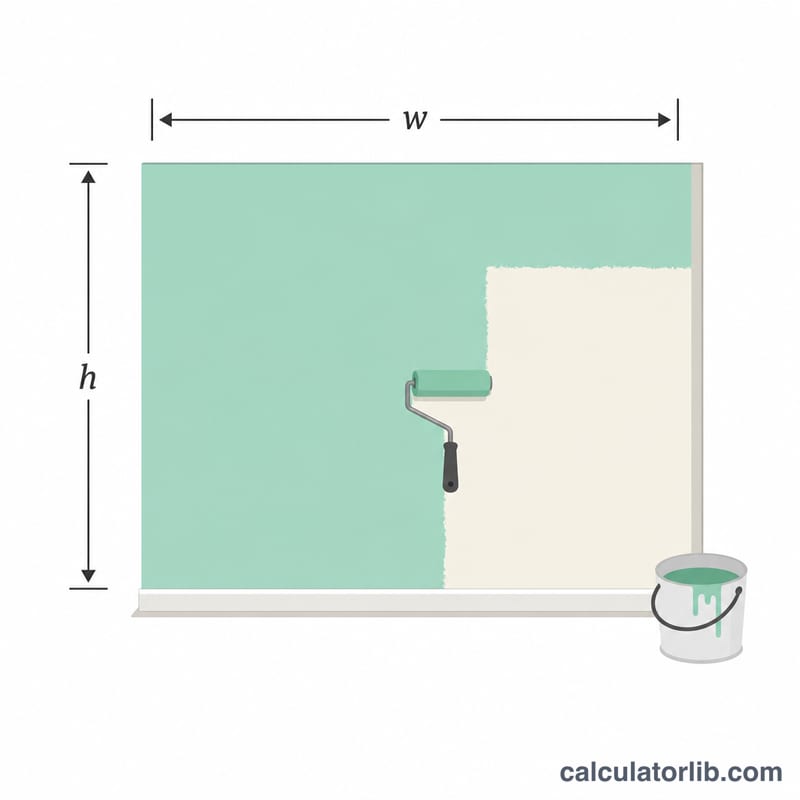
Suppose you have 800 sq ft of wall, paint that covers 350 sq ft per gallon, and you want 2 coats. The exact requirement is $$800 \div 350 \times 2 = 4.57 \text{ gallons}.$$ Rounded up, you should buy 5 gallons of paint.
Typical Paint Coverage by Surface and Paint Type
The table gives approximate coverage in square feet per US gallon (about 3.785 L). Real coverage depends on the product, how porous the surface is, and your application method.
| Surface / Paint Type | Approx. Coverage (sq ft per gallon) |
|---|---|
| Smooth interior walls, standard latex paint | 350–400 |
| Primer | 200–300 |
| Textured or rough drywall | 250–300 |
| Unprimed new drywall | 250–300 |
| Stucco, brick, or masonry | 150–200 |
| Exterior siding | 250–350 |
| Ceilings | 350–400 |
| Trim and doors | 350–400 |
Note: These figures are estimates only. The coverage printed on the manufacturer's can label for your specific product takes precedence, so use that number in the calculator when you have it. The calculator uses \(\lceil \frac{A}{C} \times N \rceil\), where \(A\) is wall area, \(C\) is coverage per gallon, and \(N\) is the number of coats. The result is rounded up to whole gallons.
Practical Tips for Buying Paint
- Buy about 10% extra. The extra covers touch-ups, spills, roller and tray waste, and uneven absorption.
- Subtract openings on large jobs. Deduct the area of doors and windows, roughly 20 sq ft per standard door and 15 sq ft per typical window. On small rooms the savings are often not worth the risk of running short.
- Keep batches consistent. Buy all the paint for a room at the same time. If you need more than one can, mix them together ("box" them) in a larger container before painting to avoid slight color variation between batches.
- Consider primer. New drywall, patched areas, stains, and dramatic color changes (for example dark to light) usually need primer. It often saves a coat of more expensive paint.
- Pick the right container size. Quarts suit small areas and touch-ups, gallons suit most rooms, and 5-gallon pails are usually cheaper per gallon for large or multi-room projects. Compare the per-gallon price before choosing.
- Save leftovers properly. Store leftover paint in a sealed container and label it with the room, color name or code, sheen, and date, so it can be used for touch-ups later.
Paint Needed in Different Scenarios
Each row uses gallons = ⌈(area ÷ coverage) × coats⌉. The raw value is shown before rounding up to whole gallons.
| Wall Area (sq ft) | Coverage (sq ft/gal) | Coats | Calculation | Raw Value | Gallons to Buy |
|---|---|---|---|---|---|
| 150 | 350 | 1 | 150 ÷ 350 × 1 | 0.43 | 1 |
| 400 | 350 | 2 | 400 ÷ 350 × 2 | 2.29 | 3 |
| 800 | 350 | 2 | 800 ÷ 350 × 2 | 4.57 | 5 |
| 1,200 | 300 | 2 | 1,200 ÷ 300 × 2 | 8.00 | 8 |
| 1,200 | 400 | 2 | 1,200 ÷ 400 × 2 | 6.00 | 6 |
The last two rows show how much coverage matters. The same 1,200 sq ft with two coats needs 8 gallons at 300 sq ft/gal but only 6 gallons at 400 sq ft/gal. When a raw value lands exactly on a whole number, consider adding the extra 10% for touch-ups and buying one more gallon.
FAQ
How much area does a gallon of paint cover? Typically 300–400 square feet on a smooth surface for one coat. Rough, porous, or unprimed surfaces cover less.
Do I need to subtract windows and doors? For small projects you can leave them in as a safety margin. For large jobs, subtract their area for a tighter estimate.
Why round up? Paint is sold in whole cans, so the calculator rounds up to ensure you have enough to finish the job without a second trip to the store.