
What this calculator does
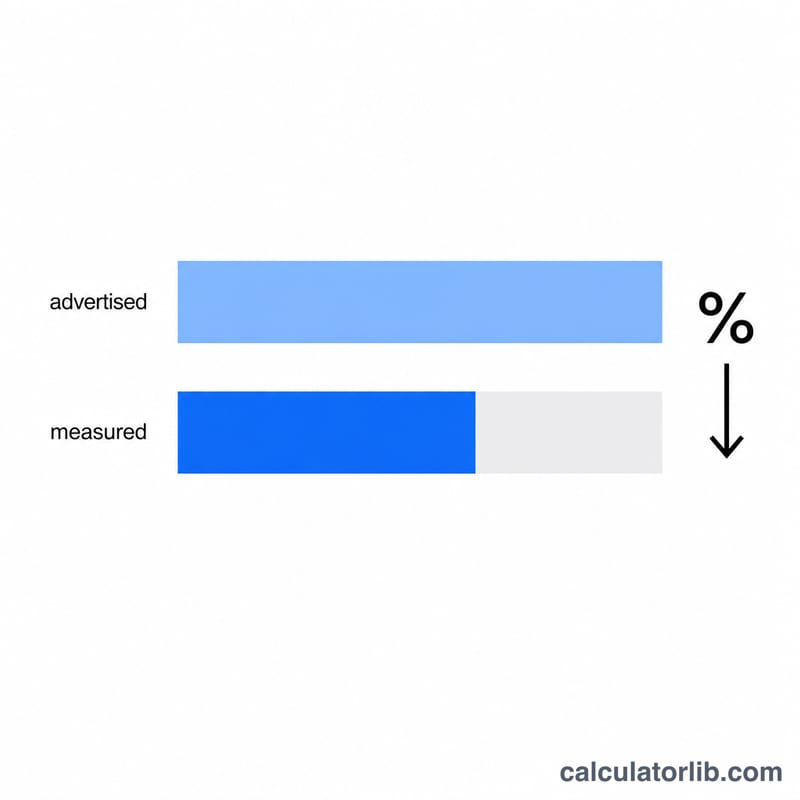
Internet providers advertise speeds like "up to 100 Mbps," but real-world results are often lower. This calculator compares the speed you actually measure (from any speed test tool) against the speed your plan promises, then tells you exactly what percentage of your advertised bandwidth you're receiving — plus how many megabits per second you're falling short.
How to use it
Run a speed test on a wired connection when no one else is using the network for the most accurate reading. Enter your measured speed in Mbps, then enter the advertised speed from your plan. The calculator returns the percentage you're getting, the shortfall in Mbps, and the shortfall as a percentage.
The formula explained
The core math is simple division: $$\text{percent} = \frac{\text{measured}}{\text{advertised}} \times 100$$ A result of 100% means you get exactly what was promised; above 100% means you're getting a bonus; below 100% means a shortfall. The shortfall is just \(\text{advertised} - \text{measured}\), and the shortfall percentage is that gap divided by the advertised figure.
Worked example
Suppose your plan advertises 100 Mbps and your speed test reads 85 Mbps. The percentage is $$\left(\frac{85}{100}\right) \times 100 = \mathbf{85\%}$$ Your shortfall is \(100 - 85 = 15\) Mbps, or 15% below the advertised rate.
FAQ
What is an acceptable percentage? Many regulators and ISPs consider 80–90% of advertised speed reasonable during peak times, since "up to" plans rarely guarantee the full rate.
Why is my speed lower than advertised? Wi-Fi interference, old routers, network congestion, distance from the exchange, and background devices all reduce throughput. Test over Ethernet to rule out Wi-Fi loss.
Can I get more than 100%? Occasionally — some providers provision a little headroom above the nominal plan speed, so a result slightly over 100% is possible.