

What is the Internet Speed Requirement Calculator?
This calculator estimates how much download bandwidth (in Mbps) your home or office internet plan should provide. Instead of guessing, you list the online activities that may happen at the same time — streaming, gaming, video conferencing and browsing — and the tool adds up their typical bitrates, then applies a headroom factor so peaks and protocol overhead don't slow you down.
How to use it
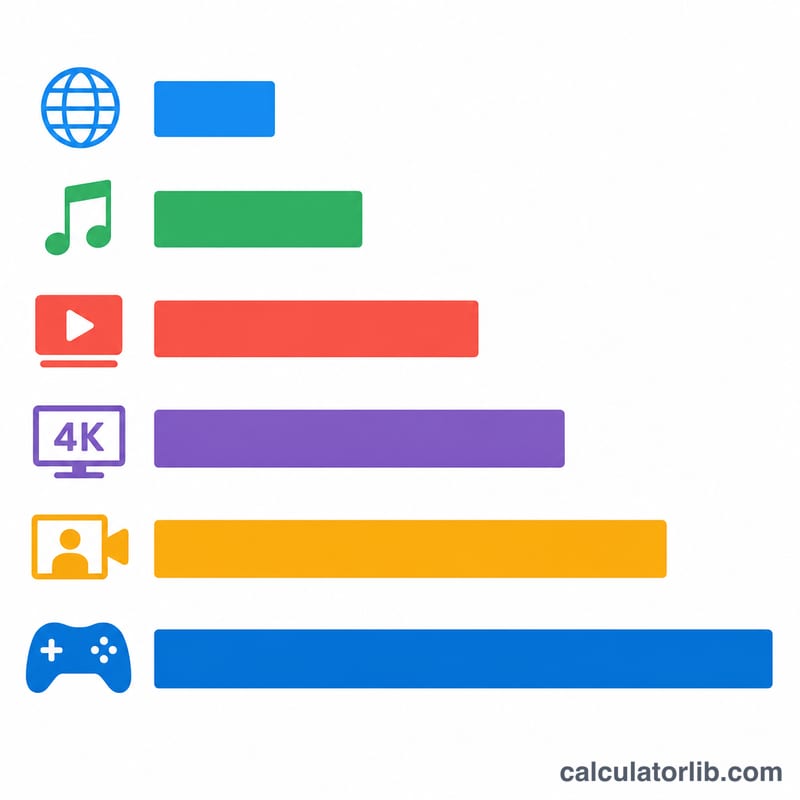
Enter the number of simultaneous instances of each activity. For example, two people watching 1080p shows on different TVs while one child plays online would be 2 HD streams and 1 gaming session. Pick an overhead factor — 1.2× is a sensible default that leaves comfortable headroom. The result is the minimum recommended plan speed; rounding up to the next available tier is always smart.
The formula explained
The math is a weighted sum:
$$\text{Required (Mbps)} = B \times \text{Overhead}$$
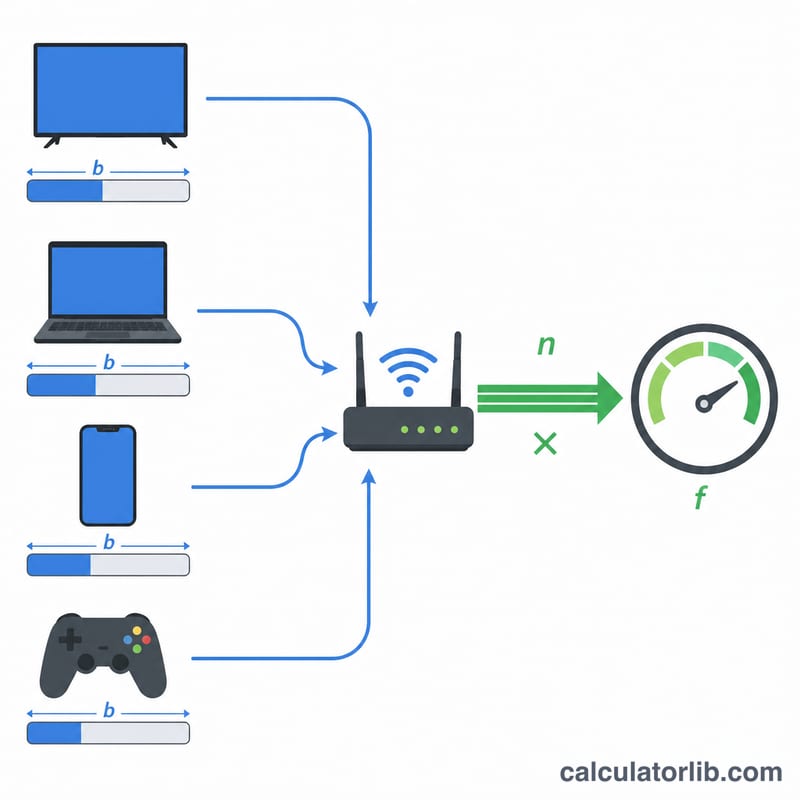
$$\text{where}\quad \left\{ \begin{aligned} B &= 3\,\text{SD} + 5\,\text{HD} + 25\,\text{4K} \\ &\quad + 5\,\text{Gaming} + 3\,\text{Calls} + 2\,\text{Browsing} \end{aligned} \right.$$
Typical per-stream bitrates used here are: SD 480p \(\approx 3\) Mbps, HD 1080p \(\approx 5\) Mbps, 4K UHD \(\approx 25\) Mbps, online gaming \(\approx 5\) Mbps, video calls \(\approx 3\) Mbps, and general browsing \(\approx 2\) Mbps. Each is multiplied by how many are running at once, summed, and scaled by the overhead factor.
Worked example
Suppose a household has 2 HD streams, 1 4K stream, 1 gaming session, 1 video call and 2 browsing devices with a 1.2× factor. $$\text{Base} = (5\times2) + (25\times1) + (5\times1) + (3\times1) + (2\times2) = 10 + 25 + 5 + 3 + 4 = 47 \text{ Mbps}.$$ $$\text{Required} = 47 \times 1.2 = \mathbf{56.4 \text{ Mbps}},$$ so a 60–75 Mbps plan would be comfortable.
FAQ
Does this measure upload speed? No — it estimates download needs, which dominate streaming. For heavy video calling or content uploading, also check your upload allowance.
Why add overhead? Real networks lose capacity to TCP overhead, Wi-Fi interference and background updates, so a 10–30% cushion keeps everything smooth.
What about latency? Speed (Mbps) and latency (ping) are different. Gaming and calls also care about low latency, which this calculator does not measure.