
What is the Cooper 12-Minute Run Test?
The Cooper Test was developed in 1968 by Dr. Kenneth H. Cooper for the US military. It estimates a person's maximal oxygen uptake (VO₂ max) — a key measure of aerobic fitness — based on how far they can run or walk in 12 minutes. Because it requires nothing more than a track and a stopwatch, it remains one of the most popular field tests for endurance fitness.
How to use this calculator
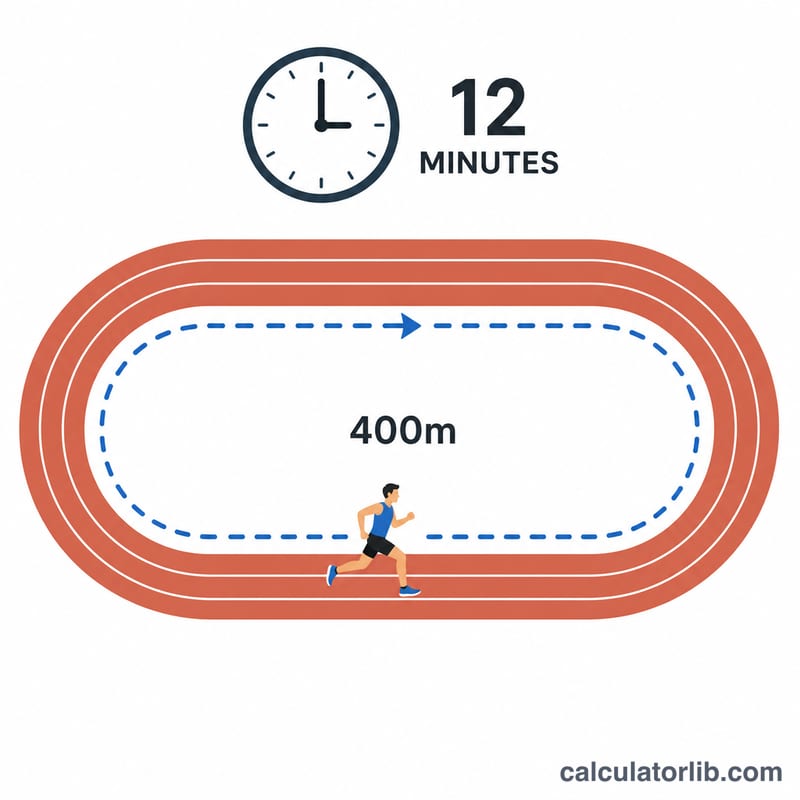
Warm up, then run as far as you can in exactly 12 minutes on a flat course, ideally a 400 m track. Record the total distance covered in meters, type it into the box above, and the calculator returns your estimated VO₂ max in milliliters of oxygen per kilogram of body weight per minute (mL/kg/min). Higher numbers indicate better cardiovascular fitness.
The formula explained
The estimate uses Cooper's linear regression:
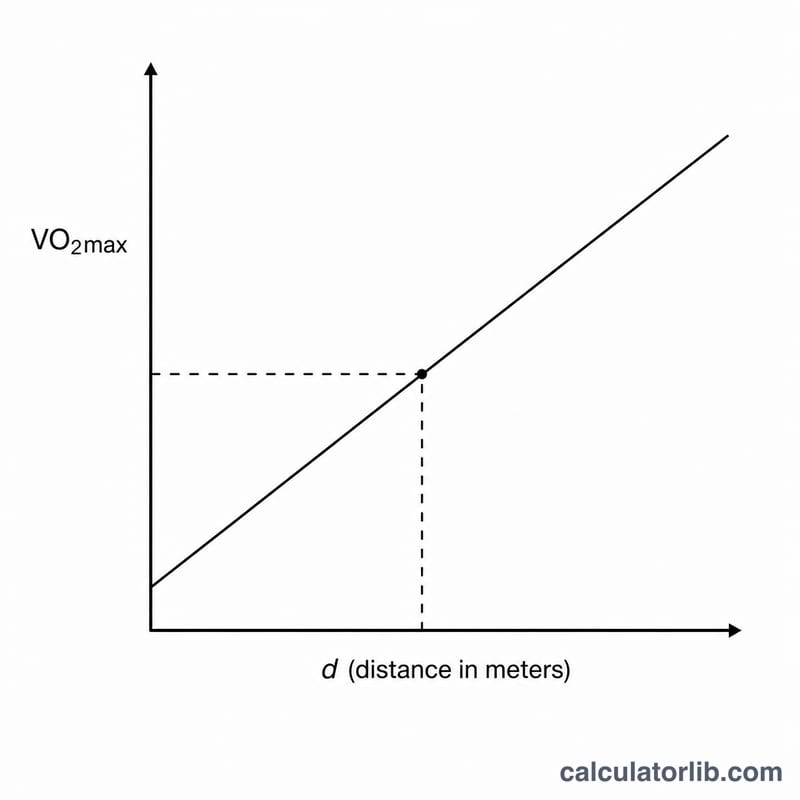
$$VO_2\text{max} = \frac{\text{distance} - 504.9}{44.73}$$where distance is in meters. The constants convert the running distance into an oxygen-uptake figure that correlates well with laboratory treadmill measurements.
Worked example
Suppose you cover 2,800 meters in 12 minutes.
$$VO_2\text{max} = \frac{2800 - 504.9}{44.73} = \frac{2295.1}{44.73} \approx 51.31 \text{ mL/kg/min}$$— an excellent score for most adults.
FAQ
Is the result exact? No. It is an estimate; lab testing is more precise, but the Cooper test is a reliable, low-cost approximation.
What is a good VO₂ max? Roughly 35–40 is average for adults, while 50+ indicates very good aerobic fitness; elite endurance athletes often exceed 70.
Can I walk part of it? Yes — the test measures total distance, so walking when fatigued still counts, though running maximizes your score.