
What Is the Cooper Test VO2 Max Calculator?
VO2 max is the maximum rate at which your body can use oxygen during intense exercise, measured in milliliters of oxygen per kilogram of body weight per minute (mL/kg/min). It is one of the best single indicators of aerobic fitness and cardiovascular endurance. The Cooper test, developed by Dr. Kenneth Cooper in 1968, estimates VO2 max from a simple field test: how far you can run or walk in exactly 12 minutes.
How to Use It
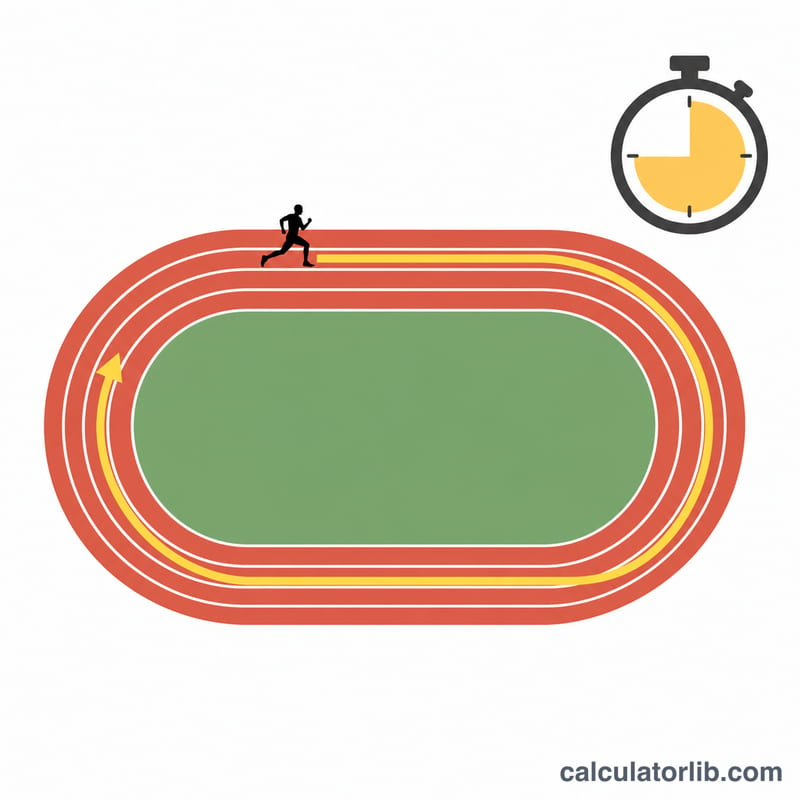
Warm up, then run or jog as far as you can in 12 minutes on a flat track or measured course. Record the total distance covered in meters and enter it above. The calculator instantly returns your estimated VO2 max. A standard 400 m track makes measuring easy—count laps and partial laps.
The Formula Explained
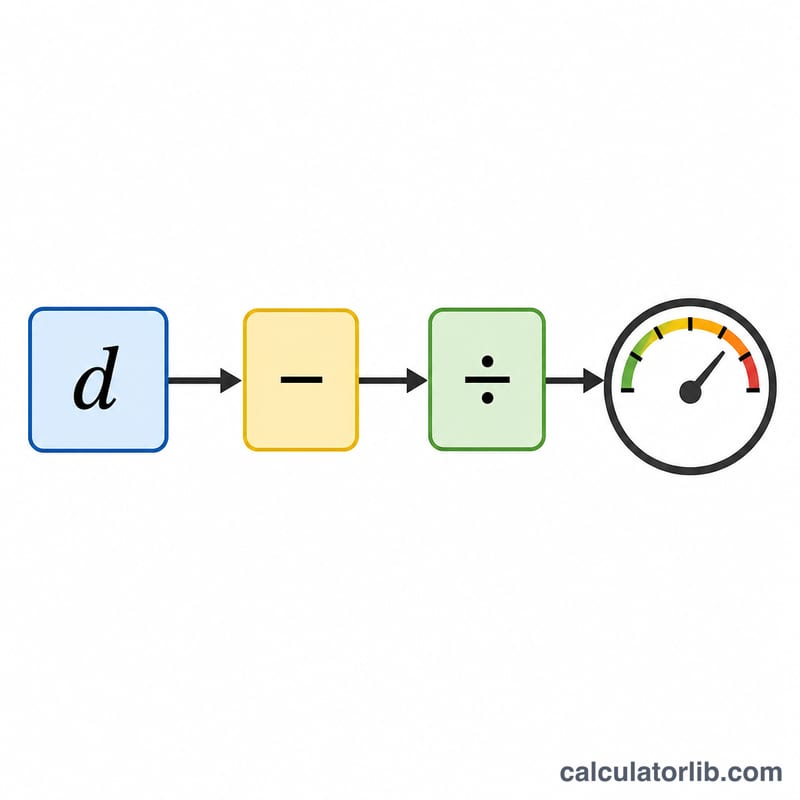
The estimate uses the linear regression Cooper derived from his data:
$$\text{VO}_2\text{max} = \frac{\text{Distance (m)} - 504.9}{44.73}$$
The constant 504.9 represents the baseline distance corresponding to minimal aerobic capacity, and dividing the surplus distance by 44.73 converts meters of extra running into oxygen-uptake units.
Worked Example
Suppose you cover 2,800 meters in 12 minutes. Then $$\text{VO}_2\text{max} = \frac{2800 - 504.9}{44.73} = \frac{2295.1}{44.73} \approx 51.31 \text{ mL/kg/min}$$ — a strong score indicating good aerobic fitness for most adults.
FAQ
Is the Cooper test accurate? It is a field estimate, not a lab measurement. Expect a margin of a few mL/kg/min compared with direct gas-analysis testing, but it is reliable for tracking your own progress over time.
What is a good VO2 max? Values vary by age and sex. Generally, 35–45 is average for adults, above 50 is excellent, and elite endurance athletes can exceed 70.
Can I walk instead of run? Yes, but the estimate assumes maximal effort, so walking will produce a lower (and less meaningful) score. Push to your sustainable maximum for the most useful result.