
What is VO2 max?
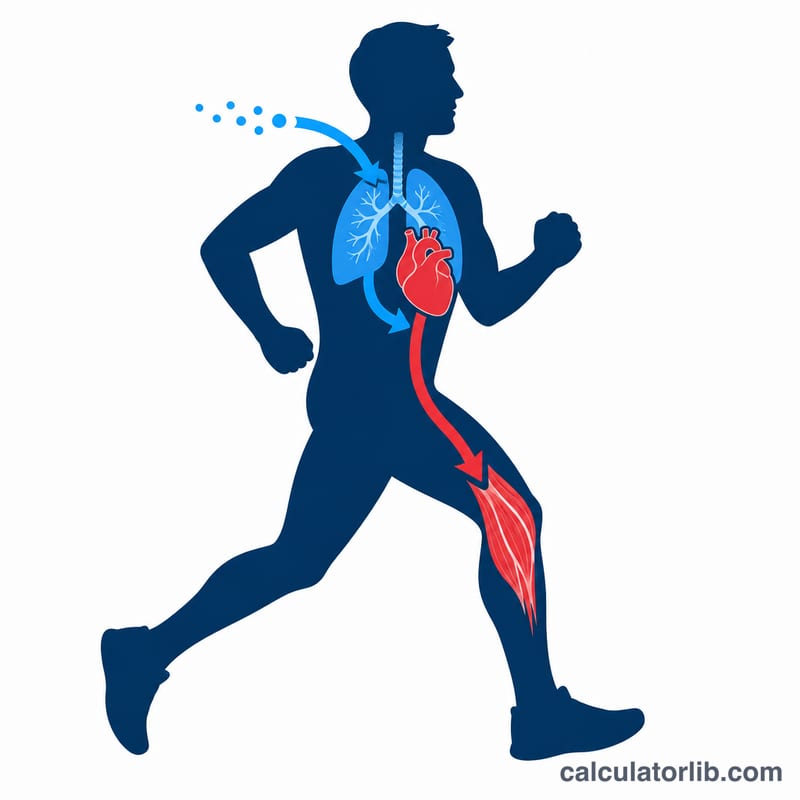
VO2 max is the maximum rate at which your body can take in and use oxygen during intense exercise, measured in milliliters of oxygen per kilogram of body weight per minute (mL/kg/min). It is one of the best single indicators of aerobic fitness and endurance potential. This calculator estimates VO2 max two ways: from the distance run in a 12-minute Cooper test, or from the ratio of your maximum to resting heart rate.
How to use this calculator
For the Cooper method, run as far as you can in exactly 12 minutes on a flat track, record the distance in meters, and enter it. For the heart rate ratio method, enter your maximum heart rate (from a maximal effort test) and your true resting heart rate, ideally measured first thing in the morning. Choose the method that matches the data you have and read your estimated VO2 max plus a fitness category.
The formulas explained
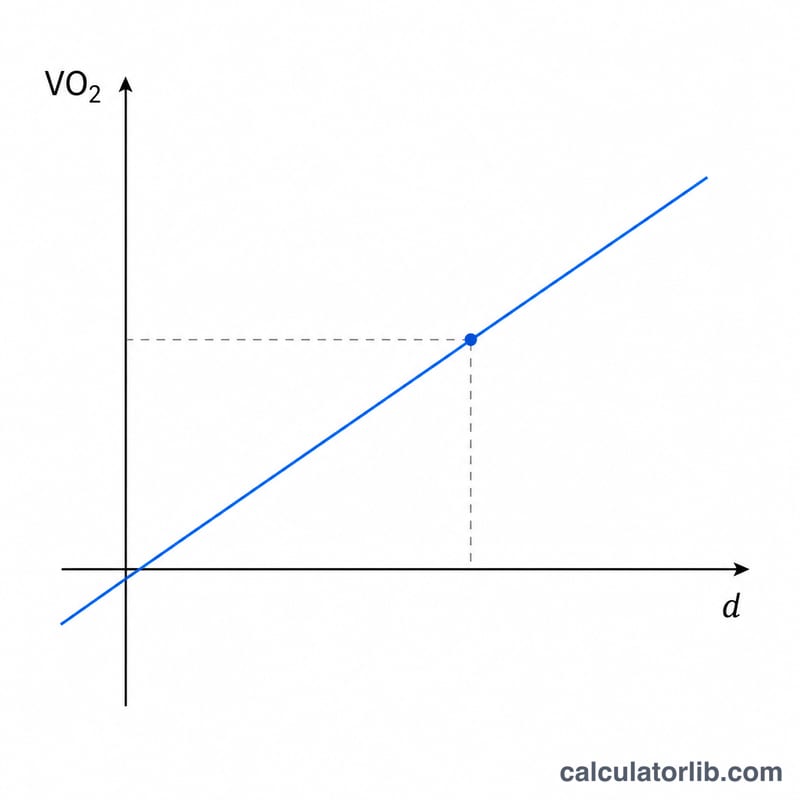
The Cooper formula is $$\text{VO}_2\text{max} = \frac{\text{Distance (m)} - 504.9}{44.73}$$ derived from Kenneth Cooper's field research correlating 12-minute run distance with laboratory VO2 max. The heart rate method uses $$\text{VO}_2\text{max} = 15.3 \times \frac{\text{Max HR (bpm)}}{\text{Resting HR (bpm)}}$$ a simple estimate that works because a wider gap between maximum and resting heart rate reflects a stronger, more efficient cardiovascular system.
Worked example
Suppose you cover 2,800 meters in 12 minutes. $$\text{VO}_2\text{max} = \frac{2800 - 504.9}{44.73} = \frac{2295.1}{44.73} \approx 51.3 \text{ mL/kg/min}$$ which falls in the "Good" range for most adults. Using the heart rate method with a max of 190 bpm and resting of 60 bpm: \(15.3 \times \frac{190}{60} \approx 48.5\) mL/kg/min.
FAQ
How accurate are these estimates? Field estimates typically fall within a few mL/kg/min of lab-measured values, depending on pacing, terrain, and motivation.
What is a good VO2 max? It varies by age and sex, but values above 50 are generally good for recreational athletes and above 60 are excellent.
How can I improve it? Interval training, long steady runs, and consistent aerobic exercise raise VO2 max over weeks to months.