What Is the Running VO2 Max Calculator?
This tool estimates your VO2 max — the maximum rate at which your body can use oxygen during intense exercise — from a single race or time-trial result. It uses the Daniels & Gilbert VDOT model, a widely used method in distance-running coaching that links a recent race performance to an oxygen-uptake estimate. A higher VO2 max generally indicates greater aerobic fitness and endurance potential.
How to Use It
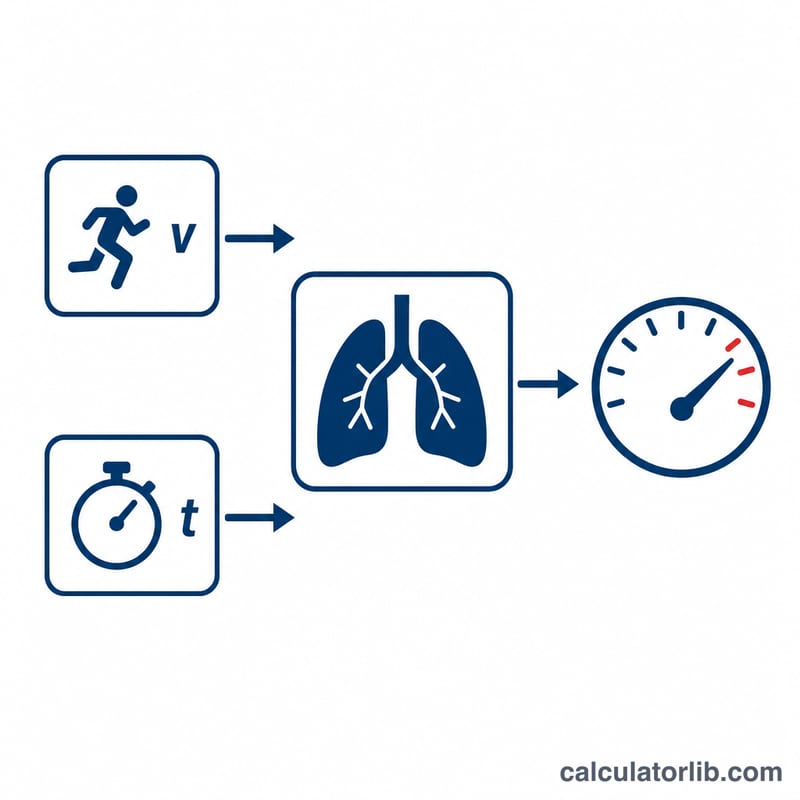
Enter the race distance in meters (for example, 5000 for a 5K or 10000 for a 10K), then enter your finishing time as minutes and seconds. The calculator converts your time to total minutes, computes your average running velocity in meters per minute, and applies the Daniels & Gilbert equations to return an estimated VO2 max in mL/kg/min.
The Formula Explained
First, velocity is found with \(v = \text{distance} / t\), where \(t\) is total time in minutes. Then:
$$\text{VO}_2\text{max} = \frac{-4.6 + 0.182258\,v + 0.000104\,v^{2}}{0.8 + 0.1894393\,e^{-0.012778\,t} + 0.2989558\,e^{-0.1932605\,t}}$$
The numerator estimates the oxygen cost of running at velocity \(v\), while the denominator adjusts for the fraction of VO2 max that can be sustained for the given duration \(t\) — shorter races allow a higher sustainable percentage.
Worked Example
For a 5K (5000 m) run in 20:00 (\(t = 20\) min), velocity $$v = 5000 / 20 = 250 \text{ m/min}.$$ The numerator is $$-4.6 + 0.182258 \cdot 250 + 0.000104 \cdot 250^{2} = -4.6 + 45.5645 + 6.5 = 47.4645.$$ The denominator is $$0.8 + 0.1894393 \cdot e^{-0.25556} + 0.2989558 \cdot e^{-3.86521} = 0.8 + 0.146692 + 0.006255 \approx 0.952947.$$ $$\text{VO}_2\text{max} \approx 47.4645 / 0.952947 \approx 49.81 \text{ mL/kg/min}.$$
Interpreting Your VO2 Max Result
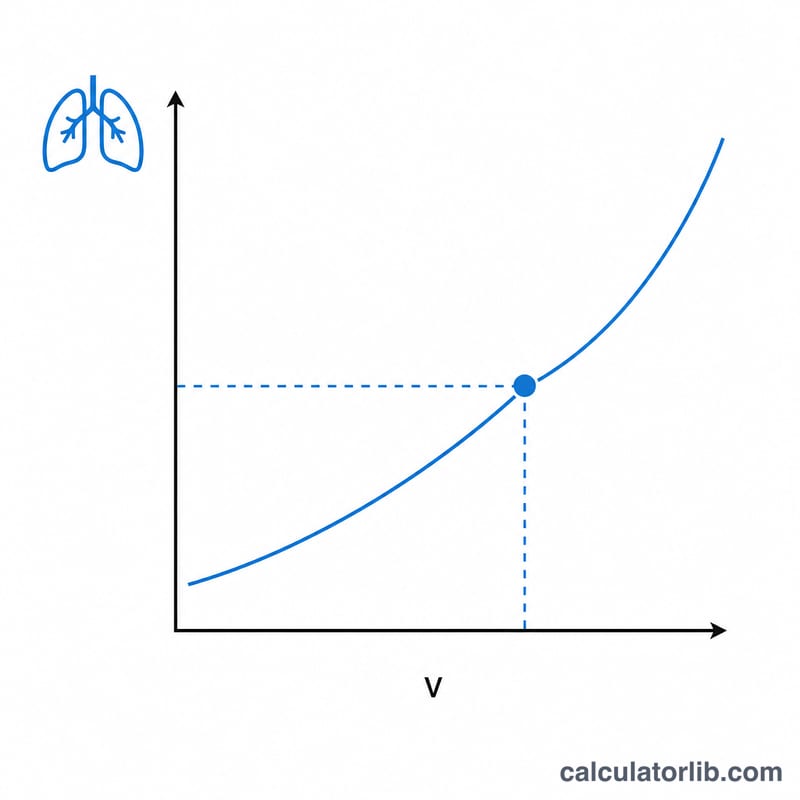
VO2 max is the highest rate at which the body can take up and use oxygen during hard exercise. It is expressed in millilitres of oxygen per kilogram of body mass per minute (mL/kg/min). A higher value generally means the heart, lungs, blood and muscles can deliver and use more oxygen per kilogram, which is why it is widely used as an indicator of aerobic fitness, especially in endurance running.
Typical values depend on age and sex. VO2 max tends to decline gradually with age, and average values are usually lower for women than for men, partly because of differences in body composition and blood haemoglobin. Compare any result with norms for your own age group and sex rather than with a single universal number (see the ranges below).
The number from this calculator is a VDOT value from the Daniels & Gilbert equations. It is a performance-based index: it asks what oxygen uptake a runner would need in order to produce this race result, given an assumed running economy and an assumed fraction of VO2 max that can be sustained for that duration. It is not a laboratory measurement taken with a gas-analysis mask.
For that reason VDOT can differ from a lab-measured VO2 max:
- Running economy: runners who use less oxygen at a given speed will have a higher VDOT than their lab VO2 max, and vice versa.
- Race conditions: heat, wind, hills, altitude and course accuracy change the finish time without changing physiology.
- Pacing and effort: an uneven pace, a poor day or a race that was not run at full effort lowers the estimate.
- Training specificity: factors such as lactate threshold and endurance affect race times beyond VO2 max alone.
Treat the result as a running-performance index useful for comparing your own races over time, not as a medical or diagnostic figure.
Estimated VO2 Max Across Common Race Results
Each row uses the formula from this calculator, with \(t\) the finish time in minutes and \(v = d/t\) the average velocity in metres per minute:
$$\text{VO}_2\text{max} = \frac{ -4.6 + 0.182258\,v + 0.000104\,v^{2} }{ 0.8 + 0.1894393\,e^{-0.012778\,t} + 0.2989558\,e^{-0.1932605\,t} }$$
Example substitution for a 5K in 20:00: \(t = 20\), \(v = 5000/20 = 250\) m/min. Numerator: \(-4.6 + 0.182258 \times 250 + 0.000104 \times 250^{2} = -4.6 + 45.5645 + 6.5 = 47.4645\). Denominator: \(0.8 + 0.1894393\,e^{-0.25556} + 0.2989558\,e^{-3.86521} \approx 0.8 + 0.14672 + 0.00627 = 0.95298\). Result: \(47.4645 / 0.95298 \approx\) 49.8 mL/kg/min.
| Race | Finish time | Velocity (m/min) | Estimated VO2 max (mL/kg/min) |
|---|---|---|---|
| 5K | 25:00 | 200.0 | 38.3 |
| 5K | 22:00 | 227.3 | 44.5 |
| 5K | 20:00 | 250.0 | 49.8 |
| 5K | 18:00 | 277.8 | 56.3 |
| 10K | 50:00 | 200.0 | 40.0 |
| 10K | 40:00 | 250.0 | 51.9 |
Note that the same speed gives a higher VDOT over a longer race: 200 m/min is 38.3 over 5K but 40.0 over 10K, because the formula assumes a runner can sustain a smaller fraction of VO2 max for longer durations.
Typical VO2 Max Ranges by Age and Sex
The table below shows commonly cited normative VO2 max categories (mL/kg/min) for adults, as tabulated by Heyward (Advanced Fitness Assessment and Exercise Prescription) from Cooper Institute data. These norms come mainly from North American adult populations, so they may not represent other populations. Only two age groups are shown; norms continue to decline in older groups, so consult the original source for those.
| Sex / age | Very poor | Poor | Fair | Good | Excellent | Superior |
|---|---|---|---|---|---|---|
| Men 20–29 | < 25 | 25–33 | 34–42 | 43–52 | 53–61 | 62+ |
| Men 30–39 | < 23 | 23–30 | 31–38 | 39–48 | 49–57 | 58+ |
| Women 20–29 | < 24 | 24–30 | 31–37 | 38–48 | 49–56 | 57+ |
| Women 30–39 | < 20 | 20–27 | 28–33 | 34–44 | 45–52 | 53+ |
How to use this: these are population norms, not a diagnosis or a measure of health on their own. Category boundaries differ between sources (the Cooper Institute, ACSM and others publish different tables), so always cite the source you compare against and check the original publication for exact values. Your VDOT estimate is performance-based and may differ from a lab-measured value, so comparisons with these norms are approximate. This is general information, not professional advice.
FAQ
Is this my true VO2 max? No — it is a performance-based estimate. A laboratory test is more accurate, but this gives a strong practical approximation for runners.
Which race works best? Use a recent, all-out effort lasting roughly 5 to 30 minutes (such as a 1500 m to 10K) for the most reliable estimate.
What units does it use? VO2 max is reported in milliliters of oxygen per kilogram of body weight per minute (mL/kg/min), the standard scientific unit.