
What This Calculator Does
The Calories Burned Jumping Rope Calculator estimates the energy you expend while skipping rope. Jumping rope is one of the most efficient cardio workouts available, burning a high number of calories per minute compared to walking or jogging. This tool uses your body weight, the duration of your session, and your jumping intensity to produce a personalized calorie estimate.
How to Use It
Enter your body weight in kilograms, the number of minutes you jumped rope, and select your intensity level. The calculator returns your total calories burned, plus your calories burned per minute so you can track and compare workouts over time.
The Formula Explained
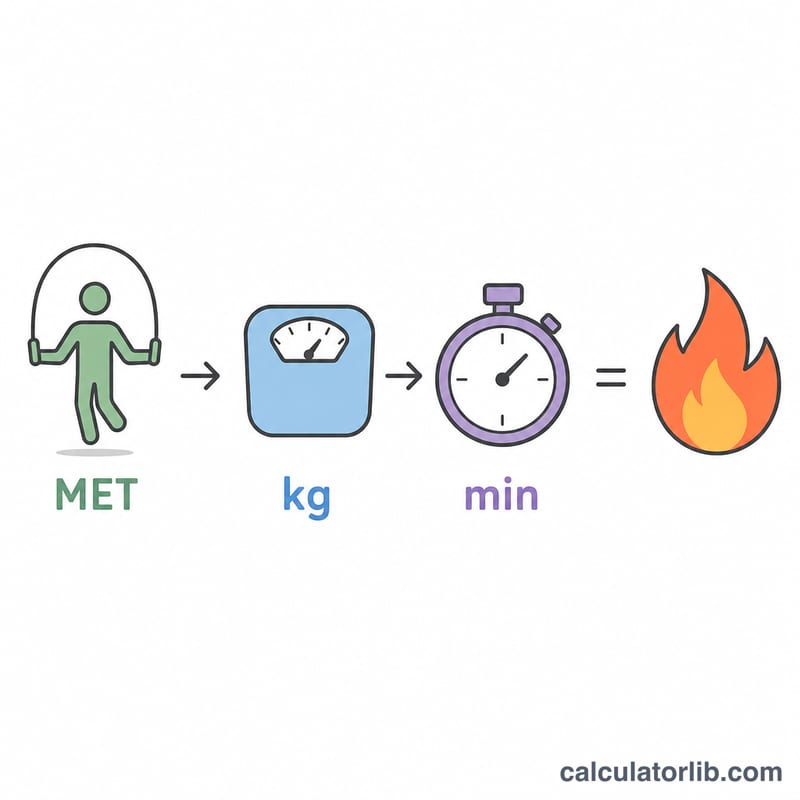
The calculation is based on MET (Metabolic Equivalent of Task) values, the standard used in exercise science:
$$\text{kcal} = \frac{\text{MET} \times 3.5 \times \text{kg}}{200} \times \text{minutes}$$
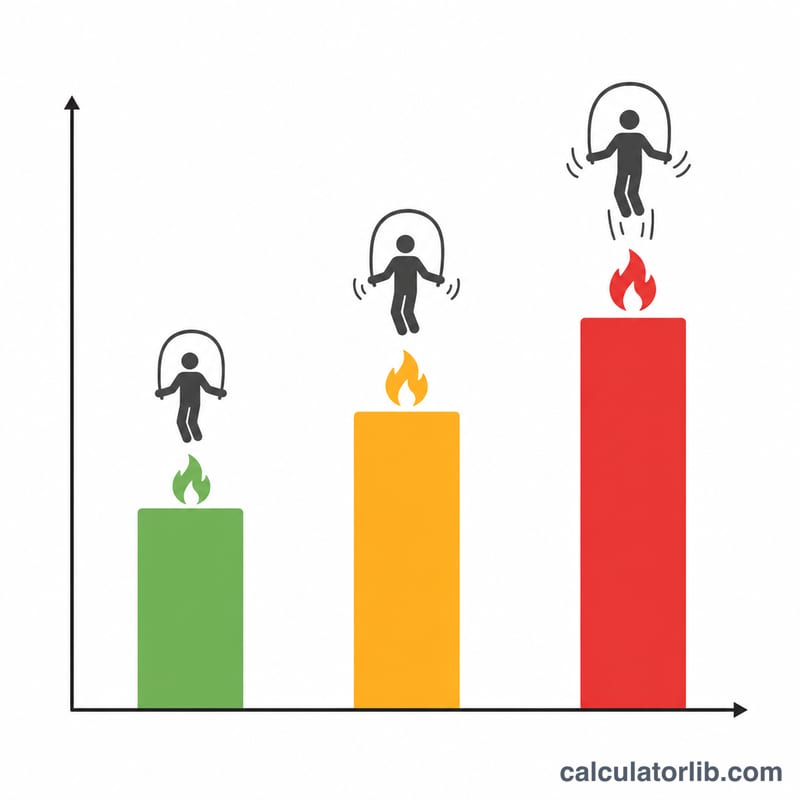
One MET equals the energy used at rest, roughly 3.5 ml of oxygen per kg of body weight per minute. Jumping rope carries a high MET value: about 8.8 for a slow pace, 11.8 for a moderate pace, and 12.3 for a fast pace. Multiplying by your weight and time converts that intensity into calories.
Worked Example
A 70 kg person jumps rope at a moderate pace (MET 11.8) for 15 minutes. Calories per minute = $$11.8 \times 3.5 \times 70 \div 200 = 14.455 \text{ kcal/min}.$$ Over 15 minutes that is \(14.455 \times 15 \approx\) 217 calories.
FAQ
Is jumping rope good for weight loss? Yes. Because it burns 10–16 calories per minute for most people, even short sessions add up quickly, making it efficient for a calorie deficit.
How accurate is this estimate? MET-based estimates are good general guides but do not account for individual fitness, technique, or rest pauses. Treat the result as an approximation.
Which intensity should I choose? Slow is a relaxed warm-up pace, moderate is a steady continuous rhythm, and fast involves rapid skips or double-unders.