
What Is the Vertical Jump Height Calculator?
This tool estimates how high you jumped based on your hang time — the total time your feet spend in the air during a jump. It uses basic projectile physics, so it works for any athlete in any country, no special equipment needed beyond a stopwatch or a slow-motion video.
How to Use It
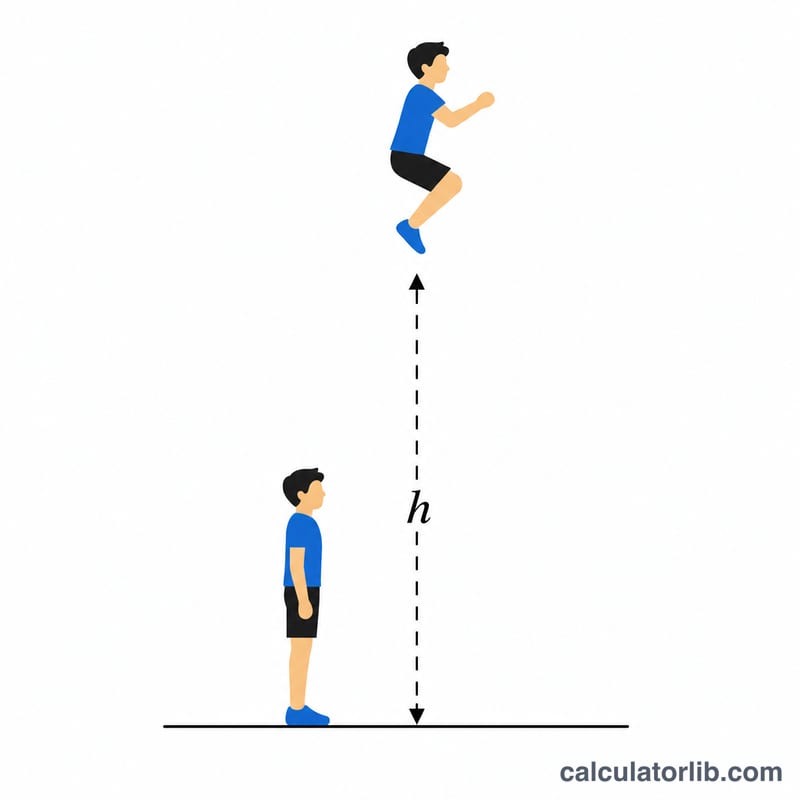
Time how long you are airborne, from the instant your feet leave the ground until they touch back down. Enter that hang time in seconds and the calculator returns your jump height in centimeters, meters, and inches.
The Formula Explained
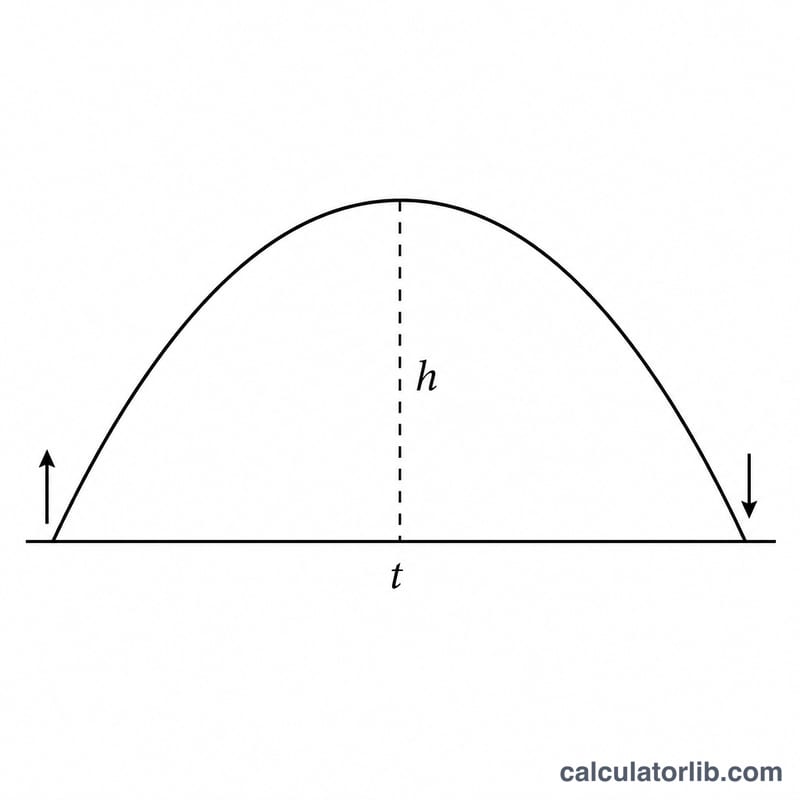
A jump is symmetric: the time going up equals the time coming down. If total air time is t, each half is t/2. The peak height reached under gravity is \(h = \tfrac{1}{2} \cdot g \cdot (t/2)^2\), which simplifies to:
$$h = \frac{g \cdot t^2}{8}$$where \(g = 9.81\ \text{m/s}^2\). Because \(t\) is squared, small timing errors have a big effect — measure hang time as accurately as you can.
Worked Example
Suppose your hang time is 0.7 seconds. Then $$h = \frac{9.81 \times 0.7^2}{8} = \frac{9.81 \times 0.49}{8} = \frac{4.8069}{8} = 0.6009\ \text{m},$$ or about 60.1 cm (≈23.7 inches).
FAQ
Is hang time the same as my vertical? Hang time is the input; vertical jump height is the output computed from it. A 0.6 m vertical corresponds to roughly 0.7 s of hang time.
Does body weight matter? No. In free fall, jump height depends only on takeoff velocity (reflected in hang time), not on mass.
Why does the result seem high compared to a standing-reach test? Hang-time estimates assume your center of mass follows pure projectile motion. Tucking your legs or measuring time imprecisely can inflate the result.