
What Is Material Removal Rate?
Material Removal Rate (MRR) is the volume of material removed per unit of time during a machining operation such as milling, turning, or grinding. It is one of the most important measures of machining productivity: a higher MRR means faster production, but it also demands more spindle power, generates more heat, and increases tool wear. Balancing MRR against tool life and surface finish is at the heart of efficient process planning.
How to Use This Calculator
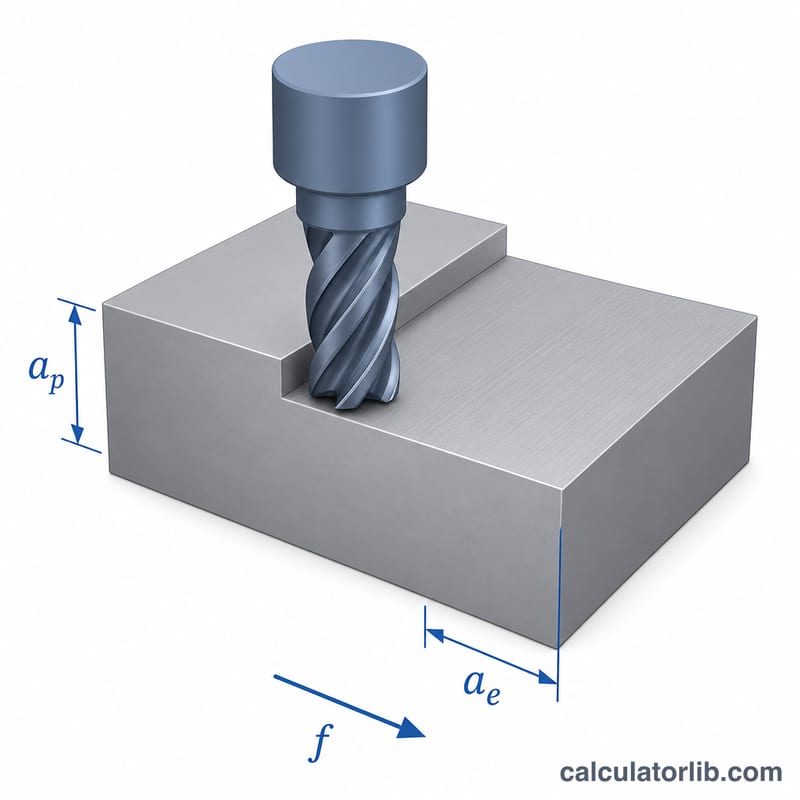
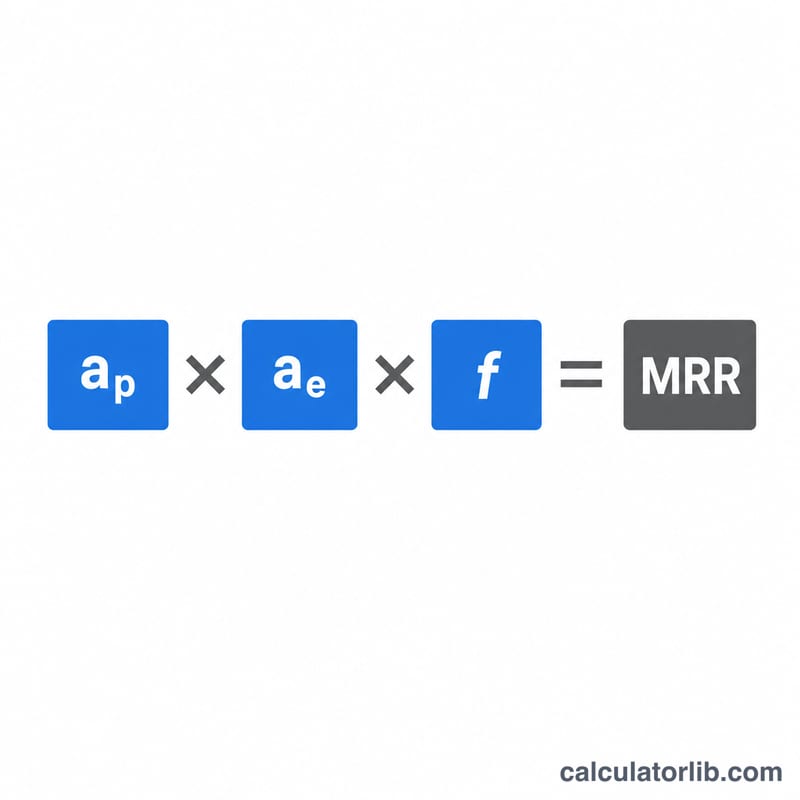
Enter three values: the depth of cut (\(a_p\), how deep the tool engages into the workpiece, in mm), the width of cut (\(a_e\), the radial engagement or step-over, in mm), and the feed rate (\(f\), the linear travel speed of the tool, in mm/min). The calculator multiplies them and returns the MRR in cubic millimetres per minute, plus a convenient conversion to cubic centimetres per minute.
The Formula Explained
The governing equation is:
$$\text{MRR} = \text{Depth of Cut (mm)} \times \text{Width of Cut (mm)} \times \text{Feed Rate (mm/min)}$$
Geometrically, the cross-sectional area of the chip being removed is depth × width (mm²). Multiplying that area by how fast the cutter advances (mm/min) gives a volume swept per minute (mm³/min). Because 1 cm³ = 1000 mm³, dividing the result by 1000 converts to cm³/min.
Worked Example
Suppose you are face milling with a depth of cut of 2 mm, a width of cut of 10 mm, and a feed rate of 150 mm/min. The MRR is $$2 \times 10 \times 150 = 3{,}000 \text{ mm}^3/\text{min},$$ which equals 3 cm³/min. If you doubled the feed to 300 mm/min, the MRR would double to 6,000 mm³/min — provided the machine and tool can handle the extra load.
FAQ
What units does this use? Depth and width in millimetres, feed rate in mm/min, giving MRR in mm³/min (and cm³/min).
Does a higher MRR always mean better? Not necessarily. Pushing MRR too high can overload the spindle, cause excessive tool wear, chatter, or poor surface finish. Always stay within the machine's power and the tool manufacturer's recommendations.
Can I use this for turning? Yes — for turning, use depth of cut and feed per revolution times spindle RPM as the effective feed rate, or apply the cutting-speed-based MRR form. This simple product works for any operation where you know the chip area and feed.