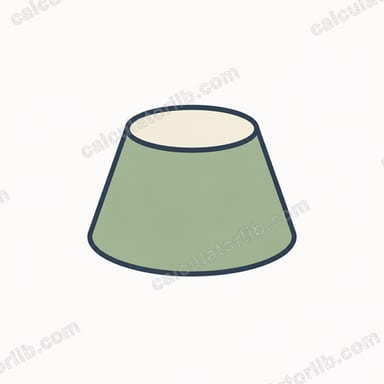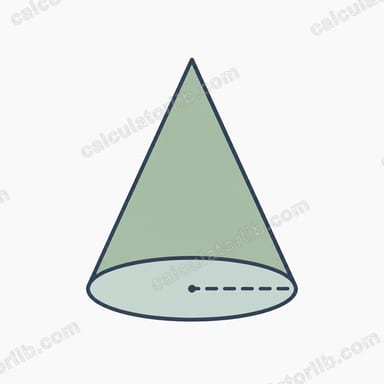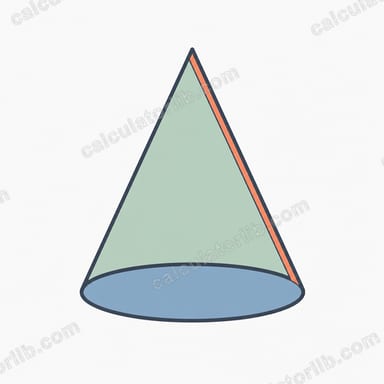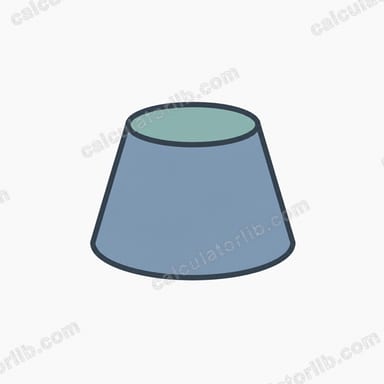

What Is a Taper?
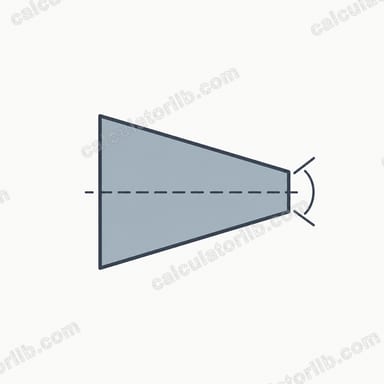
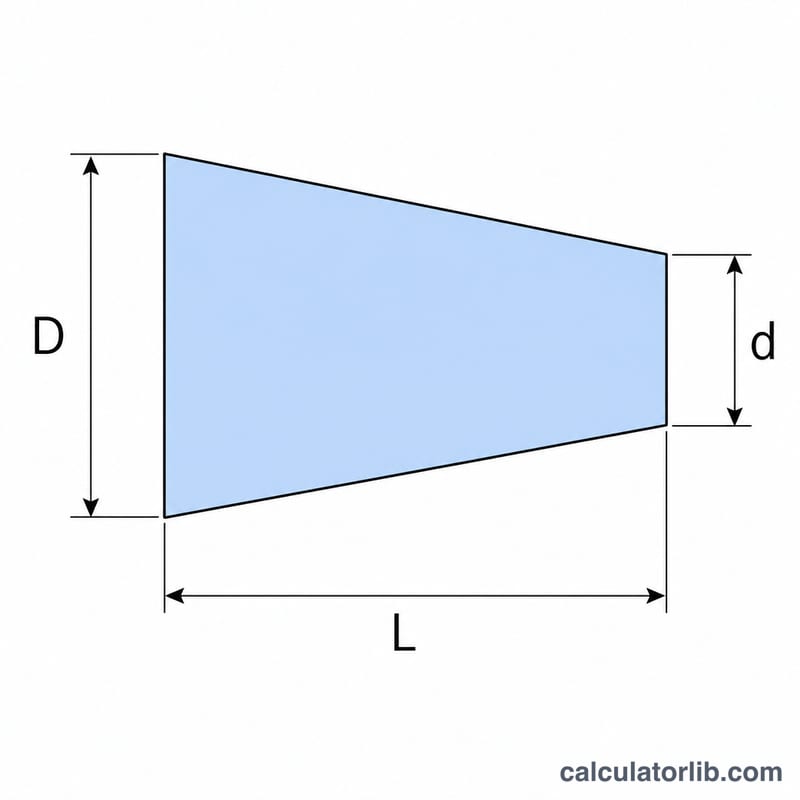
A taper is a gradual reduction in diameter along the length of a part, common in shafts, pins, tool holders, and reamers. This calculator finds the taper per unit length, the taper percent, and the taper angle from a large diameter (D), a small diameter (d), and the axial length (L) over which the change occurs. It is unit-agnostic: enter all three measurements in the same units (mm or inches) and the taper ratio and angles stay valid.
How to Use It
Enter the large diameter, the small diameter, and the length between those two measured points. The calculator returns the taper per unit length (rise over run on the diameter), the taper expressed as a percent, the full included angle between the opposing surfaces, and the half angle measured from the centerline to one side — the value most machinists set on a compound rest or sine bar.
The Formula Explained
Taper per unit length is simply the diameter difference divided by the length: \( T = (D - d) / L \). Because the diameter changes on both sides of the axis, each side rises by half that amount. The half angle is therefore \( \arctan((D - d) / (2L)) \), and the full included angle is twice that. Taper percent is the per-unit taper multiplied by 100.
$$\text{Taper} = \frac{\text{Large Dia. }(D) - \text{Small Dia. }(d)}{\text{Length }(L)}$$$$\theta = 2\,\arctan\!\left(\frac{\text{Large Dia. }(D) - \text{Small Dia. }(d)}{2\,\text{Length }(L)}\right)$$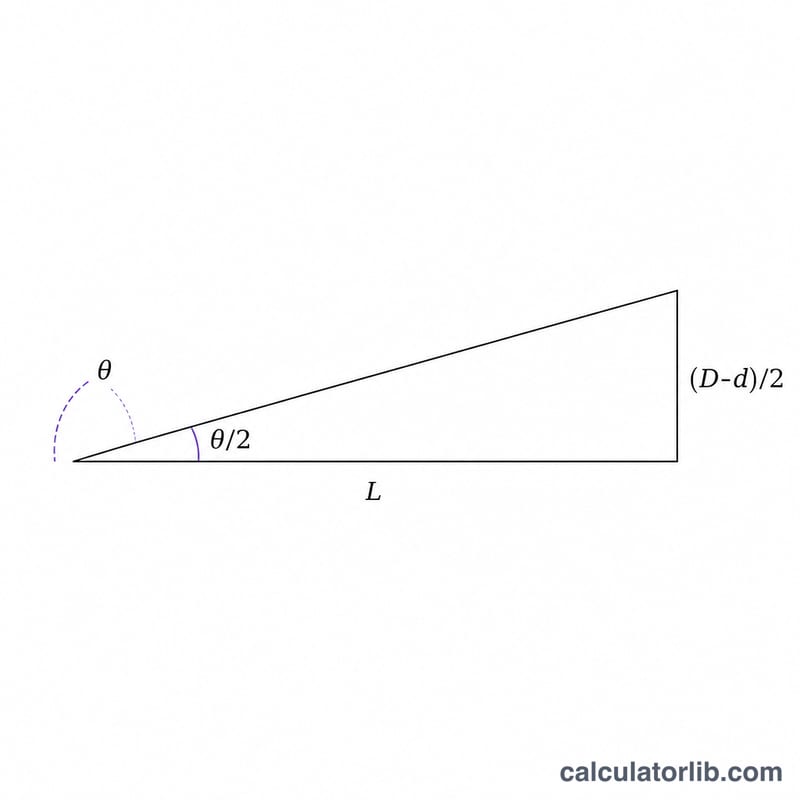
Worked Example
For \( D = 2 \), \( d = 1 \), \( L = 10 \): taper per unit =
$$(2 - 1) / 10 = 0.1$$or 10%. The half angle =
$$\arctan(1 / 20) = \arctan(0.05) \approx 2.8624^\circ$$so the included angle \( \approx 5.7249^\circ \).
FAQ
What units should I use? Any, as long as all three inputs share the same unit. Taper per unit and angles are dimensionless ratios.
What is the difference between included and half angle? The included angle spans both sides of the part; the half angle is from the centerline to one face — used when offsetting a compound slide.
How do I convert to taper per foot? Multiply the taper per unit (in inches per inch) by 12 to get inches per foot.