What Is the Punch Force Calculator?
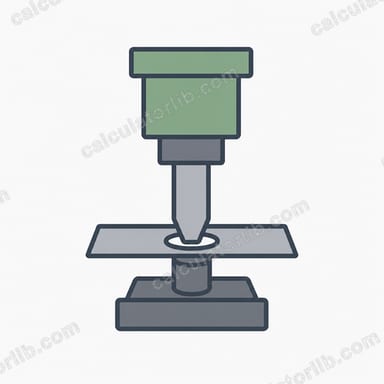
The punch force calculator estimates the force a press needs to punch, pierce, or blank a hole through sheet metal. Knowing this force lets you select a press with adequate tonnage, choose suitable tooling, and avoid overloading or damaging your equipment. It works for any ductile sheet material as long as you know its shear strength.
How to Use It
Enter three values: the cut perimeter (the total length of the line being cut, in millimetres — for a round hole this is \(\pi \times \text{diameter}\)), the material thickness in millimetres, and the shear strength of the material in MPa (which equals N/mm²). The calculator returns the required force in kilonewtons, newtons, and metric tonnes-force.
The Formula Explained
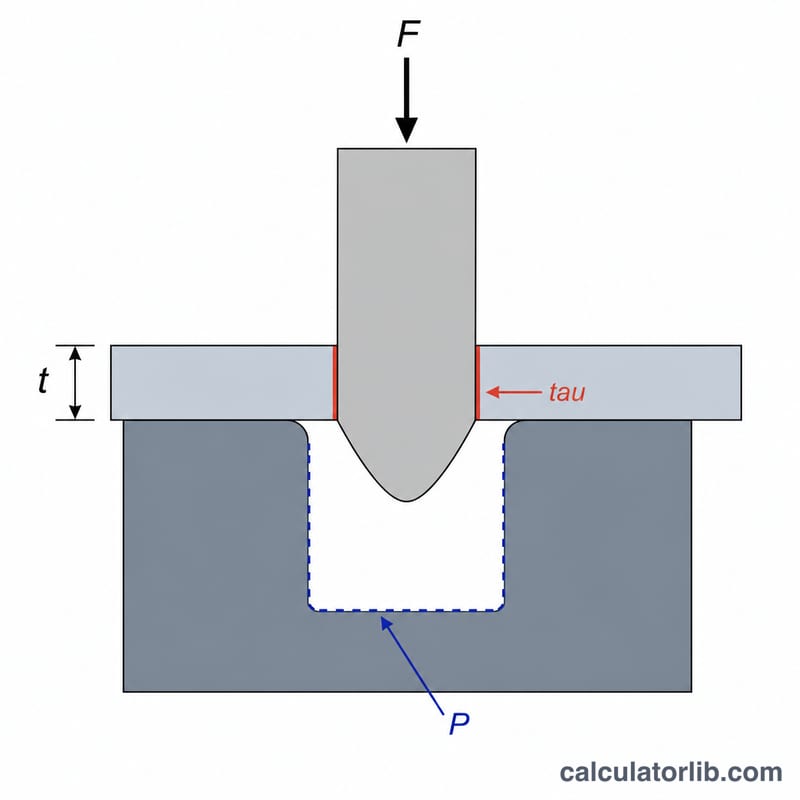
The force model is $$F = P \times t \times \tau$$ where \(P\) is the perimeter, \(t\) is the thickness, and \(\tau\) is the shear strength. The product \(P \times t\) is the area of the cut shear plane (mm²); multiplying by the shear strength (N/mm²) gives a force in newtons. Because punching shears material along the cut edge rather than pulling it apart, shear strength — not tensile strength — is the correct property. As a rough guide, mild steel has a shear strength around 350 MPa, aluminium around 110–170 MPa, and stainless steel around 520 MPa.
Worked Example
Punching a 50 mm diameter hole in 2 mm mild steel (\(\tau \approx 350\) MPa): perimeter \(= \pi \times 50 \approx 157.08\) mm. $$F = 157.08 \times 2 \times 350 \approx 109{,}956 \text{ N} \approx 110 \text{ kN} \approx 11.2 \text{ tonnes-force}$$ A 15-tonne press would handle this comfortably.
Typical Shear Strength of Common Sheet Metals
The punch force formula \(F = P \times t \times \tau\) needs the shear strength \(\tau\) of the material. Since 1 MPa = 1 N/mm², values in MPa can be entered directly into the shear strength field. As a rule of thumb, shear strength is roughly 0.6–0.8 of ultimate tensile strength. The figures below are approximate, rounded, general-purpose values.
| Material | Condition / temper | Approx. shear strength (MPa) |
|---|---|---|
| Low-carbon (mild) steel | Annealed to cold-rolled | 250–350 |
| Medium-carbon steel (e.g. 1045) | Annealed / normalised | 400–550 |
| Stainless steel 304 | Annealed | 450–550 |
| Aluminium 1100-O | Annealed | ≈ 60 |
| Aluminium 5052-H32 | Strain-hardened | ≈ 140 |
| Aluminium 6061-O | Annealed | ≈ 80 |
| Aluminium 6061-T6 | Solution treated and aged | ≈ 205 |
| Copper | Annealed to half-hard | 150–220 |
| Brass (e.g. cartridge brass) | Annealed to half-hard | 200–300 |
| Titanium, commercially pure (Grade 2) | Annealed | ≈ 210–300 |
Important: shear strength varies significantly with alloy, temper, cold work, thickness and the rolling direction. Always confirm the value against your material supplier's data sheet or mill certificate. For production tooling, it is common to add a safety margin to the calculated force to allow for material variation and tool wear.
Force and Tonnage Conversions
The calculator gives the punch force in newtons (N), kilonewtons (kN) and tonnes-force. Press capacity is often quoted in tonnes (metric tonne-force) or US short tons, so use these relationships to compare the result with a press rating.
| Relationship | Value |
|---|---|
| 1 kN | 1000 N |
| 1 kN | ≈ 0.10197 tonnes-force (metric) |
| 1 tonne-force (metric) | 9.80665 kN |
| 1 US short ton-force | ≈ 8.896 kN |
| 1 kN | ≈ 224.8 lbf |
Quick-conversion examples
| Force (kN) | Tonnes-force (metric) | US short tons-force |
|---|---|---|
| 10 | ≈ 1.02 | ≈ 1.12 |
| 50 | ≈ 5.10 | ≈ 5.62 |
| 100 | ≈ 10.2 | ≈ 11.2 |
| 500 | ≈ 51.0 | ≈ 56.2 |
Example: \(100\ \text{kN} \times 0.10197 \approx 10.2\ \text{tf}\), and \(100\ \text{kN} \div 8.896 \approx 11.2\) US short tons-force.
FAQ
Should I add a safety factor? Yes — engineers commonly add 20–30% to account for tool wear, work hardening, and friction.
Why use shear strength instead of tensile strength? Punching cuts by shearing the material; shear strength is roughly 0.6–0.8 of tensile strength for most metals.
Can I reduce the required force? Yes — grinding a shear angle onto the punch or die spreads the cut over time and lowers peak force.