
What Is the Spindle Speed Calculator?
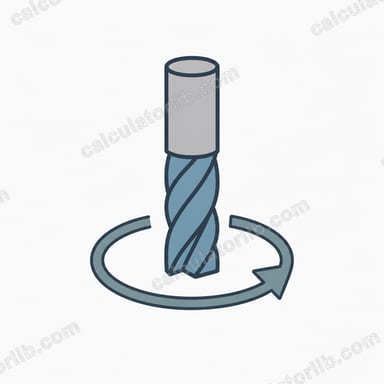
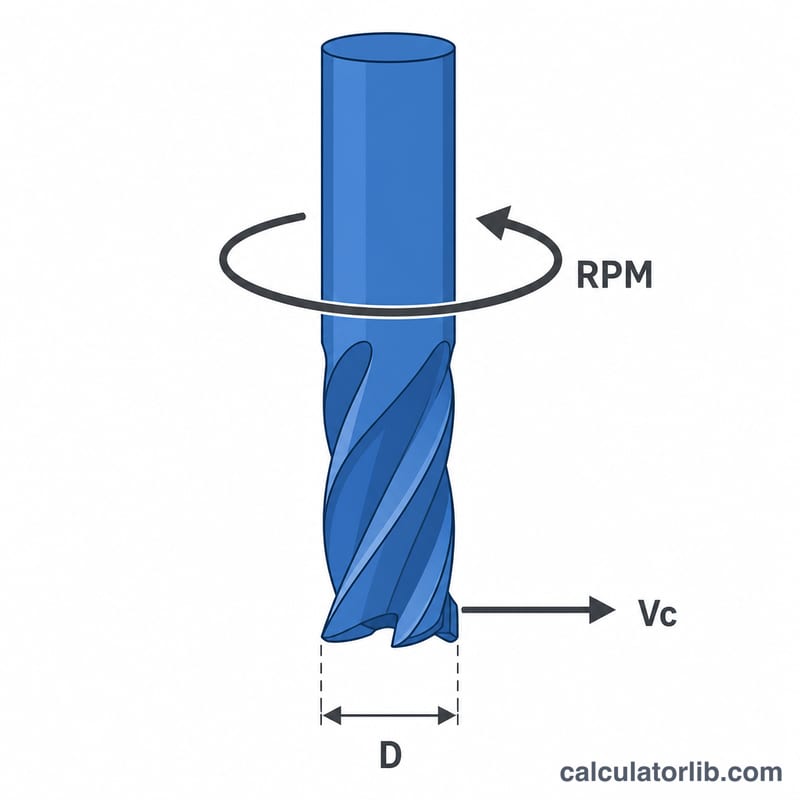
The spindle speed calculator determines the correct rotational speed (RPM) of a machine tool spindle from a recommended cutting speed and the diameter of the tool or workpiece. It is essential for milling, turning, and drilling, where running too fast burns tools and too slow wastes time and produces poor finishes. The tool supports both metric (cutting speed in m/min, diameter in mm) and imperial (surface feet per minute, diameter in inches) workflows.
How to Use It
Pick your unit system, enter the recommended cutting speed for your material and tool combination, then enter the cutting diameter — the tool diameter for milling and drilling, or the workpiece diameter for turning. The calculator instantly returns the spindle speed in RPM, which you can dial into your machine or CAM software.
The Formula Explained
Cutting speed is the linear speed of the cutting edge as it travels around the circumference. Since circumference equals \(\pi \times D\), the number of revolutions per minute is the cutting speed divided by that circumference. In metric units we multiply m/min by 1000 to convert to mm/min: $$N = \frac{1000 \times \text{Cutting Speed (m/min)}}{\pi \times \text{Diameter (mm)}}$$. In imperial units we multiply SFM by 12 to convert feet to inches: $$N = \frac{12 \times \text{Cutting Speed (SFM)}}{\pi \times \text{Diameter (inch)}}$$.
Worked Example
Suppose you are milling aluminium with a 20 mm end mill at a recommended cutting speed of 120 m/min. $$N = \frac{120 \times 1000}{\pi \times 20} = \frac{120000}{62.83} \approx 1910 \text{ RPM}$$ Round to the nearest spindle step your machine supports.
FAQ
What is cutting speed? It is the surface speed at which the cutting edge meets the material, recommended by tooling manufacturers based on material, coating, and operation.
Do I use tool or workpiece diameter? For rotating tools (milling, drilling) use the tool diameter. For turning, where the workpiece rotates, use the workpiece diameter.
Why does my result differ slightly from charts? Many charts round \(\pi\) to 3.14 or pre-round intermediate values. This calculator uses full-precision \(\pi\) for accuracy.