
What Is Hull Speed?
Hull speed is the theoretical maximum efficient speed of a displacement-hull boat. As a boat moves through water it creates a bow wave and a stern wave. When the boat's speed increases enough that the wavelength of its own wave train equals the waterline length, the boat effectively becomes trapped in the trough between its bow and stern waves. Pushing faster requires a disproportionate amount of power, so hull speed marks the practical upper limit for most non-planing vessels.
How to Use This Calculator
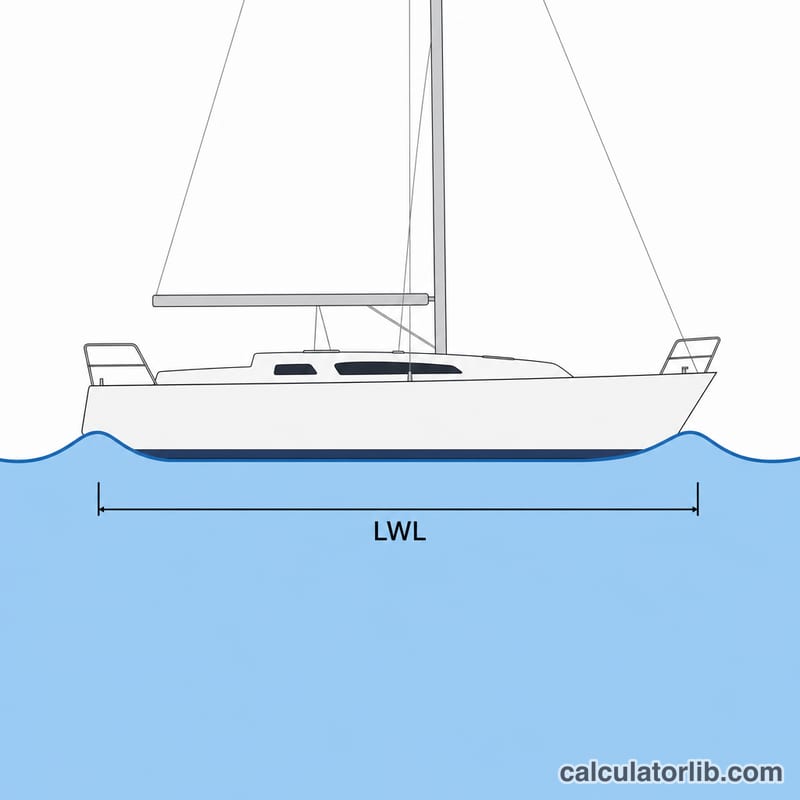
Measure your boat's waterline length (LWL) — the length of the hull actually in contact with the water at rest, not the overall length (LOA). Enter that value in feet and the calculator returns the theoretical hull speed in knots, with conversions to miles per hour and kilometres per hour.
The Formula Explained
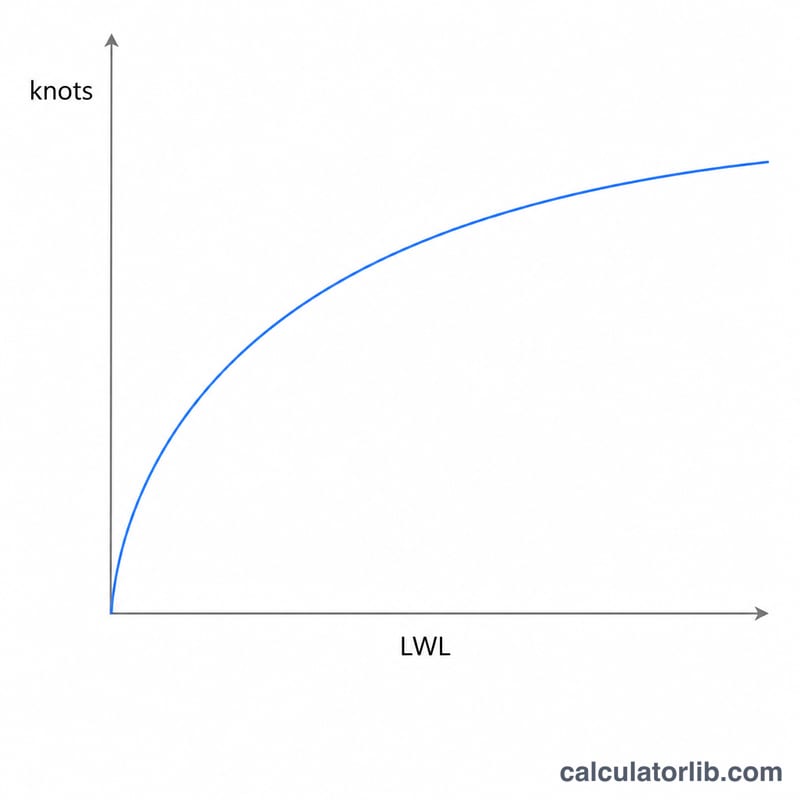
The classic formula is $$\text{Hull Speed (knots)} = 1.34 \times \sqrt{\text{LWL (ft)}}$$ The constant \(1.34\) comes from the physics of deep-water gravity waves expressed in nautical units. A longer waterline supports a longer, faster wave, which is why bigger boats are generally faster. Because the relationship depends on a square root, doubling the waterline length only increases hull speed by about 41%, not 100%.
Worked Example
For a sailboat with a 36-foot waterline: \(\sqrt{36} = 6\), so $$\text{hull speed} = 1.34 \times 6 = 8.04 \text{ knots}$$ (about 9.25 mph or 14.89 km/h). That tells the owner roughly how fast the boat can comfortably sail under good conditions.
FAQ
Can a boat go faster than hull speed? Yes. Planing hulls and very light displacement designs can climb over their bow wave and exceed it, but it takes substantially more power.
Should I use LOA or LWL? Always use waterline length (LWL). Overhangs at the bow and stern don't contribute to hull speed at rest.
Is 1.34 always exact? No — it's an approximation. Many designers use a range of roughly \(1.1\) to \(1.5\) depending on hull shape and conditions.