
What this calculator does
Triathletes train across two main disciplines that produce different heart rates at the same effort — running heart rates tend to run higher than cycling heart rates. This tool builds five sport-specific heart rate training zones from your lactate threshold heart rate (LTHR) using the widely used Joe Friel method. It is sport-neutral by jurisdiction (works anywhere) but is calibrated separately for the run and the bike.
How to use it
Select your sport (Run or Bike), then enter your LTHR in beats per minute. Your LTHR is best estimated from a 30-minute solo time trial: take your average heart rate over the final 20 minutes of an all-out effort. Enter that value and the calculator returns the bpm ranges for Zones 1 through 5.
The formula explained
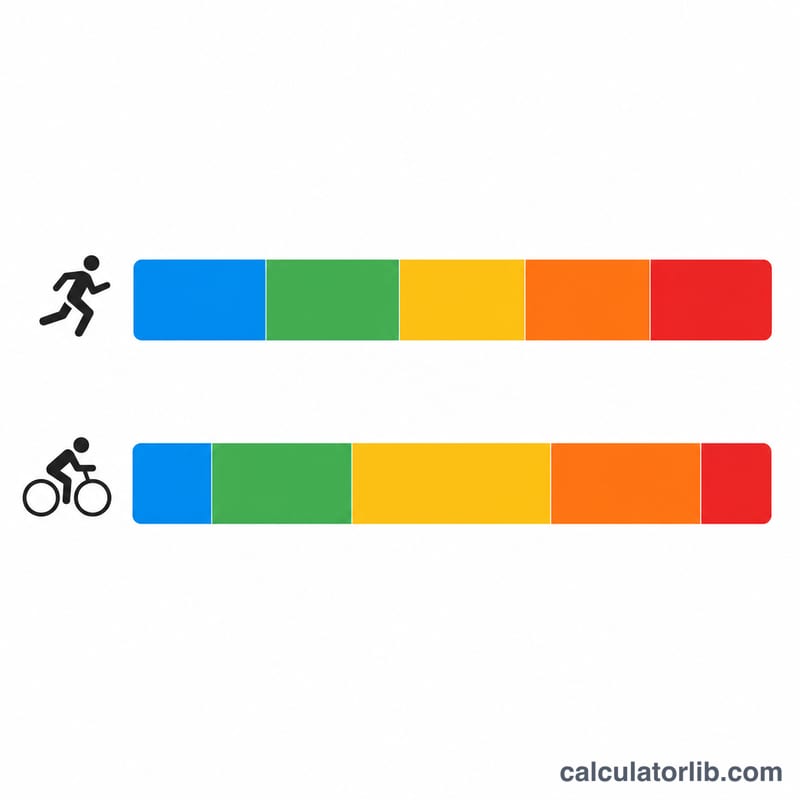
Each zone boundary equals LTHR multiplied by a fixed percentage. For the run, the upper limits are 85%, 89%, 94%, 99% and 102% of LTHR for Zones 1–5. For the bike, they are 81%, 89%, 93%, 99% and 102%. Zone 4 brackets your threshold, while Zone 5 represents VO2 max and anaerobic efforts above threshold.
$$\text{Zone Boundaries} = \text{LTHR} \times \begin{cases} 0.85 & \text{Z1 top} \\ 0.89 & \text{Z2 top} \\ 0.94 & \text{Z3 top} \\ 0.99 & \text{Z4 top} \\ 1.02 & \text{Z5 top} \end{cases}$$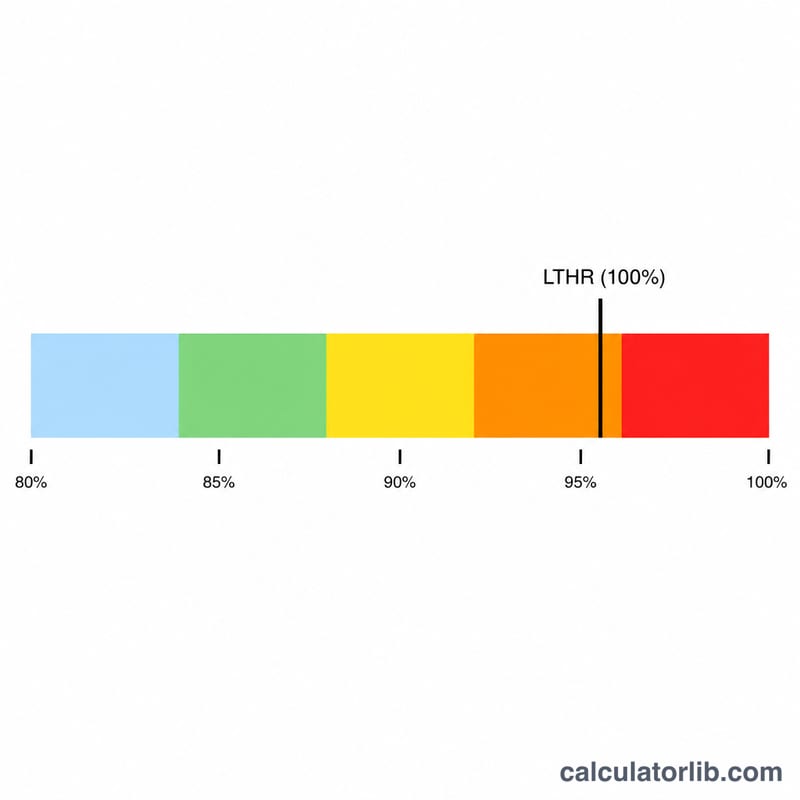
Worked example
A runner with an LTHR of 165 bpm gets: Zone 1 up to \(165 \times 0.85 = 140\) bpm; Zone 2 from 141 to \(165 \times 0.89 \approx 147\) bpm; Zone 3 up to \(165 \times 0.94 \approx 155\) bpm; Zone 4 up to \(165 \times 0.99 \approx 163\) bpm; and Zone 5 up to about \(165 \times 1.02 \approx 168\) bpm and beyond.
FAQ
Why separate run and bike zones? Maximal and threshold heart rates are typically about 5–10 bpm lower on the bike than running, so using the same numbers would push your cycling sessions too hard.
How often should I retest LTHR? Every 6–8 weeks during a training block, since fitness changes shift your threshold.
Is this medical advice? No. These zones are a training guide; consult a physician before starting intense exercise.