
What is the Wilks Calculator?
The Wilks Calculator converts a raw powerlifting total into a Wilks score, a normalized number that lets lifters of different bodyweights compare strength fairly. It implements the original (Wilks 1) coefficient formula published by Robert Wilks, with separate polynomial coefficients for men and women. All weights are in kilograms.
How to use it
Select your sex, enter your bodyweight in kilograms, and enter your total lifted (the sum of your best squat, bench press and deadlift, also in kilograms). The calculator returns your Wilks score along with the Wilks coefficient that was applied to your total.
The formula explained
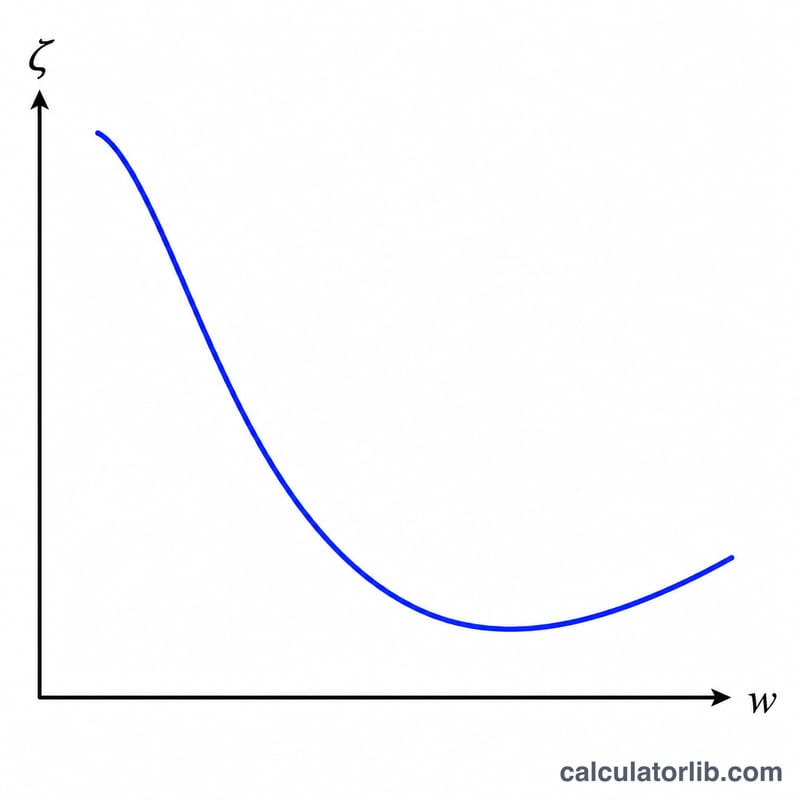
A Wilks coefficient is computed as $$500 / (a + b\cdot w + c\cdot w^{2} + d\cdot w^{3} + e\cdot w^{4} + f\cdot w^{5})$$, where \(w\) is bodyweight in kg and \(a\)–\(f\) are sex-specific constants. Your Wilks score is then your total lifted multiplied by this coefficient. Heavier lifters get a smaller coefficient, which offsets their natural strength advantage so scores are comparable across weight classes.
Worked example
A 100 kg male lifts a 600 kg total. The male polynomial at \(w = 100\) gives a denominator of about 845.66, so the coefficient is $$500 / 845.66 \approx 0.5913.$$ Multiplying \(600 \times 0.5913\) gives a Wilks score of roughly 354.8 points.
FAQ
Do I use kilograms or pounds? The classic Wilks formula uses kilograms. Convert pounds to kg (divide by 2.2046) before entering.
Is this Wilks or Wilks 2? This uses the original Wilks coefficients. The 2020 revision (Wilks 2) uses different constants and produces different numbers.
What's a good Wilks score? Roughly 300+ is strong for amateurs, 400+ is competitive, and 500+ is elite/world-class.