
What is the PHQ-9?
The Patient Health Questionnaire-9 (PHQ-9) is a widely used self-report screening instrument for depression. It contains nine items that correspond to the nine diagnostic criteria for major depressive disorder. Each item asks how often you have been bothered by a particular problem over the last two weeks, scored from 0 (not at all) to 3 (nearly every day). This calculator is for general informational and self-screening purposes and is not a substitute for professional diagnosis.
How to use this calculator
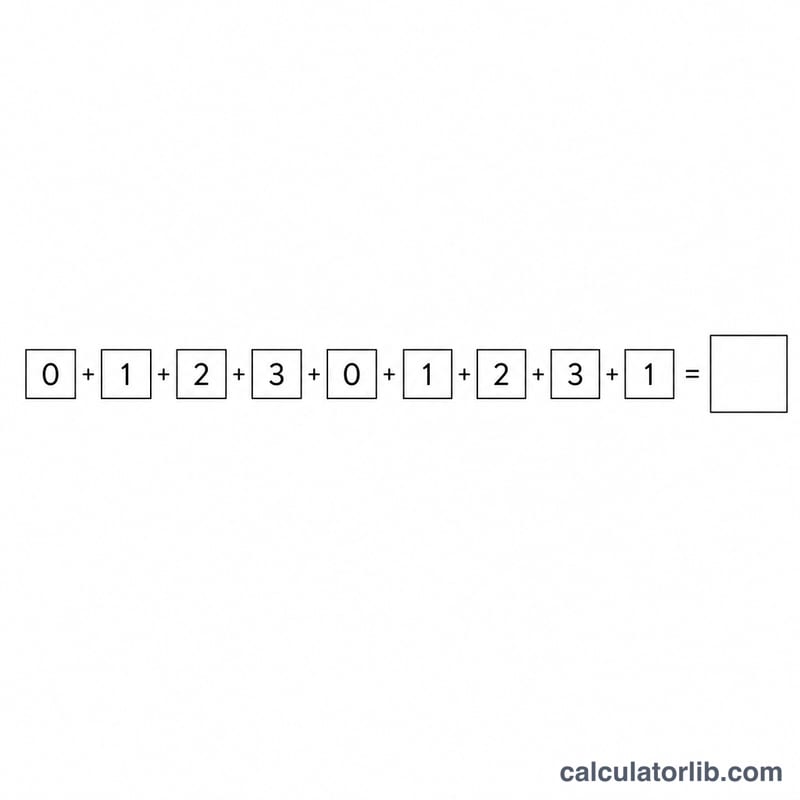
Answer all nine questions honestly based on the past two weeks. Select a value from 0 to 3 for each item, then submit. The calculator adds up the nine responses to give a total between 0 and 27 and tells you which severity band that total falls into.
The formula explained
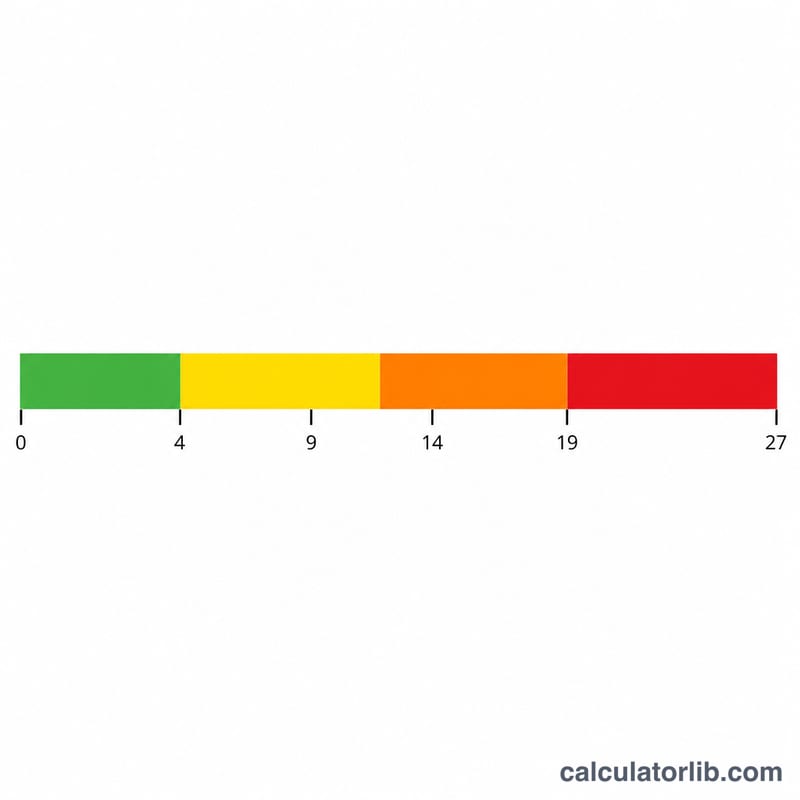
The score is simply the sum of the nine item responses: $$\text{Total} = \text{q}_1 + \text{q}_2 + \ldots + \text{q}_9$$ Because each item ranges 0–3 and there are nine items, the minimum possible score is 0 and the maximum is 27. The total is then interpreted using standard cut-off bands: 0–4 minimal or none, 5–9 mild, 10–14 moderate, 15–19 moderately severe, and 20–27 severe.
Worked example
Suppose someone answers: \(\text{q}_1=2\), \(\text{q}_2=2\), \(\text{q}_3=3\), \(\text{q}_4=2\), \(\text{q}_5=1\), \(\text{q}_6=1\), \(\text{q}_7=2\), \(\text{q}_8=0\), \(\text{q}_9=0\). Adding these gives $$2+2+3+2+1+1+2+0+0 = 13.$$ A total of 13 falls in the 10–14 range, so the result is "Moderate" depression severity.
FAQ
Is a high score a diagnosis of depression? No. The PHQ-9 is a screening tool. Only a qualified clinician can diagnose depression, considering your full history and circumstances.
What does item 9 mean? Item 9 asks about thoughts of self-harm or being better off dead. Any score above 0 here should prompt you to seek help from a professional or crisis line right away, regardless of your total.
How often should I retake it? Clinicians often repeat the PHQ-9 every few weeks to track changes over time, since it is sensitive to treatment response.